

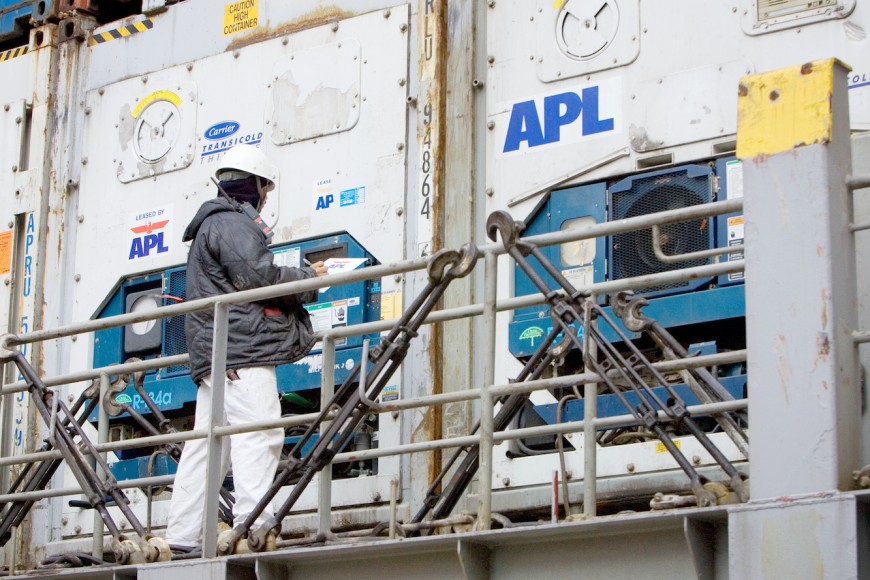

First, here is the good news: there is no imminent shortage of reefer container manufacturing capacity in China despite the shock of coronavirus (Covid-19) threatening to bring large chunks of the perishable supply chain to a complete halt.
With a 250,000 reefer-box building capacity in China – the natural home for almost all reefer manufacturing globally – the risk of the world ‘running out of reefers’ is relatively low, according to Mark Bennett of reefer lessor, Sun Intermodal.
Last year there were only 145,000 boxes built. Stock is not the problem. Container manufacturers in China have enough supplies. There are components for at least two months, including muffler grade steel or aluminium used in reefer panels, and components for reefer units.
Yet the days of lean manufacturing may be over, with the value of assets and labour suddenly getting back into fashion.
Relying on the free movement of labour could become an issue, especially in Chinese provinces adjoining those affected by a travel ban.
Whilst CIMC, MCI and Dong Fang (part of Cosco) in Shandong province (the Qingdao region) are said to be less affected, reefer manufacturing facilities in Jiangsu province bordering Shanghai are more vulnerable.
Both CIMC and reefer unit manufacturer Daikin are located near the sprawling metropolis. Itinerant workers from Hubei province, the epicentre of coronavirus, could be affected by the travel restrictions introduced by the Chinese government, especially if problems persist.
Reefer facility Fuwa in Guangdong province is seeing if anything an excess of refrigerated box capacity, according to Bennett. But some of this could also be absorbed by domestic reefer trucking demand once the crisis eases off. Of course, no one knows when this will be.
Short-term problems
There may be short-term problems for Singapore-based reefer unit manufacturer Carrier, the dominant global player in the space. The company relies more on third party components, which have to be shipped in by sea. At the time of writing, Carrier had not responded to a request for comment.
Even the smallest component can become a problem in modern supply chains, especially with companies trying to operate lean supply chains. To borrow an example from the food industry: selling a Big Mac without the obligatory lettuce leaf is a bit like being faced with a single hole in an air balloon.
Logistics in peril?
The problem with coronavirus is mainly a logistics problem. Both food supply chains, as well as components, have been affected by containers (reefers and dry boxes) that could not be discharged in Chinese ports. Reefer boxes also need to be connected as soon as possible to electricity supply in order to safeguard an uninterrupted cold chain.
At the time of writing, there are no reliable figures to indicate how many reefer boxes are currently stuck at sea or in ports in China. But as widely reported on various news sources, there is a shortage of reefer plugs (connections) in ports.
Reefer boxes have been re-routed, with ocean carriers passing on the cost to shippers (demurrage) and discharging boxes in other ports not affected by the travel ban. This could, in the worst scenario, still affect food prices, and not just in China.
Some reefer container carriers have also started to apply reefer surcharges of US$1,000-1,200 per container. With reefer box freight rates at US$2,500 for US$250,000-worth of pork destined for China not long ago, it begs the question: at what point does the proverbial tail begin to wag the dog?
What has pork demand got to do with fruit? In, fact quite a lot. As the African Swine Flu epidemic swept across Chinese pig farms during the last 12 months, more reefer boxes than ever have been funnelled into China, raising the prospect of reefer box shortage before coronavirus even made headlines.
Nevertheless, the fact the freight rate represents less than 1 per cent per container reflects how tight margins in the logistics sectors really are.
Ocean carriers have been arguing for a long time that reefer box rates are still way too cheap.
Containing a global crisis
Another aspect worth considering is that China today represents 30 per cent of global containerised seaborne exports. This could exacerbate the (pre-existing) reefer box shortage in the market, thus adding to repositioning costs of empty boxes into key supplying countries in the Southern Hemisphere. This could in extreme cases have repercussions for Chile, South Africa and other major fruit exporting countries in need of a constant flow of empty reefer boxes, potentially affecting a multitude of trade routes.
Yet as Steve Alaerts of food logistics service provider Foodcareplus pointed out at Fruit Logistica last month in Berlin, there is also a risk of the crisis being overblown.
Some leading banana shippers are not taking any risks. Ecuadorian giant Noboa has reverted to its chartered conventional reefer fleet and supplying the Belgian market with 3,500 pallets of bananas every week, a move confirmed by Johan Claes of Antwerp-based Sea-invest.
Chiquita no longer has any conventional vessels and having made the complete transition to containerised shipments. But Claes says Noboa’s decision is expected to be short-lived before returning to containers.
So, should the relationship between potential cost increases in container shipping and the container manufacturing supply chain be taken with a pinch of salt? Not necessarily.
Sulphur cap
IMO2020 – the International Maritime Organisation rule slashing marine sector sulphur emissions – only came into force on 1 January and yet it seems like old news. But given that Clarksons Research reveals many ships are still stuck in Chinese shipyards, the interconnectedness of modern supply chains also serves to demonstrate their vulnerability.
As many as 61 vessels out of 150 vessels in Chinese shipyards are waiting for scrubbers to be retrofitted in order to be able to continue using existing high sulphur-content fuel oil.
This situation could lead to increased demand for low sulphur fuel oil. Any increase could by the same token prove to be fairly insignificant as ship bunkering (fuel) costs are likely to remain depressed because of lower oil price, which is itself a direct result of the coronavirus.
China accounts for 33 per cent of global shipbuilding, according to Clarksons Research, including ship repair, compared with 12 per cent when Sars hit the headlines in 2003. There is currently a risk of increased ‘blanked sailings’ (sailings cancelled by the carrier), as Bharadwaj Bhuyan of Japanese shipping line Ocean Network Express (ONE) intimated at the Logistics Hub seminar during Fruit Logistica.
On the plus side One, Hapag Lloyd and more recently msc have all started to buy reefers again. msc, which traditionally only leased reefer boxes, has now started to invest directly in its own reefer box fleet.
Shipping lines will be wary of increasing reefer freight rates beyond what the fresh fruit supply chain can tolerate because this could easily backfire once the effects of coronavirus recede and pent-up supply chain resources bounce back.
In summary, the risk that some of the carriers may be tempted to feast on the shortage by jacking up the rates (via surcharges) very low.
This guest article appears in the March edition of Asiafruit Magazine. To order you copy, email [email protected]
Recent Comments