


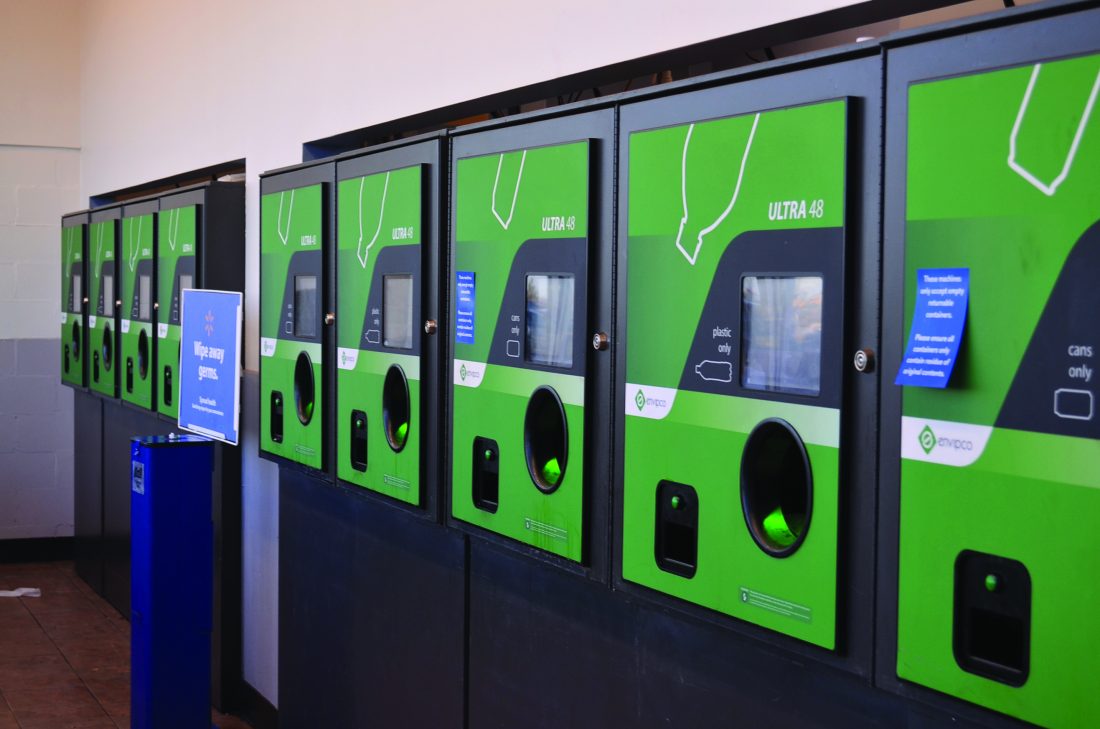
Glass, plastic and can return stations are pictured. Funds collected by the state from can deposits that are paid when purchasing recyclable products but not returned to recycling stations may be used to fund research by Michigan Technological University on the utilization of recycled glass from the Marquette County Solid Waste Management Authority. (Journal photo by Trinity Carey)
- Glass, plastic and can return stations are pictured. Funds collected by the state from can deposits that are paid when purchasing recyclable products but not returned to recycling stations may be used to fund research by Michigan Technological University on the utilization of recycled glass from the Marquette County Solid Waste Management Authority. (Journal photo by Trinity Carey)
- A glass bottle is returned at a recycling station. In October, the MCSWMA will begin collecting glass to be processed and potentially used for mine backfill, an additive in concrete and asphalt and more. (Journal photo by Trinity Carey)
MARQUETTE — According to the U.S. Environmental Protection Agency, 11.4 million tons of glass was generated in 2017, representing a total of 4.2% of all municipal solid waste generation. Just 3 million tons of that glass was recycled that year, while 6.9 million tons of glass were sent to landfills, making the glass recycling rate around 26.6%.
To develop a sustainable and economical landfill facility and produce a range of glass products, the Marquette County Solid Waste Management Authority and professors from Michigan Tech will meet with state legislators and officials at 4 p.m. March 20, in the landfill boardroom to present proposed research on glass repurposing and to seek funding from the State of Michigan. State Rep. Sara Cambensy, D-Marquette; state Rep. Beau LaFave, R-Iron Mountain; state Sen. Ed McBroom, R-Vulcan; state Rep. Greg Markkanen, R-Houghton and others will be present.
With the MCSWMA’s switch to single-stream recycling in October, will come its ability to receive and repurpose glass into various materials.
The authority hopes to receive state funding so Tech can further pursue the proposed research and overall establish the efficacy of glass recycling into value-added products, the project overview states.
“We’re probably looking at $1 million over that three-year period, so basically what we’ll be recommending to them is like $500,000 the first year, $300,000 or $400,000 the second year and either $100,000 or $200,000 the third year depending on how that works out,” said MCSWMA Board of Trustees Chairman Randy Yelle. “That’s our very first step and that has to happen before we can even consider taking region one (the Upper Peninsula) glass. If this goes into place, we will open up and take every bit of glass we can get from the whole U.P. and we’re centrally located.”
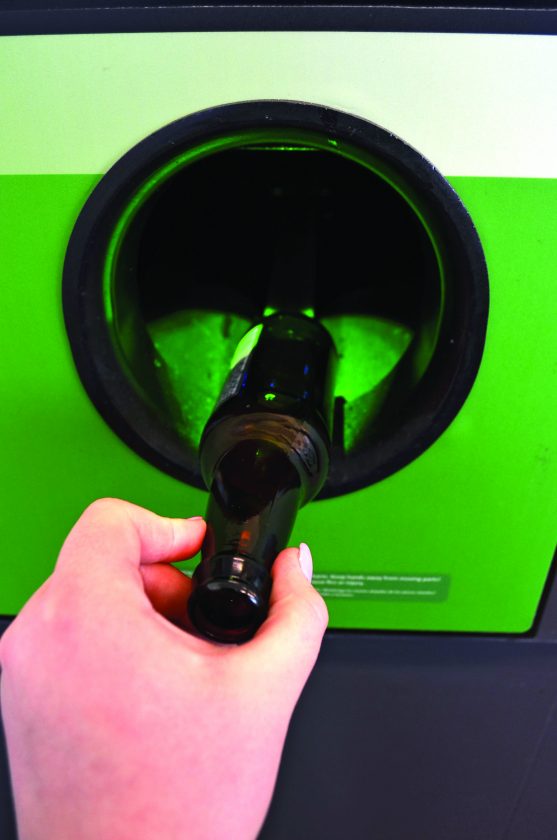
A glass bottle is returned at a recycling station. In October, the MCSWMA will begin collecting glass to be processed and potentially used for mine backfill, an additive in concrete and asphalt and more. (Journal photo by Trinity Carey)
The authority is “asking for funding from wherever,” said Bill Nordeen, legal counsel for the MCSWMA. “We want the state of Michigan to fund Michigan Tech’s research so they can go out and certify the different possibilities and we can get rid of our glass.”
While asking for funding from wherever available, Nordeen has identified funds from the Michigan Deposit Bottle Law escheat, or the unclaimed deposits reverted to the state, that could be used to fund the research.
“It turns out that when you and I and everybody else, we go and buy a 12-pack of beer at the store and we pay a deposit on those cans, some people don’t return their cans,” Nordeen said. “So say we throw them in the garbage what happens to all the dimes that we paid?”
According to the Michigan Bottle Deposit Law, 75% of the money from unclaimed deposits is deposited into the Cleanup and Redevelopment Trust Fund and 25% is returned to retailers. Of the 75% deposited into the trust fund, 80% is deposited into the Cleanup and Redevelopment Fund and 10% is deposited into the Community Prevention and Pollution Fund. The other 10% remains in the trust fund.
The $800,000 grant awarded to the MCSWMA from the Michigan Department of Environment, Great Lakes and Energy for the authority’s recycling project came from this fund.
“Last year we went to the Legislature, to EGLE, and said: ‘Listen, what better way to spend the money on these items that were not turned back in, than on recycling, which is trying to keep these things from going to the landfill,” Nordeen said. “That was our last year’s pitch. Our pitch this year is: ‘What better way to spend it than to try to figure out what to do with the glass?’ Many of those deposits were glass bottles.”
Documents from the authority and MTU note that glass is the most difficult material present in municipal solid waste to find a suitable market for.
“To be economically feasible, recycled glass needs to be used in local markets or needs to be processed to a level where significant value-added results, which justifies higher transportation costs for both the source materials and the products. In the case of the new single-stream Material Recovery Facility being commissioned by the MCSWMA, located in Marquette, MI, the issues of transportation to potential markets is even more acute,” documents state.
If granted funding, MTU plans to research the possible uses for repurposed glass, including:
≤ Mine backfill using coarse product: Once ore is extracted from a mine it is refilled with crushed rock derived from original tunnels drove into the mine. Other materials will eventually be needed, the research concept states, and crushed glass could be used in its place.
≤ Using the coarse glass product as aggregate: The concept noted that aggregate supply is a challenge nationwide, but recycled glass may be a viable alternative in asphalt or fill material.
≤ Using the fine glass product in concrete: The glass product could be used in portland cement concrete or the basic ingredient in concrete.
≤ Using the fine glass product as an abrasive: Glass is used as an abrasive in some industrial applications like sandblasting.
The research of these possible applications has been broken down into five general areas of study to be conducted over a three-year time period. Tech will conduct an economic and sustainability assessment, geotechnical testing and research, asphalt testing and research, concrete testing and research and design of the required processing facility.
Specific topics to be addressed throughout these areas of research include looking at the availability of glass in the waste stream serviced by the MCSWMA, testing the long term performance of glass in asphalt and concrete mixtures and more.
Certification from MTU would make the glass processed by the MCSWMA more marketable to manufacturers, Yelle said.
“We need the help from the community to participate in the recycling program and we need them to separate their glass from the single-stream. And the reason for that is if you’ve got them together, the glass will contaminate the paper and cardboard. And then we can’t get rid of them and they go to the landfill,” he said.
Removing glass from the landfill will overall extend the life of the landfill which currently has just over 50 years of life.
“The recycling program as projected will add 10 to 12 years per cell to the life of the landfill. There are currently five cells left,” Yelle said. “We could end up with 80, 100 years of life at the landfill. It all depends on the participation we get from the residents.”
Yelle is hoping for the support of legislators at the meeting as he is confident once the research is conducted, markets would support the authority’s processing of glass.
“We need the financial support to finish out this research,” Yelle said. “Glass, I mean, that takes up a lot of space.”
Trinity Carey can be reached at 906-228-2500, ext. 206. Her email address is [email protected].
Recent Comments