


As a woman under 30 working within a procurement consultancy, I am interested by, and often asked about, diversity and inclusion in the workplace and the profession. Among the most commonly asked questions are; why was/is procurement unattractive to women? How do we increase the number of women in senior roles, and are quotas part of the answer?
In this article, I address some of those points, giving a view on where things stand today on gender equality both in procurement and more widely, as well as taking inspiration from a few women who haven’t let this hold them back and have risen to the top.
Women continue to be under-represented from Executive level upwards
Opinions are divided but what is clear is that there remains a perception of “traditional” and “non-traditional” occupations for women, and that not all opportunities are created equal. Whilst we may see change coming in our schools and universities, for those of us “in career”, there are still professions which are male-dominated and which could benefit from greater diversity. Most would agree that procurement is one such profession.
In the US, research published by Catalyst outlines that today, only 6% of S&P 500 organisations had a female CEO. Further, they highlighted that whilst women make up 45% of the overall workforce, representation from Executive level upwards is limited to 27%.
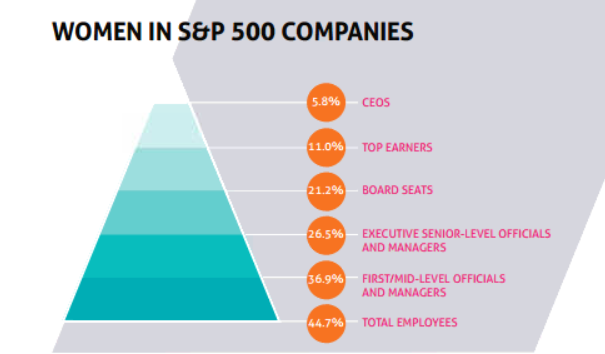
We are living through a time of accelerated change; roughly half of those CEO’s have taken post since 2017 and the total number has increased by c. 1500% since the turn of the century. But the upward trajectory doesn’t mask the disappointing truth; 50% of the population only translates through to 5% of CEO’s.
In contrast, the UK Government has set quotas for the number of board positions to be held by women – 33% by 2020, and the latest Female FTSE Board Report (2019), published by Cranfield University, would suggest that they are on track. Further good news is that Alison Rose, RBS, has just become the first female CEO at a top UK bank: a fantastic achievement and a step in the right direction.
In procurement specifically, significant progress is being made. 20% of the top sixty CPO roles in the US and Europe are now filled by women and the ISM “30 under 30” winners included more women than men. These are great stories and these women are a great inspiration.
Women are starting to make it onto the boards of the largest UK companies, but is this a case of organisations reacting to diversity trends and targets rather than truly committing to, and realising the benefits of inclusion? In the UK, the Hampton-Alexander review monitors and supports inclusion, getting more women into meaningful roles. Denise Wilson White OBE, its Chief Executive, has announced that she will be turning her attention to the “one and done” culture next. There is change. But it must be inclusive, and it must be pervasive.
Moving away from diversity targets to inclusive cultures
Diversity is in the spotlight. It’s not just important to governments and regulators; its significance to the next generation makes gender parity critical for future businesses. In the world of instant news, companies with poor diversity are thrown into the spotlight.
Many companies now publish internal and external statistics, create positive policies and processes and score diversity amongst potential suppliers. But, is creating frameworks and scoring diversity the starting point rather than the measure of success?
Without realising it, we all use language that is subtly ‘gender-coded’ and can be more attractive to one gender or the other. Dunhumby have pledged to improve the number of women in their management roles by 2% every year and they are leveraging technology to eliminate gender bias from job descriptions. An organisation’s life blood is its new talent and ensuring policies, processes and tools are gender neutral is key.
As with driving up “board statistics”, creating an inclusive culture means moving beyond diversity and onto inclusion: women (in this case) having an equal opportunity and seat at the table where their opinion is valued and matters. As Vernā Myers says[1]: “Diversity is being invited to the party. Inclusion is being asked to dance”.
Gender equality improves your customer proposition and profits
Achieving gender equality is not just important because it’s the right thing to do, it can also provide huge benefits to business. Failing to think about diversity precludes companies from 45% of the working talent: women bring education, ambition, and diverse ideas and experiences with them. As a result, they offer corporations a potent force of insight and innovation that will be increasingly needed to meet the needs of a diverse customer base.
The Peterson Institute Research, conducted on over 21,000 global companies, found that hiring more women into corporate leadership positions significantly increased profitability.[2] However, as Oliver Wyman points out; “Companies don’t need a business case for gender equity. The real reason to achieve better gender balance (or better racial balance, or fairer treatment for employees with disabilities) is not for the sake of profits. It’s for the sake of justice and fairness. It is a responsibility companies owe to society”.
“Diversity is being invited to the party. Inclusion is being asked to dance”
Diversity in Procurement
According to the Oliver Wyman ‘Women in Procurement’ report, 76% of 300 CPOs recently interviewed perceive more creativity and innovation thanks to having a more balanced male/ female ratio within their teams. Further, they report greater efficiency and faster cycle times in these environments. The survey5 tackles a number of statistics, stereotypes, and initiatives regarding gender equality in procurement. Some of the most startling:
- 42% of CPO’s surveyed feel that women are not promoted at the same rate as men.
- 38% feel women have less chance of being promoted to management positions.
- 34% feel the work environment is not favorable to all women.
Whilst these troubling statistics, there is also progress being made. For example, 20% of the top sixty CPO roles in the US and Europe are now filled by women. Further, the ISM “30 under 30” winners in 2019 included more women than men. These are great stories and these women are great role models to have.
Looking to role models in Procurement
Being passionate about gender equality is not always viewed in a positive light. In many cases, it is seen as championing a cause to which many are already committed. So why bother? Because there is still work to be done, and some of us are passionate about bringing positive change forward for men and women.
In seeking to inspire others who are passionate about this, I took the opportunity to ask a few questions from four inspirational women who are shaping the future of procurement.
Melinda Johnson, Commercial Director at the Department of Health and Social Care
Melinda is the Commercial Director at the Department of Health and Social Care which supports the Health family’s arm’s length bodies and makes sure we are working as one health function, alongside holding responsibility for several companies owned by DHSC, and supporting the NHS with their work in improving the NHS commercial function. DHSC is part of the Government Commercial Function (GCF) and Melinda represents the Health system’s interests on the GCF agenda, as well as leading on commercial innovation and the GCF Northern Hub; an initiative to attract, recruit, develop and retain the best commercial talent across the north.
Beth Bradley: Are you involved in promoting/championing diversity and inclusion in any way?
MJ: Yes, I am Women’s champion for Health, supporting the DHSC Women’s network which involves holding regular events for Women, and promoting Women’s issues. I also champion Social Mobility and Smart Working.
Beth Bradley: Do you think that procurement has a diversity and/or inclusion challenge?
MJ: Not as much as it did in my early career! I recall being the only woman in many a meeting for years, with few senior women role models. The GCF (Government Commercial Function) has tackled this, with lots of women now in senior commercial positions. We are now focusing on other diversity issues. We are using strength based questions in interviews, not just competency based, and looking at how we can make our services, such as the Assessment and Development Centre, more inclusive.
Beth Bradley: Have you ever come up against or observed subconscious bias in the workplace?
MJ: The civil service is increasingly better at this, with mandatory annual unconscious bias training, and senior role models for all aspects of diversity. But yes, occasionally I do, and I call it out.
Beth Bradley: What is your advice to a young woman considering a career in procurement?
MJ: It’s a great career, join the Chartered Institute of Procurement and Supply and let that be your career anchor, but develop yourself more broadly with other disciplines. Keep up your CPD always, it gives you confidence. Take opportunities; raise your personal profile through wider corporate contributions that do lead to new opportunities; recognise the symptoms of ‘imposter syndrome’ for what they are; remember that when considering applying for a promotion – you don’t need experience in all aspects of the role already under your belt – the point is for you to be developed as well as bringing your own experience and expertise.
Beth Bradley: There is always a danger with diversity that it becomes an excuse, a reason for failure, or worse a reason not to try. What characterises the inspiring women we spoke to is not just that they are striving to improve inclusion in the workplace, but also that they are examples of what tenacity and hard work can achieve, male or female. They have been successful neither because of nor in spite of their gender, rather because they worked for it, and now they are giving back.
You can read Proxima’s report on the capability crisis in government here.
Or more of their insight articles here.
Recent Comments