


The U.S. military is stepping up its efforts to enlist autonomous eVTOL aircraft for a variety of missions, especially those that would reduce risk to troops, such as moving cargo in combat zones. In early January, the U.S. Air Force issued a request for information to civil eVTOL developers in a bid to evaluate options for investing in the technology. For 2020 alone, the Pentagon has allocated almost $170 million to investigate options for what it calls unmanned logistic system-air (ULS-A) capability.
In Iraq and Afghanistan, U.S. forces have faced difficulty moving supplies, according to Carmine Borrelli, deputy head for logistics innovation with the Marine Corps Warfighting Lab. Valuable military aircraft often need to be kept in reserve for higher-priority missions, and even when they are used, high sustainment costs make resupply an inefficient use for them.
“They [eVTOLs] have the potential to have a platform that could be cost-effective, that could go far distances and that could carry stuff, potentially, at a lesser cost than what we were doing,” said Borrelli in a press briefing hosted by the Vertical Flight Society on March 10.
The Marines are partnering with both the Army and the Air Force on different projects to realize that goal through what it calls small, medium, and large unmanned logistics systems. The Office of the Secretary of Defense is allocating approximately $120 million to the efforts of the Naval Air Systems Command (Navair) with small and medium ULS-A vehicles covered by the program objective memorandum (POM-19).
Another $30 million for medium-size ULS-A in combined stakeholder investment and funding from the Office of the Secretary of Defense is being put toward joint capabilities technical demonstrations that need to be completed before the POM funding can be put to use. And the fiscal year 2020 budget from Congress includes $18.5 million to advance autonomous technology, particularly in large aircraft.
There is more funding for the smaller ULS vehicles, because the use case is more clearly defined, and the work is further along. Instead of usual rigid requirements, the Marine Corps is now deliberately thinking about possible use cases in terms of range. Borrelli that this approach allows more flexibility in finding the best way to use the burgeoning eVTOL technology.
The Department of Defense (DoD) considers “small” ULS to be vehicles with a 60- to 150-pound payload, designed for trips within 10 or 15 miles and a daily throughput of about 1,000 pounds per aircraft. Borrelli said the Marines are finding that it’s realistic for vehicles of that size to weigh as much as or less than the payload they’re designed to carry.
The goal is to use them for squad resupply, leveraging highly automated routines to complete simple operations without requiring much manpower. Early operational capability is scheduled for 2023 with full operational capability on the docket for 2026.
A medium ULS carries 300- to 500 pounds anywhere from a 20 to 125-mile combat radius, allowing for carrying up to 5,000 pounds of cargo in a day. As with a small ULS, medium ULS can keep their weight efficient enough that payload about meets vehicle weight, though they will be used for more complicated missions, such as supplying platoons, operations between advanced bases, and more. “We’re trying to anticipate the future; potentially that size range could also do casualty evacuation…if these things prove out and they are reliable enough,” Borrelli said.
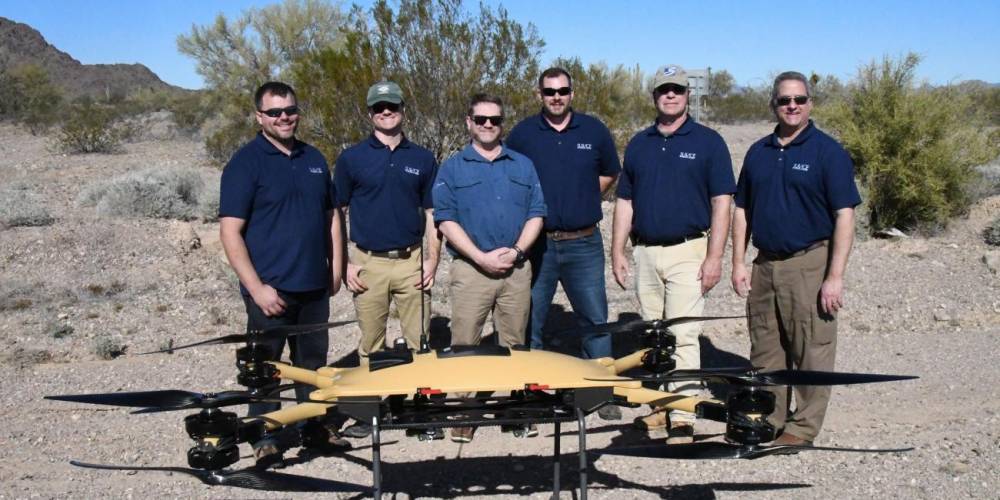
The Marine Corps is working with the U.S. Army Research Laboratory on medium ULS efforts. At the end of January, Navair hosted a tactical resupply unmanned aircraft systems fly-off competition in Yuma, Arizona, won by Survice Engineering’s TRV-150 system, which is based on the Malloy Aeronautics tactical resupply vehicle drone platform. Other competitors included Bell, Autonodyne, AirBuoyant, Pacific Aerospace Consulting, and Chartis Federal.
Borrelli said medium ULS are targeted to enter service during fiscal year 2024 or 2025, with full operational capability in 2030. The category just finished its first year of successful joint-capabilities technical demonstration flight tests as part of a three-year effort.
The large ULS category is still a bit more abstract. Initially, DoD conceived of vehicles with a 2,000- to 6,000-lb payload, in some ways a replacement for Bell Boeing V-22 Ospreys or Sikorsky CH-53 Sea Stallions on shorter trips. However, as the consumer market has defined and taken shape, the military realized that scaling back to vehicles with 1,000- to 2,000-lb payloads will make more sense.
“We want to seriously consider and match industry’s approach,” Borrelli said. “If the market is moving toward the 1,000-pound platform—a “flying car”—and many [new eVTOL aircraft] are going to be out there, it would be in our best interest to figure out how best we can use that platform to do what we need to do. We look to ride the coattails of industry.”
The military is still interested in larger vehicles that can move up to 6,000 lb, but it recognizes that isn’t where the bulk of innovation is taking place right now. In the large ULS category, the Marine Corps is working with the Air Force, whose Agility Prime program was started last year to leverage the commercial VTOL industry to find more efficient ways to execute resupply missions than through its high-sustainment-cost aircraft.
The military wants to use these larger ULS for company resupply in remote areas with austere landing zones and launched from a new class of small, minimally-manned ships, as well as potentially to transport troops. The vehicles would work in a radius of up to 350 miles, each handling throughputs ranging from 15,000 to 30,000 pounds per day. Early operational capability for large ULS is scheduled for 2023, with full operational capability in 2030. While the military has done less work on large ULS, it hopes to rely more on the investment of the commercial UAM industry.
For large ULS, Borrelli said the same weight efficiency won’t be possible, so it will take a heavier vehicle to lift 2,000 pounds. Both hybrid and fully-electric propulsion is on the table and, in either case, new propulsion technology brings infrastructure questions with it.
“That’s something that we have constantly in the back of our minds,” Borrelli said. “So, as we’re moving to the rest of the ULS space, the ground and surface and sub-surface, we’re considering where those charging stations could be or where a battery inventory would be. If we don’t have a charging station, we have to have a battery inventory. It’s not going to do us any good to have a considerable amount of inventory unless we can be able to charge efficiently.”
This story comes from FutureFlight.aero resource developed by AIN to provide objective, independent coverage of new aviation technology, including electric aircraft developments.
Recent Comments