


With fears about the novel coronavirus (COVID-19) impacting the economy and global supply chains, we spoke to Nick Vyas, executive director of the Center for Global Supply Chain Management at the USC Marshall School of Business. Vyas is an assistant professor of clinical data sciences and operations and the academic director for USC Marshall’s master’s program in global supply chain management.
What is the impact of the novel coronavirus having on the global supply chain?
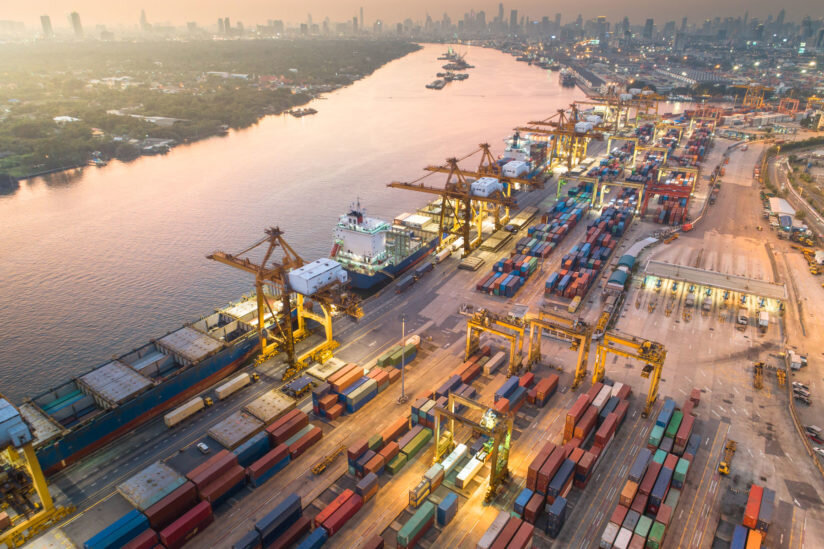
Nick Vyas: Coronavirus has posed tremendous global disruption in the end-to-end global supply chain. When we think about supply chain disruption, consider the products you use every day. Each product entails many elements before it reaches you: the raw material, the manufacturing, packaging, transportation and distribution. Each one takes a journey using ocean, rail, air and road before being made available to your store or doorstep. Imagine each of these steps having its own complex supply chain network connected globally. Once you take one of the nodes out of commission, you will impact the entire value chain. In the case of COVID-19, it has affected all of the nodes connected through the China-centric network.
Take toilet paper, for example. Demand has skyrocketed, but shelves are empty due to production capacity and lead times constraints. The raw material used to make the tissue paper you buy at the store is linked by a sophisticated network. The factory where it’s made might not have enough labor or truck drivers to get the raw material to the factory or product into warehouses, and from there onto shelves. This is what we mean when we say that the end-to-end global supply chain has been affected.
When will we see the impact on the broader global economy?
NV: We already see it. At the Center for Global Supply Chain Management, we looked at this about eight weeks ago when the disruption was still localized in China. We saw a supply chain disruption beyond the planned Lunar New Year shutdown. This unplanned shutdown caused a rapid chain reaction throughout the world.
This is now a global pandemic and a growing crisis for the financial markets. There are various scenarios—some average to worst. It appears that there will be a significant impact in the short term to the global economy.
What are the long-term changes we’re likely to see?
NV: What is likely to happen with COVID-19 is that we’ll start to see a decoupling from some long-term supply chain dependencies from the China-centric supply chain network. Initially, the trade war set the stage to begin the process, and COVID-19 might be the last straw that will force the supply chain redesign. As part of the redesign, I think we’ll be seeing a lot more appetite to bring the supply chain close to customer demand with on-shore or near-shore. Mexico will likely play a more significant role than it has in the past if its government can stabilize and deal with its drug violence and political corruption issues.
We will also see a lot more focus on supply chain resiliency and risk mitigation and global supply chain management in international settings; all the things we teach in our program.
We will also be seeing a push for more diversification. If there were more diversification of supply chain nodes across the globe, we would not see the impact of disruption we see now.
How long before things go back to normal?
NV: It will take us two to three months once the virus has passed through our system. China appears to have stabilized the spread, but data transparency is a big issue. We can see the impact through the third quarter before the supply chain stabilizes and normalizes.
Longer-term goals—such as decoupling from China with a more diversified supply chain network—will take a few years at least.
What is the silver lining here? What can companies learn from this situation?
NV: The takeaway here is that cost should not be the only consideration when establishing your company’s supply chain. There have to be some mitigation strategies as well, where essential commodities have several pathways to markets. You have to build these into your company’s global strategy. You have to think through certain what-if scenarios, so you’re not caught off guard. Companies need to be proactive instead of reactive.
We, as humans, have become globally connected. With the help of a very sophisticated supply chain network, household customers can receive their services and products right away. In this process, we removed access to excess inventory and slack capacity. This phenomenon took away elasticity to market demand such that there is no room for any disruption, whether caused by natural disaster or pandemic event. We’ve become dependent on each other’s capacities, or lack thereof. COVID-19 is a perfect example. When this started, everyone thought this was a “China-only” issue. We didn’t collaborate in a way that could have helped proactively, or engage in a way that could have prevented the spread, or collaborate on potential mitigation plans.
At the Center for Global Supply Chain Management, we’re optimistic that this will pass, and we will come back to normalcy with much better resiliency. For now, we think this situation is a great lesson, and we will have a better global supply chain network that is resilient, agile and reliable in the future.
Citation:
Five questions on how coronavirus will impact the global supply chain (2020, March 13)
retrieved 13 March 2020
from https://phys.org/news/2020-03-coronavirus-impact-global-chain.html
This document is subject to copyright. Apart from any fair dealing for the purpose of private study or research, no
part may be reproduced without the written permission. The content is provided for information purposes only.
Recent Comments