




AI
Node
It’s hard to believe that a mere 50 years ago we still relied on humans to manage telephone switchboards. What once required an army of people to operate at scale was quickly replaced by computers powered by microprocessors. Nowadays, most of us can’t imagine a world where humans are required to make a telephone call.
Data science is in the midst of a similar revolution. While the mathematical tools to make predictions from data have existed for centuries, and the algorithmic ones for several decades, all have required humans to manage the data inputs and interpret/iterate on the outputs.
Artificial Intelligence (AI) has the potential to change all of that. Predictions that once required months to generate and required frequently manual tweaks could instead be handled by powerful technologies that operate near-autonomously. Innovative companies understand the enormous potential of this technology, and many are attempting to migrate to an AI-centric operational model.
Mark Cuban is one of many investors who foresees AI’s unparalleled impact. He’s said, “As big as PCs were an impact, as big as the internet was, AI is just going to dwarf it. And if you don’t understand it, you’re going to fall behind. Particularly if you run a business.” Indeed, strong evidence supports Cuban’s predictions—it is estimated that AI will add a staggering $13 trillion to the global economy over the next decade.
Venture capital incongruencies
Yet despite the scale of the opportunity the rate of AI adoption has been surprisingly slow, as existing tools are still complex, require specialized talent, and (most importantly) require companies to re-think their data management strategy. New innovation is required in order to accelerate the rate of AI adoption and reduce the time and capital required to deploy across every business.
One of the major drivers of the slow rate of adoption is the disconnect between venture capital norms and the realities of building an AI-first company. Specifically, AI companies require 3-6x greater upfront investment as compared to traditional SaaS companies but in return have 3-6x bigger market opportunity. Therefore, the time horizon to realize meaningful commercial traction is much longer; typically in the ballpark of five to six years and a minimum of $10M investment to progress from concept to working prototype, and approximately ten years to get to meaningful commercial traction. This timeline doesn’t align with the predilections of most venture capital funds that typically look for a seven-year time horizon.
Despite the rise of AI-focused venture capital funds, investors continue to cling to SaaS multiples when evaluating AI-first companies. Amir Orad, CEO of big data analytics unicorn Sisense, is one of numerous AI founders that deems this propensity very problematic. He explained to me, “There’s a time horizon issue with how some venture capitalists are incentivized. The typical VC structure doesn ‘t actually work if it takes half a decade just to do the R&D to then get an AI prototype off the ground.”
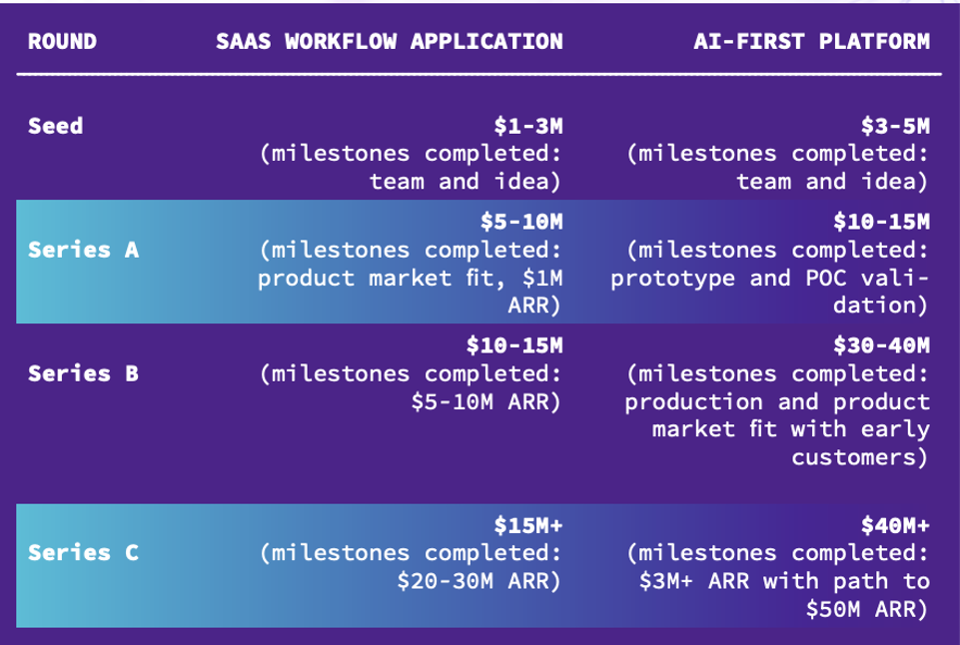
Instead of expecting AI companies to experience traction on par with SaaS companies at similar “series” stages, the following ballpark funding figures, milestones, and annual recurring revenue (ARR) values are more in line with the realities of companies building SaaS workflow applications, as compared to those building AI-first platforms. Put simply we need to redefine the investment requirements and expectations for true AI-first companies going forward in order to fuel transformational innovation:
AI
Node
Martin Casado and Matt Bornstein, partners at venture capital firm Andreessen Horowitz, reiterated the differences between AI-first companies and traditional software companies in a recent article. They note that, based on their experience, AI companies don’t look or act like traditional software companies due to their comparatively lower gross margins (typically in the 50-60% range as compared to the 60-80%+ benchmark for comparable SaaS companies), scaling challenges, and weaker defensive moats as a result of the commoditization of AI models, as well as the fact that IP is likely to be owned by the customer and lack broad applicability. For these reasons and in addition to the ongoing human support and material variable costs required to operate today, the financial metrics of AI-first companies often resemble those of service companies, especially at first.
Despite AI being hailed as a wrecking ball for enterprises, adoption by enterprise companies is abysmal—and not for lack of desire. Most companies don’t understand that AI’s potential is contingent on data—understanding where it is, how to aggregate, clean, and normalize it, and how to build the data architecture required to process and glean insights from it. As Jean-François Gagné, CEO of Element AI (which produces ready-to-implement AI products built by top-notch AI talent), explained to me, “The market is still in an early adopter market and most organizations, not only don’t know where their data is, they don’t have the right infrastructure in place to support it.”
Indeed, the gap between AI hype and execution is large, and will continue to be as long as companies fail to develop an AI-first data strategy. This critical aggregation of data requires marrying companies’ internal and application data with data gleaned from the companies and people that comprise their ecosystems. The net-net of all this is that AI-first startups need to venture into the data business as there isn’t yet a single AI tool on the market that spans end-to-end data selection and prediction. AI-first companies will inevitably need to raise even more money for go-to-market so that they can guide customers to the desired solutions until the market matures.
Horizontal AI companies too often overlooked
Rather than investing in AI-first companies, investors are gravitating towards two quasi-AI plays: vertical workflow-enhancing SaaS application companies that claim a “sprinkle of AI”, and talent acquisition companies that are playing the long game to eventually build a suite of AI products for the enterprise. Companies outside of these two plays are facing an uphill battle in terms of securing the funding they need—in turn, hindering material innovation from seeing the light of day.
Horizontal AI companies are especially promising, yet are all too often overlooked by venture capitalists accustomed to funding verticalized SaaS solutions. Horizontal AI companies tackle a number of different use cases effectively and eliminate the need for enterprises to build the DNA required to leverage the power of AI internally. While they take longer to get to market, horizontal AI companies have the potential to be game-changing in accelerating the adoption of AI. I recently spoke to Jitendra Kavathekar, Founding General Manager of Horizon 3 Venture Capital (H3VC), and former co-founding Managing Director of Accenture Ventures and Open Innovation, who emphasized the potential of horizontal AI companies:
“Digital Transformations call for full-scale transformation of operational and executive actions across the entire enterprise with data-driven and intelligent capabilities applied at a functional level to drive both growth and efficiencies. The resulting Intelligent connective tissue, or Horizontal AI, that these insights tie across functional silos can drive game changing results. A dynamic enterprise that leverages intelligence from one org to multiply the impact of another org in the enterprise novel and exciting. Take it one step further and enable a new class worker to find and define intelligent cross functional capabilities in a self-serve way and the transformations can be driven at the ground level. This type of dynamic digital transformation horizontally will drive massive value well into the future but only with substantial services and consulting augmentation. The large services and consulting companies are in a prime position to provide some of that initial value to their enterprise clients with a platform + services approach.”
In order for horizontal AI companies to secure the funding they require to reach their potential, there needs to be a shift in venture capital funding definitions and expectations in order to encourage AI-first companies to build great game-changing companies, rather than prematurely exit due to a lack of funds. Gagné saw this firsthand. He explained to me, “I realized there were a lot of companies that were actually massively undercapitalized and were forced out of staying true to their thesis, which was they use AI to do X, Y, or Z.” It isn’t in the name of technological progress—and simply doesn’t make sense—given the market opportunity and development time to market, to evaluate AI-first companies according to SaaS multiples.
Solving the business problem
Another major hindrance to AI adoption relates to the associated value propositions touted by AI companies. In particular, most companies evangelize the solution AI helps realize, rather than the problem it aims to solve. According to Ryan Welsh, founder of artificial intelligence company Kyndi, this shift is important because oftentimes most enterprises don’t know they have a problem. Take, for example, an AI solution that promises to replace the work of 100 people tasked with manually reading documents over the course of 90 days with one machine that can accomplish the task in 90 minutes. Welsh explained to me,
“The biggest challenge with transformational technology is that the problems they solve are not top-of-mind for people…They don’t know it’s a problem because they’ve had this business process in place using 100 people to read documents over 90 days, they’ve had that business process in place for 30 years. And until you come through and show them that they can use one machine and now do it in 90 minutes instead of 100 people in 90 days, they don’t know they have a problem. We need to evangelize the problem. Once they understand that they have a fundamental problem, then we can evangelize the solution.”
This translates into longer sales cycles and more capital required for marketing for true AI-first companies that could end up creating entire new markets of opportunity.

AI
Node
AI pollution
Adding insult to injury, AI-first companies are also grappling with market ambiguity regarding what AI actually is. We’ve hit what Orad has coined peak “AI pollution”, where the market and media are unclear as to what qualifies as AI and what does not. “.ai” domains are popping up, left, right, and center and virtually every technology company is pitching AI as the centerpiece of its marketing strategy—whether the company is truly leveraging AI or not. Even for sophisticated investors, it can be difficult to sift through the noise.
An important step towards realizing the potential of AI is clear and concrete education about what AI is and what it isn’t. As Jai Das, Sapphire Ventures, a VC firm that invests in growth-stage technology companies, explained to me:
“What is out in the air about Artificial Intelligence, the nomenclature and definitions, are all over the map and there are no standard definitions. If you don’t have a common way to define things, it’s very hard to have an engaging dialogue.”
Alex Vratskides, CEO of Persado, a company that uses natural language processing and machine learning to increase efficacy in the choice of words used for marketing, sales, and servicing communications between large companies and their customers, also agreed with this sentiment when I spoke with him:
“Artificial intelligence has been abused as a term. If you ask most academics, they will tell you it’s actually not here because it actually means something else. Silicon Valley, as with most new trends, just jumped on the term and adopted it before it even happened – anybody with a clustering algorithm claims that they are AI.”
Summary
Despite the marketing frenzy, AI is still in its infancy. The enterprise market needs at least another few years to mature before AI can be widely adopted without a lot of hand holding and support services. This does not mean that AI progress and investment should be unduly curtailed, however. Rather, we need to recalibrate the funding definitions for true AI-first companies and recognize the value of horizontal AI platforms (whose ROI benefits and market opportunity are exponentially better than vertical solutions). We also need to align on a common language, so that all parties can discuss AI intelligently without the risk of pollution from overzealous marketers. In doing so, we’re likely to see a wave of innovative, AI-first companies receiving the necessary funding and support required to build the next generation of transformational technologies.
Recent Comments