

Credit: Shutterstock
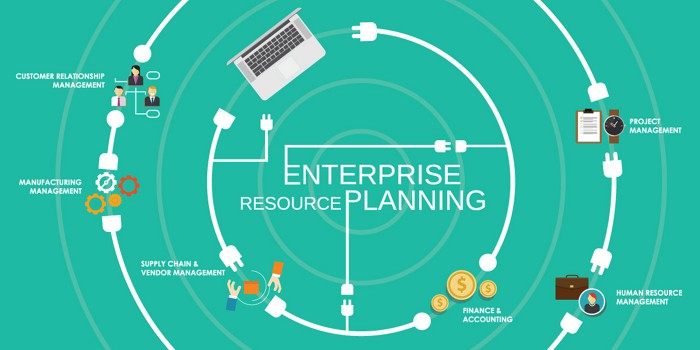
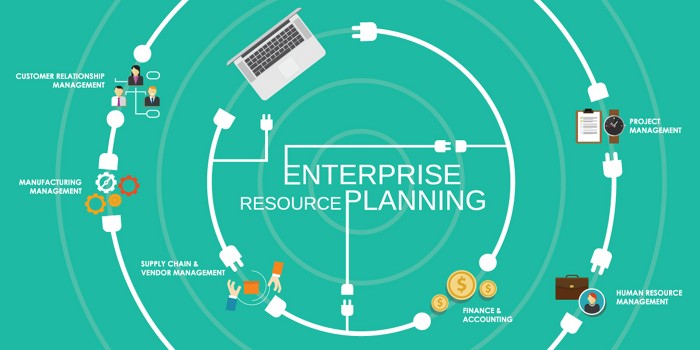
Enterprise resource planning software can be found at the core of most corporate information technology architectures. But the core may soon dissolve in a wave of digitization.
The Harvard Business Review ran an article in 1990 by management consultant and former Massachusetts Institute of Technology computer science professor Michael Hammer titled “Reengineering Work: Don’t Automate, Obliterate.” Hammer, recognized as the seminal theorist of reengineering, the consultant-driven discipline of streamlining work processes, encouraged businesses to radically restructure rather than rely on information technology to automate work.
Generations
Enterprise resource planning (ERP) software’s path is from dispersed to monolithic to dispersed again.

1980s to 1990s: Best of breed
▸ Functionally focused software
▸ Multiple vendors
▸ Lack of central control
1990s to 2000s: Monolithic
▸ One core software product
▸ Centralized information technology
▸ Oversight by the corporate IT department

2010 to the foreseeable future: Postmodern ERP
▸ Networking of specialized software
▸ Maintenance of a central ERP backbone
▸ Access to cloud-based software and services
▸ Oversight by independent business departments

Emerging architecture: Beyond ERP
▸ Supporting digitized business functions
▸ Greater automation with artificial intelligence
▸ Functional applications easily added to core IT
▸ Breakdown of business function silos
▸ Programming and oversight by power users
▸ Rise of functional applications
Source: Gartner.
This proved impossible. While the 1990s is now viewed as an epoch of business reengineering, the revamp of work processes advanced hand in hand with the rise of centralized corporate IT, enabled by enterprise resource planning (ERP) software.
The 2020s, on the other hand, appear poised for the final takedown of monolithic business IT in response to a new revolution in work processes spurred and enabled by digitization. IT managers in the chemical industry, among the first industries to opt for ERP systems, are preparing for a new wave of change in business management software.
To understand the likely changes ahead, it helps to look back at the provenance and evolution of IT systems currently in operation at most chemical companies.
The computing infrastructures that emerged some 30 years ago supported efficiency gains, the kind also targeted by business reengineering. But ERP software installations also caused years-long headaches for many companies as they converted from hodgepodge mixes of software to monolithic IT systems covering most financial aspects of business and plant operations.
During this period, SAP, a German software firm started by former IBM engineers, rose to prominence in ERP. Starting with its first customer, the UK’s Imperial Chemical Industries, SAP swept the chemical sector. By the early 2000s, many major companies had lashed their operations to the firm’s R/3 software.
By today’s standards, the IT platforms of the early 21st century are museum pieces. Cloud computing, artificial intelligence, and big data have fundamentally changed IT and the workplace.
SAP and other major vendors of ERP software, including Oracle and JD Edwards, have introduced successive generations of their products over the years that chip away at the monolithic, comparatively lethargic control of early IT architectures. In the process, a modular approach to IT has emerged in which specialized software for specific work functions can be added to a centralized, often multivendor network of business management software with an ERP system at the core.
Industry watchers agree that the next step is to reengineer the core.
“Enterprise resource planning has evolved far beyond its original purpose and scope,” the consulting firm Gartner writes in a report issued last year. “It now represents different things to different organizations, but in all cases is no longer focused on ‘resources’ or ‘planning.’ ” The view is echoed by Forrester, another consulting firm, in a recent report: “Today, we see the beginning of a new era of operational systems that are so different that calling them ERP no longer makes sense.”
The abbreviation is still in use, however, despite the alternatives floated, such as Forrester’s DOP, for digital operations platform. Gartner characterizes the current, modular state of business software as postmodern ERP. Mike Guay, a senior analystwith the firm, describes a “hybrid approach” in which specialist companies like Salesforce.com, a provider of customer relationship software, can add modules to an ERP system.
Guay notes that ERP vendors have partnered with and acquired specialized software providers to offer hybrid networks. SAP, for example, acquired SuccessFactors, a cloud-based human resources management services provider, and now offers the service as an adjunct to its core software.
In Guay’s view, today’s generation of postmodern software is starting to give way to something more abstract. This fourth generation of ERP—counting hodgepodge computing and monolithic software as the first and second—will dismantle the familiar image of centralized control.
“In 3 to 5 years,” he says, “IT focus will shift from doing most of the development in IT departments to architecting an environment in which the end users—the power users in their departments—will actually be able to build applications. Low-code/no-code development platforms are emerging as standard in the market right now.”
Liz Herbert, a vice president and principal analyst at Forrester, says business software is now driven by the speed at which data can be processed. “ERP conjures up overly complex, slow-moving technology that may not live up to expectations,” she says. “Technology has changed dramatically. It is much more cloud based, much more built for intelligence, more for flexibility and easy extensibility by business users. Not everything has to rely on programmers and IT departments.”
Artificial intelligence will play an increasing role in business IT, Herbert says. AI was initially harnessed to improve error detection and automation accuracy, but the technique is ramping up. She points to two examples at SAP: Ariba, software for managing materials procurement that employs IBM’s Watson AI technology, and Concur, a travel and expense system that applies AI to vetting expense reports using data from receipts.
The latest iteration of SAP’s ERP software, S/4Hana, reflects the changes the consultants see. It stores tables in columns rather than in standard row arrangements, vastly increasing the speed of data analysis, the firm says. The database allows transactional and analytical work to be done simultaneously.
Joe Binkley, SAP’s director of cloud platform product marketing, notes that S/4Hana employs in-memory data processing, in which data is stored in random-access memory rather than disk storage or relational databases. “It means we are able to dramatically recast our systems and do things in seconds that used to require waiting days to complete.”
Dave Dunn, head of marketing for chemicals at SAP, says the company remains the dominant supplier of ERP software in the sector, counting 6,500 users it categorizes as chemical companies. A modular approach to adding software, such as Salesforce.com and SAP’s own adjuncts in areas like materials sourcing, has advanced with upgrades to R/3 in recent years. This includes a version called ECC consisting of a suite of business management software modules that put the tool in reach for smaller companies.
“Only the large guys could afford it years ago,” Dunn says. “With S/4 and ECC, a load of smaller, midtier companies have implemented SAP because it is simpler, and much faster, to implement.”
Credit: Dow
Melanie Kalmar, chief information officer at Dow, says the company is focused on simplifying work processes and making it easier for customers to do business with Dow.
Dow, an early adopter of ERP, has rolled with the changes at SAP for decades. The company gained somewhat of a renegade reputation years ago by skipping an upgrade to R/3 when most of its cohorts converted. Dow eventually undertook a multimillion-dollar conversion to a version of the SAP software to which users add targeted software products, essentially a first step into Gartner’s postmodern ERP world. Since then, Dow has pushed further.
“Over the past few years, we have migrated capabilities to software-as-a-service solutions,” says Melanie Kalmar, chief information officer at Dow, referring to a technique of accessing software from cloud-based providers and paying a service fee rather than purchasing it. “Our current focus is all about simplification in how we do work. This means making it easier for our customers to do business with us while providing capabilities for our employees that make their job easier and them more empowered.”
Dow will continue adding “best-in-class” applications to its ERP system, Kalmar says, while eliminating applications that fall short. “There is no plan to move away from our core ERP capabilities or to move away from our strategy of one global ERP instance,” she says.
DuPont is similarly working to adapt its core SAP system to a new generation of business IT. “We are constantly working to simplify yet modernize our enterprise-wide systems, including our legacy ERP,” says Steve Larrabee, chief information officer for the company. “Artificial intelligence, particularly in the R&D and manufacturing spaces, has helped significantly advance the roll of IT-based technology as a key business and value driver.”
Larrabee adds that modernizing and evolving from a monolithic ERP system does not lessen the importance of a core IT infrastructure. Centralized data, or “master data,” support old and new technologies, he says, and are necessary to “provide real-time information both to optimize our working processes and guide our decision-making.”
Evonik Industries, another longtime SAP user, is also sticking with its core system. “For Evonik’s core transactional business processes, like ‘order to cash’ or ‘plan to produce,’ a reliable and on-time information flow is key,” says Bettina Uhlich, the firm’s chief information officer. “You just want to have the right data at the right time in the right place. For this, a well-integrated IT architecture is a key success factor. We see the monolithic ERP as an advantage.” She points to the company’s success in integrating the ERP system of J.M. Huber’s silica business, which Evonik acquired in 2017.
But Evonik also moves in the postmodern ERP world described by Gartner. “Business IT architecture can now draw from a far bigger solution portfolio than just SAP,” Uhlich says. “This might make it more challenging for the IT department, but it is clearly an advantage for the business.”
And challenges lie ahead. A move underway at Evonik to convert to SAP’s S/4Hana by next year will be more thorough than a mere software upgrade, Uhlich says. It will be a conversion of Evonik’s core ERP to a wholly new architecture.
Not all SAP users are Goliaths like Dow and Evonik. Borchers, a paint additives company, has been a customer since 2008, shortly after Lanxess sold the business to OM Group. When OMG sold Borchers to investors in 2017, Borchers upgraded to an SAP product called Suite on Hana—essentially ECC software running on the same database as S/4Hana.
Borchers plans to fully upgrade to S/4 by 2022, says Jonathan Mortlock, the firm’s chief information officer. He wants to act before SAP terminates maintenance coverage for Suite on Hana, at which time he foresees a rush of upgrades by companies that are all competing for support from SAP.
And there are plenty of other ERP software options for small to midsize chemical companies. Datacor, a supplier of distribution and process management ERP software, is one example. It began serving the chemical industry with its Chempax software in 1981.
Sage Group, a UK-based supplier of ERP software, is another. The company’s software is often sold by firms that adapt its software for specific markets. Net at Work, for example, enhances Sage software with functionality geared to chemical companies in a product called Chem at Work.
MFG Chemical, a midsize specialty chemical company based in Dalton, Georgia, installed its first ERP system, Datacor’s Chempax, 9 years ago. “It basically houses all our supplier information,” says Andrew Hopkins, MFG’s quality assurance manager. Formulas and raw material lists and prices are stored and managed on the system, which accesses data from a network drive or central data server.
MFG also uses software called OESuite supplied by a company called Operational Sustainability. It coordinates information on changes to production procedures and functions independently from Chempax.
MFG is considering implementing a materials resource planning (MRP) module that already resides in its Chempax system, Hopkins says. While the company would likely benefit from MRP, which keeps track of orders and inventory, he says it would be a complex installation given the number of customers and products the company deals with.
Credit: Evonik Industries
Bettina Uhlich, chief information officer at Evonik Industries, says the firm will move to SAP’s latest ERP software, S/4Hana, by next year.
Reducing complexity remains a key target in business software development. Vestiges of monolithic ERP remain in place at most companies, as do vendor service agreements and a need for support in upgrading or adding to systems. Software developers aim to simplify upgrades by allowing businesses to configure IT in a distributed fashion that includes gateways to customers and suppliers.
As new software options emerge, users are expected to have more discretion in adding applications using low- or no-code techniques that have moved into IT architectures since they were introduced about 20 years ago.
No-code approaches are especially likely to surge in next-generation business computing. Software developers such as Itesign, a German start-up targeting a midyear product launch, envision a future in which IT departments equip corporate networks with menus of options from which users choose applications to add to their work processes, according to CEO Jan Philippe Wimmer.
Those IT departments of the future, Forrester’s Herbert notes, will be headed by business analysts as opposed to computer technicians. In fact, she envisions a complete dissolution of the core ERP system, a shift that will challenge IT departments to keep add-on applications from reverting to the kind of IT hodgepodge that led to monolithic ERP software in the first place.
But industry watchers agree that the ERP model born in the age of reengineering has already been obliterated. “It is no longer about systems solely within an enterprise,” Guay and colleagues write in Gartner’s recent report. ERP “has simply become a three-letter acronym for something that most people cannot describe other than to name a vendor or a list of modules. Whether or not we continue to use the acronym remains uncertain.”
Chemical & Engineering News
ISSN 0009-2347
Copyright © 2020 American Chemical Society
Recent Comments