

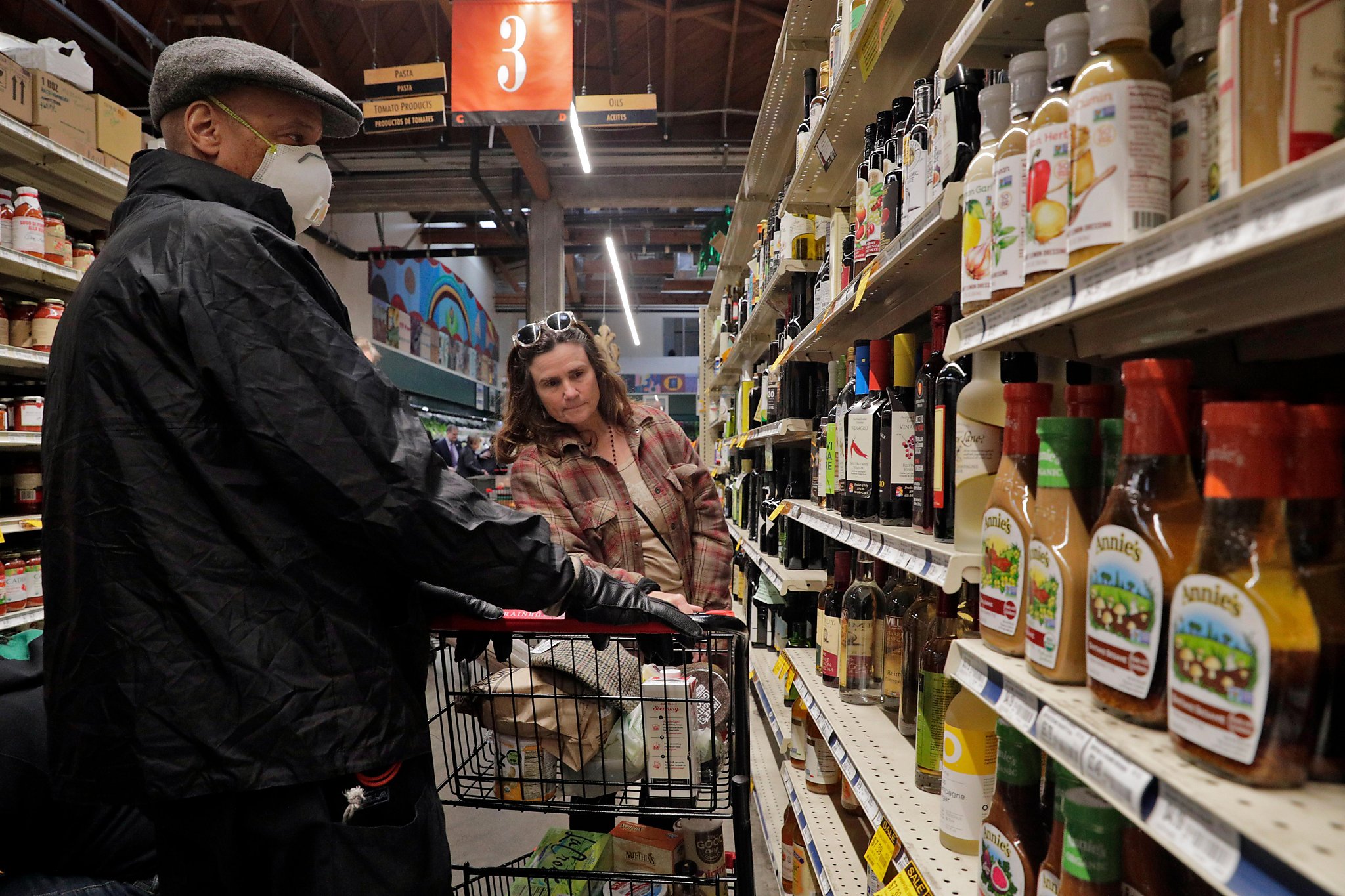

Those picked-over grocery store shelves don’t tell the full story. The Bay Area is not in danger of running out of food, industry members and experts say, and the food supply chain is as healthy as ever.
“We’re not seeing any challenges on the supply side at all,” said Michael Janis, managing director of the San Francisco Wholesale Produce Market, which sells produce to local stores, restaurants and catering companies.
Even before six Bay Area counties issued “shelter in place” orders on Monday, long lines snaked through many grocery stores here, and items like toilet paper and hand sanitizer appeared to be in short supply as residents prepared to hunker down in their homes to mitigate the spread of the novel coronavirus. But despite the rush, the supply chain for food products like fruits, vegetables and meat has not yet been disrupted — even if it’s taking some stores a little longer to re-stock the shelves.
“Food is not going to run out,” said Karan Girotra, a professor of operations and technology at Cornell Tech in New York City.
People are buying more food, but they’re not eating more, Girotra explained: “What’s happened is the pattern of shopping has changed. People are panicked and are buying more goods than usual.” Unlike hand sanitizer, which is being consumed more than usual, “when shoppers buy a month’s supply of food, it’s not going to be used in a week.”
Grocery stores in the Bay Area depend largely on distributors, who work with suppliers like farmers and packaged-food companies. Most of the U.S.’s imported food comes from Central and South America, Girotra said, and those regions have not been heavily affected by the coronavirus.
In Bakersfield, Creekside Organics owner Brenda Haught prepared to receive 18 truckloads of produce from Mexico on Monday. The trucks en route carried items like peppers, zucchini, watermelons and cucumbers. Haught said the truckloads translate to 30,000 cases of produce, her weekly average, and will be distributed to grocers across the U.S., including clients like Whole Foods.
“For shoppers, I don’t think there’ll be trouble buying fresh fruits and vegetables. What people seem to be more concerned about are toilet paper and bottled water,” she said.
One challenge that food suppliers might face is an exacerbated labor shortage due to the coronavirus. If workers get sick, or if they can’t go to work because their child’s school has been canceled and they don’t have alternate childcare arrangements, that could hold up food production.
Then again, many segments of the food industry, like agriculture, have already been dealing with a labor shortage for years.
“If we don’t have people to pick oranges in Florida, that might be a problem,” said Girotra. “But we didn’t see that happen in China, and it’s unlikely to happen here.”
Jim Monroe, who handles communications for the National Pork Producers Council, echoed that sentiment from the meat side of food production. “We’re not seeing any current disruptions in the pork supply chain,” he said. “But we’re trying to get ahead of it and seeing if we can find solutions to keep workers in plants.”
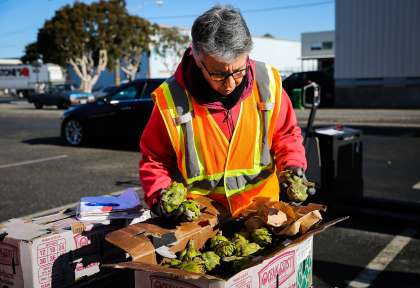
If there is a hold-up in the supply chain, it’s due to increased demand, not decreased supply. Buyers from grocery stores showed up in droves to the San Francisco Wholesale Produce Market in the early hours of Monday morning, looking to refill their shelves.
For Earl Herrick, owner of Earl’s Organics, one of the distributors located inside the market, it represented his biggest single sales day in 32 years of business, 50% larger than a typical day’s sales. “The product is there,” he said. But some of the farmers who sell him produce have had to put him on an allocation — if he normally gets 10 pounds of broccoli a day from a farm, for instance, he might now be getting only 6 — and as a result, he’s had to allocate his wares for some of his clients, too.
Rainbow Grocery in San Francisco’s Mission District did experience one hiccup: Its Monday delivery from United Natural Foods — a major national distributor of natural food brands including Larabar, Amy’s and Stonyfield — was canceled with no explanation, said marketing coordinator Cody Frost. That leaves a gap in some of Rainbow’s inventory, but Frost emphasized that in general the store is well stocked, with the exception of paper products.
“Our produce section is robust,” he said. “So up until today it seemed like we were able to steadily stock and restock most products. We’re hoping that the delay on our receiving products is temporary.”
The store has been moving through pasta and dry bulk items more quickly than normal, but Frost was not concerned that Rainbow’s suppliers were going to run out of it. “A lot of packaged products are manufactured well before they’re actually delivered, so most of our distributors should have a considerable back stock of items like pasta,” he said. “The thing that would be more concerning would be if fresh product were immediately affected,” which it is not.
For Jim Offenbach, owner of Golden Gate Meat Co., his trucks carrying meat from farms in Nebraska, Minnesota, Oregon, Arkansas and other locations were still arriving on schedule. In fact, if anything, “we might have an over flux,” he said. Northern California restaurants account for 80% of his business, and many of them have cut down on orders or temporarily closed in light of the pandemic. However, increased demand from Offenbach’s retail customers, like Berkeley Bowl, had offset some of that — and, he said, there’s plenty more meat available if local stores want to buy it.
The bigger challenge, said Cornell’s Girotra, is if coronavirus-induced job losses lead to a situation where many people cannot buy food. “That’s when people will go hungry,” Girotra said.
Herrick of Earl’s Organics stressed that his company was working harder than ever to ensure that its grocery clients could buy as much food as they need. “We’re trying to maintain enough inventory so that everybody gets served,” he said. “We understand that we provide a service that’s essential to the community, and we take that seriously.”
Esther Mobley and Shwanika Narayan are San Francisco Chronicle staff writers. Email: [email protected] and [email protected] Twitter: @Esther_mobley @shwanika Instagram: @esthermob
Recent Comments