

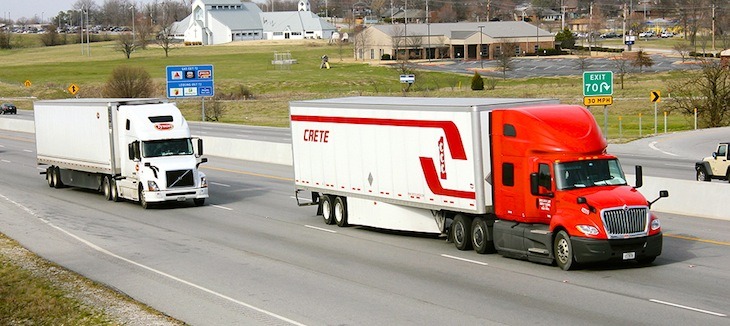

The trucking industry has received a reprieve from the hours of service rule for drivers who are hauling freight to provide relief in the national emergency that is the healthcare pandemic COVID-19. Meanwhile, the spot market has started to tighten amid the outbreak as carriers ask their employees who can work remotely to do so.
The Federal Motor Carrier Safety Administration (FMCSA), a division of the U.S. Department of Transportation, won’t require commercial vehicle drivers to abide by the hours of service regulation if they are transporting freight to provide relief in the outbreak. This is the first time the FMCSA has issued nationwide relief of the regulation and follows President Donald Trump’s national emergency declaration in response to the virus.
The exemption from the regulation will allow drivers to haul “critical goods to impacted areas faster and more efficiently,” said Jim Mullen, acting administrator for FMCSA. “FMCSA is continuing to closely monitor the coronavirus outbreak and stands ready to use its authority to protect the health and safety of the American people.”
Drivers will be exempt from the regulation for providing direct assistance in support of emergency relief efforts, including the delivery of medical supplies and equipment related to the testing, diagnosis, and treatment of COVID-19; items such as masks, gloves, hand sanitizer, soap and disinfectants for healthcare workers, patients and community safety and to prevent the spread of COVID-19 in communities; and food for emergency restocking of stores.
Once a driver completes a delivery, they must receive at least 10 hours of off duty time, if transporting property. The exemption will remain in effect until the termination of the emergency or April 12.
In a recent report, senior research analyst Benjamin Hartford and research analyst Andrew Reed, both of Baird, said FMCSA’s decision to allow for the exemption is in part a response to the recent tightening in truckload capacity. Spot truckload market activity has risen as a result of “the surge in demand for consumer staples and destocking of inventory given preparation for extended shuttering of activities across the U.S. in recent days and incremental reduction in supply.”
Spot market pricing data for the week of March 8 rose 2.1%, from the same week in 2019, and was the first positive growth rate since late August 2018, according to Hartford and Reed. Spot market pricing increased by 5.2%, from the week of March 1, and exceeded the 11-year average increase of 1.3%.
Some small carriers have closed recently as a result of rising insurance costs, and other carriers said their pool of drivers has been shrinking and is expected to continue to shrink as a result of precautions taken during the broadening pandemic. Demand risk is rising for the second quarter of 2020 and the second half of 2020, but the supply chain disruptions related to the outbreak are likely to be beneficial for truckload companies, according to Hartford and Reed.
With regard to intermodal, volumes have been soft so far through the first quarter, and this is expected to continue as inbound ocean freight has been limited, said Hartford and Reed. Imbalances have led to container shortages inland for export volumes. Intermodal pricing is expected to fall in the low-single digits in 2020, from 2019. And, some shippers are concerned about capacity later in 2020.
Concerning less-than-truckload companies, the FMCSA’s exemption is more relevant to truckload carriers, but the less-than-truckload mode has a unique risk in the outbreak with regard to its network operations and close proximity of workers at area terminals, according to Hartford and Reed.
“This is an unprecedented period with still-unknowable impacts, making attempts to forecast future aggregate demand impossible. But we’re confident about a couple of things: We should remain focused on the crisis’ human element, and greater challenges still lie ahead,” Hartford and Reed said. “To that end, the cascading closures of events nationwide and globally in recent days will be essential in arresting the virus’ outbreak. Meantime, the acuteness of the economic impact could exceed anything we’ve experienced in our lifetimes — including the 2008-09 financial crisis.”
The analysts noted China’s Purchasing Managers Index, which is a measure of manufacturing economic activity in China, as a glimpse at how the virus might affect the U.S. economy. The index fell to a record low of 35.7 in February, from 50 in January. Also, they pointed to real-time traffic data, such as OpenTable’s daily restaurant activity report, to provide insight on the impacts of social distancing. The percentage of seated diners in the United States and the United Kingdom declined 20% in the week of March 8, from the same week in 2019. As of March 12, the rate had fallen to about 30%.
In a separate report, Hartford and Reed noted recession risks were rising, and one was likely a matter of when not if.
“We’ll leave it to the economists to tell us when we’re in a formal recession, but clearly economic risks are rising given the impairment to economic activity in China following quarantine/forced social distancing taken in February to stem the virus’ spread,” Hartford and Reed said. “Impact from similar actions now taken in both Europe and the U.S. should appear in upcoming months.”
Times of recession are relevant to the transportation sector in that it often outperforms the broader market, according to Hartford and Reed. Federal Reserve interest rate cuts and an inverted U.S. Treasury yield curve have been precursors to previous periods of recession and also when transportation stocks have outperformed the broader market.
Analysts with Bank of America Global Research said its trucker shipper survey of demand fell to the lowest level in its history. Vessel calls at the Port of Los Angeles are expected to fall more in March than in February, according to the analysts. They noted, “an accelerating recessionary environment” was building in the United States as a result of quarantines and business shutdowns, and this will delay the expected rebound in the second half of 2020. The analysts were neutral on stock for Lowell-based carrier J.B. Hunt Transport Services Inc.
Meanwhile, J.B. Hunt employees have been asked to work from home, if they can do so, between March 16 and April 3. J.B. Hunt released the following statement on this:
“J.B. Hunt takes the health and safety of our employees, contractors and service providers very seriously. To mitigate the risk COVID-19 poses to our workforce, we have asked all employees who are able to work from home to do so starting on Monday, March 16, through Friday, April 3. As conditions changes, we will adapt plans and responses in accordance with public health guidelines.”
Also, Fort Smith-based ArcBest, the parent company of less-than-truckload carrier ABF Freight, has plans in place to allow employees to work remotely if needed. Following is a statement from ArcBest:
“Our primary focus is the health, welfare and safety of our team members, and we have business continuity and contingency plans in place in the event of a widespread outbreak. These plans include enabling employees to work remotely if necessary, to reduce the risk of service interruptions. Our teams across the country are limiting travel to business-critical travel and are using technology and digital tools to conduct meetings virtually instead of in person.
“We understand shippers have concerns about service networks. While the full impact of the coronavirus is not yet determined, we are well-positioned and prepared to aid you if you experience supply chain challenges or disruptions that develop because of the coronavirus. Our locations across North America remain fully operational, and we have strategies in place to adjust operations if necessary to ensure service continues without interruption.”
Recent Comments