


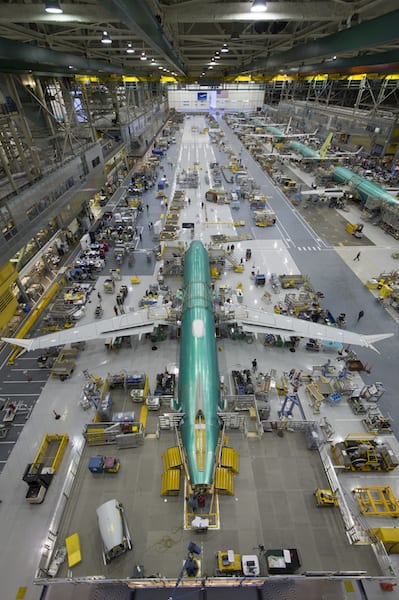
Boeing, whose 737 manufacturing facility in Renton is shown here, is among a number of major aviation industry companies taking actions and releasing statements with information about how the outbreak of COVID-19 is impacting their business. Photo: Boeing
While Boeing has requested a $60 billion lifeline from the federal government to cushion the impact from the COVID-19 pandemic and U.S. airlines through the Airlines for America trade group have asked for more than $50 billion in federal aid, domestic avionics manufacturers have warned about the downstream impacts to their business in recent Securities and Exchange Commission (SEC) filings.
“We are vulnerable to the global economic effects of epidemics and other public health crises, such as the novel strain of COVID-19 virus reported to have surfaced in Wuhan, China in 2019,” Astronics Corp. said in its 10-K report filed with the SEC on March 2. “Due to the recent outbreak of the COVID-19 virus, there has been a substantial curtailment of global travel and business activities which could have an impact on airline spending and demand, and could negatively impact our sales if conditions worsen or extend for a prolonged period of time. China has also limited the shipment of products in and out of its borders, which could negatively impact our ability to receive products from our China-based suppliers and our ability to ship products to customers in that region. Supply chain disruptions could negatively impact our sales. If not resolved quickly, the impact of the epidemic could have a material adverse effect on our business.”
Gogo Inc. said in its 10-K report filed with the SEC on March 13 that COVID-19 “has had, and is expected to continue to have, an adverse impact on our CA [commercial aviation] business.”
“In recent weeks, we have seen significantly reduced demand on aircraft operated in the Asia Pacific region as compared to demand levels in January 2020 before COVID-19 affected travel,” according to the filing. “More recently, demand for both business and leisure airline travel on a global basis has declined significantly due to COVID-19, and airlines are responding by cancelling additional flights, including domestic U.S. flights. All of our U.S. airline partners have announced international and domestic capacity reductions, and in the week in which this report is being filed, we are seeing for the first time reduced demand on domestic U.S. flights as a result of COVID-19.
Gogo said that the company expects “COVID-19 to continue to have a significant negative impact on CA revenue and are unable to predict how long that impact will continue.”
The company also specifically mentioned that it has seen no impact on its business aviation segment from COVID-19. In its annual filings, Gogo separated expenses between its business aviation segment and its commercial aviation segment to show how corporate jet operators are outperforming their airline customers.
“If our airline partners continue to experience significantly reduced demand for passenger traffic for an extended period, our 2020 consolidated results of operations and our liquidity and financial condition may be materially adversely affected. The extent to which the outbreak affects our earnings and liquidity will depend in part on our ability to implement various measures intended to reduce expenses and/or conserve cash. Earnings in CA-ROW [Rest of World, i.e. not North America] may be particularly affected if reduced demand for travel continues, as we provide service in that segment solely via satellite-based systems and satellite capacity and certain other costs are largely fixed,” Gogo told the SEC.
L3Harris said in its 10-K filing with the SEC on March 3 that “the ongoing coronavirus outbreak emanating from China at the beginning of 2020 has resulted in increased travel restrictions and extended shutdown of certain businesses in the region.”

The Harris-built integrated core processor, pictured here, is what Lockheed Martin will use as a processing upgrade for F-35s beginning in 2023. Photo: L3Harris
“These or any further political or governmental developments or health concerns in China or other countries in which we operate could result in social, economic and labor instability,” the report said. “Any inability to develop alternative sources of supply on a cost-effective and timely basis could materially impair our ability to manufacture and deliver products, systems and services to our customers. We can give no assurances that we will be free from disputes with our subcontractors; material supply constraints or problems; or component, subsystems or services problems in the future. Also, our subcontractors and other suppliers may not be able to acquire or maintain the quality of the materials, components, subsystems and services they supply, which might result in greater product returns, service problems and warranty claims and could harm our business, financial condition, results of operations and cash flows.”
Garmin said in its Feb. 19 10-K filing with the SEC that “natural disasters and extreme weather events, such as tsunamis or earthquakes, and medical epidemics or pandemics, such as COVID-19 (coronavirus disease), could occur in a region where we have a manufacturing or warehousing facility which would cause disruptions in our business operations or loss of inventory.”

Textron Aviation expects strong aftermarket demand for retrofits of the Garmin G5000 avionics suite, pictured here, for Citation Excel and XLS business jets. Photo: Garmin
“These events could also have an impact on our suppliers and affect our supply chain,” according to the report. “If our backup and recovery plans are not sufficient to minimize business disruption and if our insurance is not sufficient to recover the costs associated with these types of events, our financial results could be adversely affected.”
Honeywell’s 10-K filing with the SEC on Feb. 14 did not mention COVID-19.
In its 10-K filing on Jan. 31, Boeing also did not refer to COVID-19, but on March 17, the company did say that much of the $60 billion requested by the company this week “will be used for payments to suppliers to maintain the health of the supply chain.”
In a press release published March 17, Boeing said it “supports a minimum of $60 billion in access to public and private liquidity, including loan guarantees, for the aerospace manufacturing industry.”
“The long term outlook for the industry is still strong, but until global passenger traffic resumes to normal levels, these measures are needed to manage the pressure on the aviation sector and the economy as a whole.”
Recent Comments