


As the coronavirus pandemic continues to spread, it’s becoming clear that there will be significant economic fallout. Unfortunately, in addition to the direct impact COVID-19 will have on those it infects, jobs will be lost, businesses will go under, and money will be lost. But just as in times past, life will move on, albeit changed.
The world was already headed the way of digital before, and if I had to make an early guess, one of the consequences of this global health crisis will be an acceleration in the digital movement.
This brings us to the two stocks under consideration in this article: Universal Display (NASDAQ: OLED) and Applied Materials (NASDAQ: AMAT). There is some overlap between these two tech manufacturing suppliers, though Universal is hyper-focused on OLED screens versus Applied’s broad-based know-how in screens, chips, and quality control systems. (Full disclosure upfront, I own shares of both.) But with the two stocks beaten down in the last month (Universal down 40% in 2020 as of this writing; Applied down 32%), I think it’s time for a review.

Image source: Getty Images.
Screens or silicon?
First, a quick recap of the business models. As just mentioned, Universal focuses its attention on OLED screen manufacturing. It reports its revenue in two primary segments: material sales (the raw ingredients manufacturers need to purchase to make OLED displays; about 60% of revenue) and royalty and licensing fees (which it earns when allowing a manufacturer to use its patented manufacturing systems; about 40% of revenue). Still in the early days of OLED overtaking the current display standard, LED, management estimates it has made inroads into less than 2% of the total market and sees manufacturing capacity increasing by 50% in the next two years.
Then there is Applied, which also operates in the display industry, but also supplies equipment and services to semiconductor outfits. The company reports in three segments: semiconductor systems (equipment sales; two-thirds of revenue in the first quarter of 2020), global services (support and service to manufacturers; a quarter of revenue), and displays and adjacent markets (OLED and other display-related services; 8% of revenue in the first quarter). The situation has changed rapidly since the last quarterly report, but Applied had just returned to growth as of its last report, and had been forecasting that a further rebound was in store in 2020.
Though they share a little overlap, Universal and Applied are both manufacturing-related service firms, and thus have fluctuating revenues that come with the normal ebb and flow of the sector.
As far as pure long-term growth, though, it’s Universal that wins in this department, with its dependence on the up-and-coming OLED industry. With its patents on OLED giving it a corner on at least a portion of the new display market, it also touts higher operating profit margins.
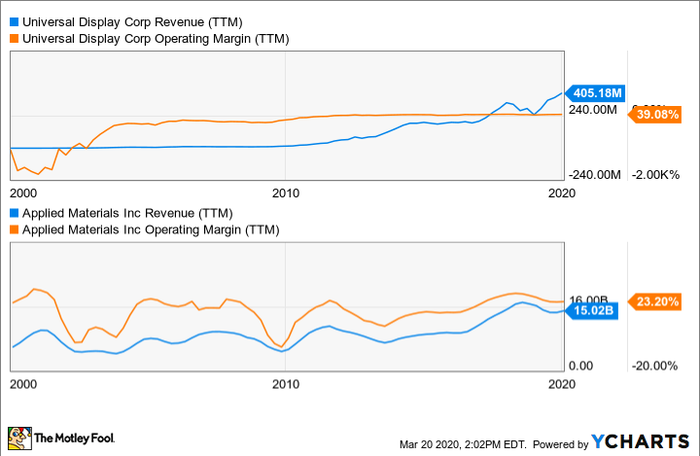
Data by YCharts.
Pocket depth and diversification
However, as a much smaller company with reliance on just one ingredient in the world of tech, Universal’s business results and stock are prone to be far more volatile than Applied’s stock — although Applied isn’t immune to wild swings itself.
As the smaller company, Universal also has lower cash reserves — $132 million at the end of 2019, but good for about nine months’ worth of operating expenses (using 2019 results). The company also has zero debt.
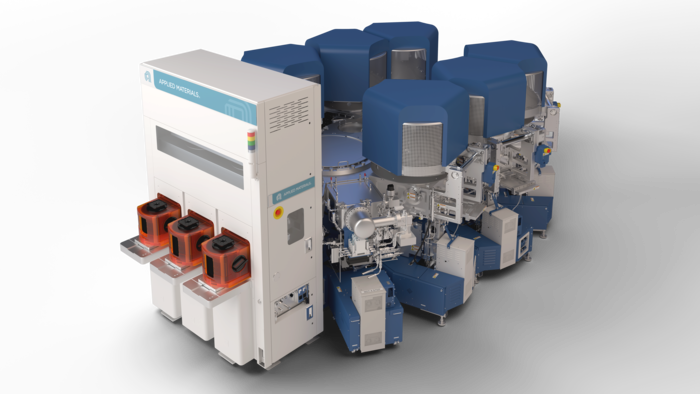
An Applied Materials semiconductor fab machine. Image source: Applied Materials.
Applied, on the other hand, had over a year’s worth of operating expenses in cash — or $3.42 billion at the end of the first quarter of 2020, to be exact. Granted, it also had $5.31 billion in debt, part of which is a term loan it is aggressively paying down with excess free cash flow after its acquisition of Kokusai Electric over the summer of 2019.
Thus, even though it has debt on the balance sheet, Applied has deeper pockets, and its diverse mix of business will help it weather the coming economic storm.
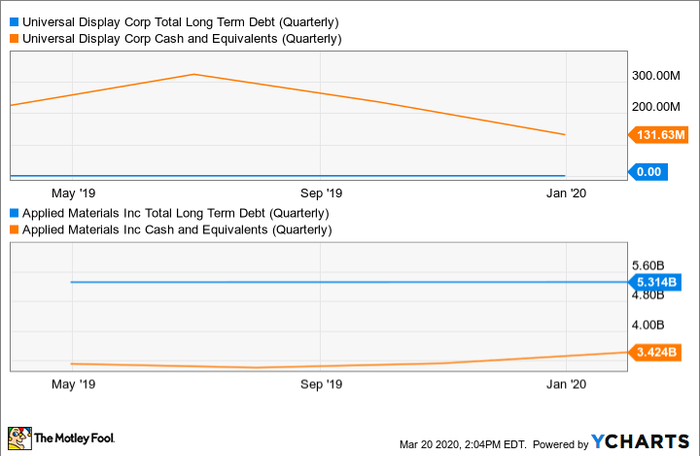
Data by YCharts.
Share valuation matters
After both stocks’ sharp decline in response to the COVID-19 disruption, shares are trading at significant discounts to what they were in the recent past. But it’s Applied that looks like the better bargain — not to mention having more pain priced in than Universal.
Universal shares trade for 35.1 times trailing-12-month free cash flow (money left after basic operating and capital expenditures are paid). The company has massive growth potential in the years ahead, but it’s a steep premium for an immediate-term outlook that has gotten very dark and cloudy. If premium smartphone and TV sales take a hit and manufacturer ordering taps the brakes, there could be plenty of downside left for the stock.
Applied is priced at 12.8 times trailing-12-month free cash generation. Granted, that’s because it isn’t the small, high-octane business that Universal is, and free cash flow could also take a hit. Nevertheless, it’s a significant discount that is already pricing in substantial disruption in the next few quarters.
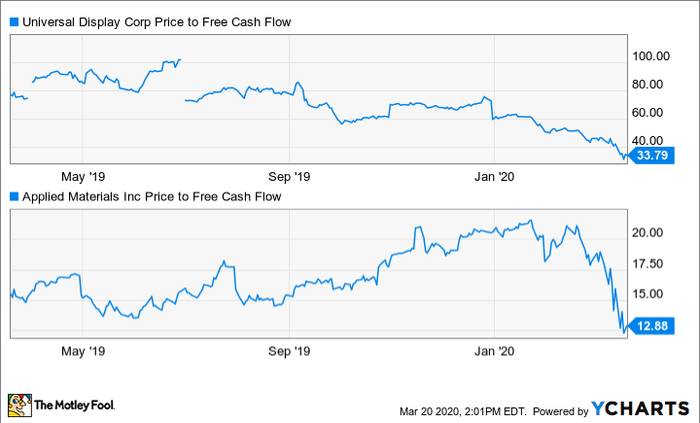
Data by YCharts.
So which stock is the better buy? I believe Universal Display has better prospects for long-term overall growth. However, given the uncertainty lurking in the market, I’m waiting to buy until there is more clarification on outlook. Put another way, I think the stock could continue to fall.
Applied Materials, on the other hand, looks like a value. It’s a more diversified business, and though its long-term growth potential likely isn’t as great as Universal’s, it still looks like a solid bet for those that believe the digital economy will keep growing. Thus, I think it’s the timelier purchase of the two.
10 stocks we like better than Universal Display
When investing geniuses David and Tom Gardner have a stock tip, it can pay to listen. After all, the newsletter they have run for over a decade, Motley Fool Stock Advisor, has tripled the market.*
David and Tom just revealed what they believe are the ten best stocks for investors to buy right now… and Universal Display wasn’t one of them! That’s right — they think these 10 stocks are even better buys.
*Stock Advisor returns as of March 18, 2020
Nicholas Rossolillo and his clients own shares of Universal Display and Applied Materials. The Motley Fool owns shares of and recommends Universal Display. The Motley Fool recommends Applied Materials. The Motley Fool has a disclosure policy.
The views and opinions expressed herein are the views and opinions of the author and do not necessarily reflect those of Nasdaq, Inc.
Recent Comments