

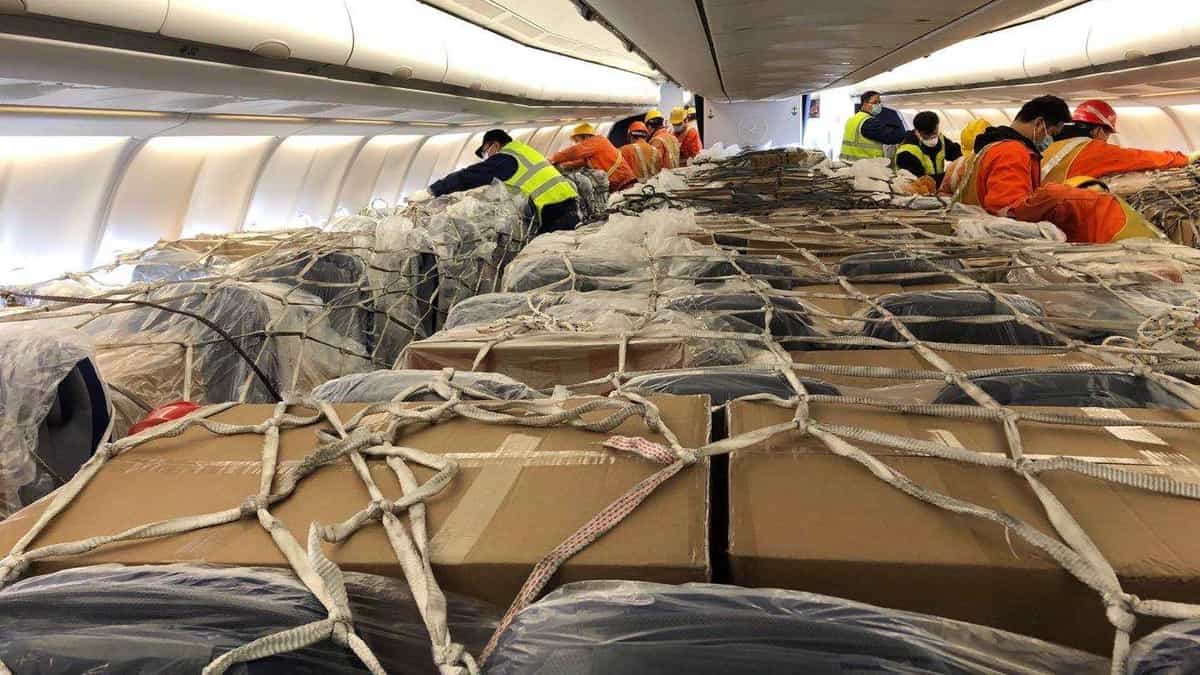

More passenger airlines are helping fill the severe shortage in freight capacity by turning their aircraft into cargo-only airplanes to haul critical medical supplies, foodstuffs and other economically essential goods.
The rapid implosion of air travel as countries closed borders to contain the coronavirus outbreak forced airlines to ground most of their fleets, especially widebody planes used in intercontinental service. Lower-deck space in passenger planes represents about half the worldwide capacity for moving goods – and even more between North America and Europe.
Glyn Hughes, global head of cargo at the International Air Transport Association (IATA), estimates that 30% of global air cargo, under normal circumstances, doesn’t have space to move now. Although shipments of many manufactured and high-tech goods have dried up with the stall of the global economy, carriers are experiencing hyper-demand to move medical supplies, protective gear, foodstuffs and e-commerce shipments as people sheltering at home use online delivery services.
With one million flights cancelled through June 30, there aren’t enough all-cargo planes to make up the difference and air freight rates are shooting up as a result.
The ability to command top dollar and generate revenue from assets that otherwise would sit idle is motivating passenger carriers to operate dedicated cargo charters, even though they have less room than a full freighter and finding freight for the return leg can be a challenge when trade is imbalanced.
A one-way charter for a full freighter on key routes can cost up to $1 million today, four times the rate before the crisis, according to industry experts.
Airlines are relying heavily, but not exclusively, on large aircraft such as the Airbus A350, and the Boeing 777 and 787 that carry huge amounts of cargo even when loaded with passengers and baggage. Much of the activity at the moment is trans-Atlantic, but airlines are also dispatching cargo-only flights between North America and South America, and Australia, and between Europe and Asia.
Some carriers are being creative by putting cargo in the seats of the passenger compartment, secured by netting and other restraints, to maximize efficiency. And a few are offering multi-party, less-than-full aircraft charters for importers and exporters that don’t have enough volume to rent an entire plane. Freight forwarders, intermediaries that manage international goods movement for clients, also can use the services of a charter broker to pool smaller shipments and secure access to an aircraft.
The capacity shortage is so acute that the Airfreight Forwarders Association is urging airlines to consider scheduled freight-only flight operations – not just ad hoc charters – to ensure an adequate supply of affordable air transport for cargo owners.
“A reliable, planned schedule of flights between origin and destination points that are driven by cargo demand and not by passenger demand would ensure forwarders the ability to access needed lift on behalf of their customers proximal to the cargo’s beginning and endpoints, speeding critically needed raw materials and finished goods to their destination,” the group said in a letter to Congressional leaders requesting the industry be included in any emergency economic relief.
IATA is acting as a central clearinghouse of information for passenger carriers trying to make sure they are complying with regulatory and industry standards for carriage of certain products, Hughes said in a telephone briefing with reporters.
Passenger airplanes, for example, may not have fire suppression systems, or temperature controls needed to maintain environmental conditions for pharmaceuticals.
“Each carrier is looking at its fleet, its capabilities, its handling capabilities because many of these airlines don’t actually operate freighters, so they’re not used to carrying large quantities of fully regulated dangerous goods,” Hughes said. “Many of the airlines are choosing not to because their handling systems are not designed to manage that type of cargo in a normal operation” and are sticking to general cargo.
Hughes said it’s important to broadcast to logistics providers and shippers that passenger carriers that previously haven’t operated freighters have added capacity to the system and where it can be found.
FreightWaves was first to identify several airlines that were flipping their passenger aircraft into freighters and offering charters to logistics companies and shippers. The following is a rundown of the latest airlines to diversify their business with freight-only flights.
Air Canada
Air Canada said on March 25 it launched its first cargo-only flights this week from Toronto to Frankfurt, London and Amsterdam using Boeing 787 Dreamliners capable of carrying 35 tons of cargo – the equivalent of 80 grand pianos. More “mini-freighter” flights are planned for Latin America. On its website, the carrier also offers Boeing 777 planes that can carry 40 tons of cargo.
The airline said it is also exploring opportunities, in conjunction with local governments, to sell the service domestically based on assessments of demand to move relief goods from multiple markets within Canada. Air Canada Express regional aircraft will be used to serve smaller or remote regions in Canada.
Air Canada Cargo said it charges shippers and freight forwarders a flat rate for both directions and is introducing a partial-load program, so shippers that don’t require a whole aircraft can book space. The arrangements contain clear provisions to ensure that the goods being moved are being sold at fair market rates and to authorized suppliers.
To facilitate the cargo-only flights, Air Canada Cargo has created five, segment-specific sales teams to focus on the unique needs of customers at different levels of the supply chain.
Lufthansa
Deutsche Lufthansa AG said the first passenger aircraft with cargo as the only payload landed March 25 from China at Frankfurt International Airport carrying 30 tons of masks, personal protective equipment and other medical supplies for combatting the COVID-19 virus. In addition to the cargo compartments, Lufthansa Cargo workers also filled the stowage compartments above the seats of the Airbus A330.
Lufthansa said it is exploring the possibility of operating more passenger aircraft exclusively for cargo purposes.
Lufthansa is a combination carrier that also operates a fleet of 13 freighters, and uses the capacity of four more in its AeroLogic joint venture.
United Airlines
More than offering a handful of random flights, United says it will initially operate a schedule of 40 cargo charters each week, using 777 and 787 aircraft, between the U.S. and international locations. United Cargo said in a news release that its first cargo-only flight departed March 19 from Chicago O’Hare International Airport to Frankfurt International Airport with 29,000 pounds of goods in the hold.
Delta Air Lines
Delta said it operated a freight-only flight from Dublin to Atlanta on March 24 carrying 32,000 pounds of medical supplies on an Airbus A350 and expects to make more runs this week. Ireland is home to two dozen of the top biotech and pharmaceutical firms in the world.
On the same day, two Boeing 777-200 long-range planes took off from Los Angeles for Sydney, Australia, with more than 80 tons of cargo. A cargo flight from Chicago to Amsterdam delivering U.S. mail is expected later this week, Delta said on its website.
American Airlines
The world’s largest airline (measured by the number of passengers and distance carried) is expanding its pure cargo program with two more round trips between Dallas-Fort Worth and Frankfurt later this week and two more April 2-3, spokeswoman Laura Bassel said. American launched its cargo-only service last week with flights connecting Dallas-Fort Worth and Frankfurt.
Overall, the company has 40 widebody flights, most involving passengers, operating this week around the globe to several major cities.
LATAM Airlines
The Chilean-based carrier, which is 20% owned by Delta Air Lines, said it recently operated its first passenger-as-freighter flights between Santiago and Mexico City using Boeing 787-900 aircraft, each carrying about 40 tons of product – mostly salmon. It also used an Airbus A320 airplane to move perishable products, medicines and other goods between Lima and Iquitos, Peru, a remote region that is difficult to reach by land or sea.
LAN Cargo employees are also making use of the upper deck by putting boxes in the seats, which are protected with a cover.
The company also said it has modified routes and increased the frequencies for its fleet of 11 Boeing 767-300 freighters to help address the current shortfall in cargo capacity. There is now five times more freighter capacity on the Santiago-Miami lane, primarily helping salmon exporters, and 20% more capacity between Europe and South America. The six weekly frequencies will support delivery of automotive spare parts, medicines and other products to South America and shipments of perishable products to Europe.
In addition, frequencies between North and South America were increased by almost 15%, totaling 26 flights. And LATAM will begin operating between Santiago and Los Angeles supporting salmon transportation, with the return route stopping in Mexico City and Lima, to offload technology and healthcare products, and spare parts.
Virgin Atlantic
Virgin Atlantic operated its first-ever dedicated cargo charter on March 22 from London to New York using a Boeing 787. The plane carried 12,500 kilograms of pharmaceutical and medical supplies. The airline said it has more supplementary cargo flights scheduled this week.
Etihad Airways
Etihad’s cargo division is offering to operate 34 weekly flights to 10 markets with 787-10s as cargo aircraft. Each airplane will have room for 12 lower deck pallets and four containers, with a payload of 45 tons.
The passenger-to-freighter network will insert capacity into India, Indonesia, the Philippines, Singapore, South Korea, Thailand, and other locations.
The service complement’s Etihad’s fleet of Boeing 777 freighters. The company said it is also beefing up its freighter schedule with additional flights into Hong Kong, London, Riyadh and Shanghai.
Air New Zealand
The carrier is putting 787-9 Dreamliners into service as cargo airplanes, with space for 11 cargo pallets. It is also offering fractional charters designed to help small- and medium-size shippers that only need part of the cargo hold for their goods.
An Air New Zealand news release didn’t indicate whether any cargo-only flights had occurred yet, but said customers are expressing interest in the service for moving goods to and from Hong Kong, Los Angeles, Melbourne, San Francisco, Shanghai and Sydney,
China Eastern Airlines
The airline stated on its website that it has used passenger airplanes in the cargo-only configuration to move medical supplies. A couple of flights went to the Czech Republic, with part of the shipment loaded in passenger seats, IATA’s Hughes said .
Cathay Pacific
Cathay Pacific is heavily marketing its cargo-only passenger schedules, saying it is able to rapidly flex capacity with additional flights on an ad hoc or charter basis, where it makes economic sense.
.
Recent Comments