


Grain markets this morning are in the green as demand from the supply chain for essential foodstuffs remains strong.
“The amateurs discuss tactics. The professionals discuss logistics.” – Napolean Bonaparte (former French Emperor and military leader)
Is Our Supply Chain at Risk of Default?
Grain markets this morning are in the green as demand from the supply chain for essential foodstuffs remains strong. After a three-day rally to start the week (including the Dow jumping 11% on Monday, a new record single-day performance) stock markets are all lower this morning. Nonetheless, the complex is set to see its first positive week in March, but this is probably highlighted best in Asia where markets are headed for their best weekly performance in 30 years! Worth noting though is that China has now closed its borders to most foreigners starting tomorrow, as they minimize the risk of COVID-19 re-starting its spread within the People’s Republic. [1]
The U.S. has now become the country with the most cases of COVID-19, passing China’s “official” numbers (but let’s be honest: who believes them?). [2] Michigan alone now has nearly more cases than Canada, and already more COVID-19 deaths, but New York is the epicentre with one doctor saying “9/11 was nothing compared to this.” [3] Also, U.K. Prime Minister Boris Johnson has tested positive for COVID-19.
Our Food Supply Chain Has a Strong Base
At its core (read: the production level) the food supply chain in Europe and North America is very strong. [4] Those who are farming grains, oilseeds, pulses, vegetables, fruit, or are running livestock are now being counted on and recognized. While the healthcare industry and truckers might get the most praise right now, farmers are getting more admiration than usual, begging the suggestion from Real Agriculture’s Kara Oosterhuis of a “rural revival”! [5]
That said, there are some challenges that the supply chain is facing that I would encourage some groupthink on. One is getting safety materials like gloves, masks, and hand sanitizer to truckers. [6] Another is the lack of truck stops and/or restaurants who are still open to allow these essential workers to reset with a hot shower and a decent meal. [7]
The bottom line is that its base, our food supply chains are robust and ready to meet the challenge. For example, the meat industry is cracking on at full-tilt. [8] We’re also seeing North American wheat millers searching every corner of their supply chain to satisfy the current panic-demand for bread, flour, and other foodstuff staples made from cereals. [9] Naomi Blohm of Stewart-Peterson notes that if the economic downturn drags on, “the food that will then be in demand will be bread and pasta. This food is cheap, easy to make, and fills the bellies of hungry children. [10]
The bottom line is that there is still a lot of grain in the world – especially wheat – but it’s nice to see some fresh demand headlines for a change. High-protein wheat is finding some strength as well, as evidenced by the continued strong pace of U.S. hard red spring wheat exports. Through its Week 42 of the 2019/20 crop year, U.S. HRS wheat exports are tracking more than 8% higher than a year ago with 5.3 MMT shipped out (or 194.7M bushels if converting metric tonnes to bushels). Of note this week from the USDA was that export sales of U.S. corn hit a marketing year high, while U.S. soybean and wheat export sales were above and near the top-end range of expectations, respectively.
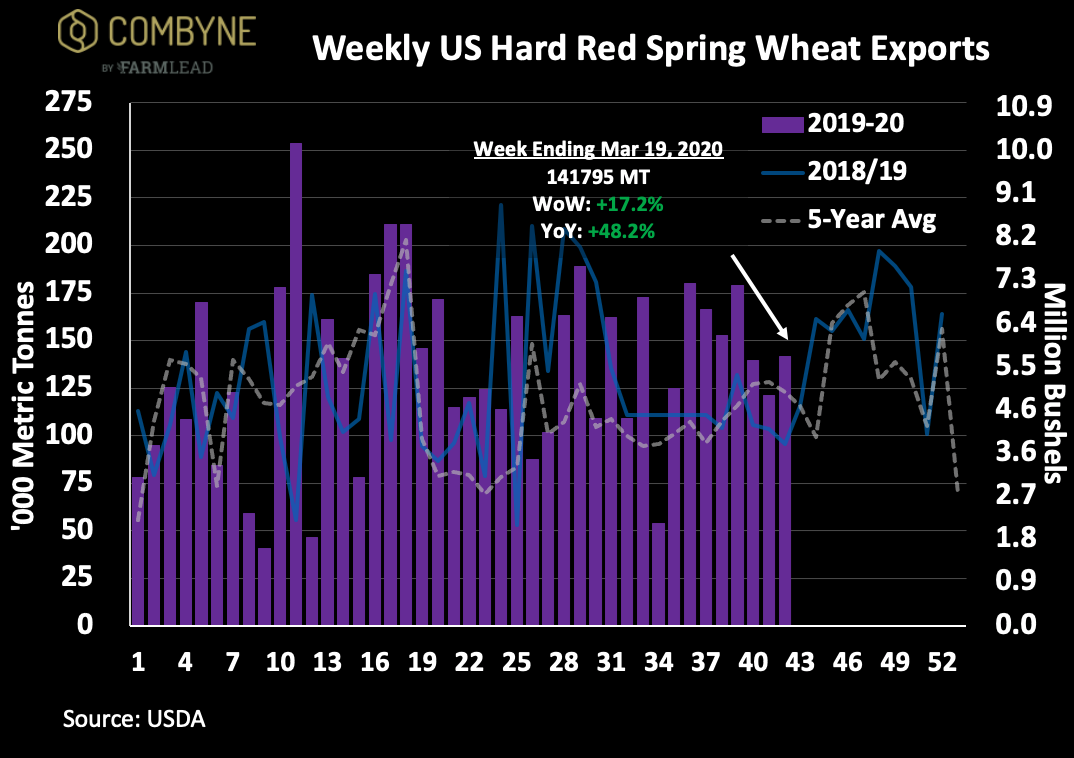
Nonetheless, it’s no surprise that, and as mentioned in Monday’s Breakfast Brief, we’re seeing wheat prices retest their highs seen in January, as well as a significant uptick in deal making on the Combyne cash grain marketplace. Here are few deals to look at and as a reminder, you should tap the “Connect” button to be notified of new bids from these specific buyers in the future (or would you rather miss the next deal?)
Note: there’s also been healthy activity from buyers in Manitoba, North Dakota, and Ontario their bids have already expired this week or they’re choosing to engaging with farmers to have their Offers listed publicly. That said, the Combyne cash grain marketplace is completely free so post your Listing today.
Will the Supply Chain Cede to Government?
To be honest, I had a much different Breakfast Brief teed up for today, talking about the macro environment and where things may end up a few months down the road. However, the plan changed when I read this headline this morning when I woke up “B.C. assumes power to take over supply chains amid COVID-19”. [11] Not to fret, you’ll get my macro perspective next week, but I had to share my thoughts on this fresh development, as I’ve actually been thinking on it for the last few weeks.
More concretely, I’ve shared my concerns in private conversations with investors and supply chain risk managers about the possibility of governments nationalizing food supply chains in order to maintain, well, order. With the B.C. government appropriating the province’s supply chain, I’m not very optimistic as to where this will end up and to answer your question of “why?”, it’s simple: the government is not a supply chain expert.
Alongside our general freedom (which we do STILL enjoy today) is the fact that we can pursue any occupation that we wish and become the best in those fields! What the B.C. government is doing in taking over the supply chain is the equivalent of saying to ICU and emergency room doctors and nurses, “Hey, sorry, but you’re not doing a good enough job of treating COVID-19 patients because too many people have died so we’re gonna take over here.” This obviously would never happen because, even though they have a few people who lead medicine & healthcare, the government is not a front-line expert and don’t have the capacity or experience to manage this chaos. The same can be said for the supply chain and probably best evidenced by Cargill’s chief risk officer, Brian Sikes, who was said, “we’re making decisions by the hour.” [12]
While some of you may disagree with me, the fact remains that there are people who know every single nook and cranny of their supply chain. Inserting a bureaucrat into said supply chain to do a better job is a grossly understated waste of resources and a definitive road to a supply chain that will be in no way, better than what we’re seeing today in terms of reliability and order.
If anything, if you have connections to anyone making decisions in your local, provincial, or national government, you should ask them NOT to appropriate supply chains – especially food supply chains. Instead, encourage them to work with the current supply chain experts to remove any obstacles in their way. For example, the U.S. has designated many parts of the agricultural supply chain as essential infrastructure, but no move has been matched by Canada, and this comes just as Plant 2020 is ready to fire up. [13]
More broadly, we should be encouraging our governments to support the companies who are bringing essential goods to market in any way. Replacing their authority and expertise would be the equivalent of Gary Bettman telling Sidney Crosby, “You know what, you can take the night off; I’ve been watching you play for a long time and I think I can do this so I’ll be suiting up in your place tonight. Of course, this won’t happen because (1) the NHL is suspended and (2) Gary Bettman can, self-admittedly, barely skate. [14]
My same argument for entrusting the supply chain experts to do their job can be said for your farm or agribusiness. If you need a solution to a problem right this second, are you going to try to learn all the expertise associated with that problem, or are you going to leverage the expertise of someone who knows the issue backwards and forwards? Immediately the areas that come to mind are accounting and veterinarian services.
One healthy exercise you might consider this weekend is to write down all the jobs that must be done in your operation, and then you and your co-workers write down what areas you are experts in and what you’re terrible at. You’ll find out pretty quickly where your gaps are, which will tell you what type of experts you need to find to help you make that next step forward.
Have a great weekend!
To growth,
Brennan Turner
CEO
FarmLead
TF: 1-855-332-7653
[email protected]
@Combyne on Twitter
At 8:15 AM CST in the North American futures markets (*not cash prices*):
(all prices in dollars per bushel unless otherwise indicated)
$1 USD = $1.4085 CAD, $1 CAD = $0.71 USD)
May Corn: -1.8¢ (-0.5%) at $3.47 USD or $4.887 CAD
May Soybeans: +2.8¢ (+0.3%) to $8.83 USD or $12.437 CAD
May Soybean Meal (per short ton): +$3.00 (+0.95%) to $325.90 USD or $459.01 CAD
May Soybean Oil (cents per lbs): +0.05¢ (+0.2%) to 26.55¢ USD or 37.39¢ CAD
May Oats: +5.8¢ (+2.2%) to $2.668 USD or $3.757 CAD
May Wheat (Chicago): +11.3¢ (+2%) to $5.803 USD or $8.173 CAD
May Wheat (Kansas City): +14.3¢ (+2.9%) at $5.015 USD or $7.063 CAD
May Wheat (Minneapolis): +7¢ (+1.3%) to $5.383 USD or $7.581 CAD
May Canola: +1.6¢ (+0.15%) to $10.512/bu / $463.50/MT CAD or $7.464/bu / $329.09/MT USD
COMMODITY TRADING INVOLVES RISK AND MAY NOT BE SUITABLE FOR ALL RECIPIENTS OF THIS POST. Neither the information presented, nor any opinions expressed, constitutes a solicitation for the purchase or sale of any commodities. The thoughts expressed in this email and basic data from which they are derived are believed to be reliable, but cannot be guaranteed due to uncertainty about future events and complexities surrounding commodity markets. Those acting on the information are responsible for their own actions.
Recent Comments