


- The COVID-19 pandemic is raising questions about risks in supply chains.
- Past disruptions offer lessons for the current crisis.
- Solutions include data sharing, trusted networks and multi-stakeholder input to legislation.
Governments are battling to figure out the right trade response to the COVID-19 pandemic amid escalating economic turmoil. Initial responses show the difficulties and the risk of getting things wrong. An understandable response of locking everything down to slow the spread of disease and keep control of equipment also limits the movement of essential workers and stops critical supply chains from functioning effectively
Over 50 countries were restricting the export of certain medical supplies by mid-March, and travel barriers are in place worldwide – in many cases even blocking movement between sub-national regions. Measures away from the border like the closure of hotels mean supply-chain workers – from research scientists to engineers to cargo pilots – are constrained from operating effectively.
A new strain of Coronavirus, COVID 19, is spreading around the world, causing deaths and major disruption to the global economy.
Responding to this crisis requires global cooperation among governments, international organizations and the business community, which is at the centre of the World Economic Forum’s mission as the International Organization for Public-Private Cooperation.

The Forum has created the COVID Action Platform, a global platform to convene the business community for collective action, protect people’s livelihoods and facilitate business continuity, and mobilize support for the COVID-19 response. The platform is created with the support of the World Health Organization and is open to all businesses and industry groups, as well as other stakeholders, aiming to integrate and inform joint action.

As an organization, the Forum has a track record of supporting efforts to contain epidemics. In 2017, at our Annual Meeting, the Coalition for Epidemic Preparedness Innovations (CEPI) was launched – bringing together experts from government, business, health, academia and civil society to accelerate the development of vaccines. CEPI is currently supporting the race to develop a vaccine against this strand of the coronavirus.
Firms are calling for governments to intelligently and flexibly implement pandemic response policies to avoid freezing the supply system for medical goods at a time when they’re most needed. In the shorter term, businesses also need flexibility to adapt production to manufacture critical goods; the supply chain finance to keep suppliers working, and the legal adaptability to cope with practical problems such as accepting digital signatures to minimize human contact. Critical goods should not be sitting for days waiting to clear customs.
In the long term, the need for visibility into supply chain data, and ability to provide services digitally across borders, whether for telehealth or education, is clear. Trade decisions made now will help shape whether we have diverse, cost-effective and accessible sources of supply in the future.
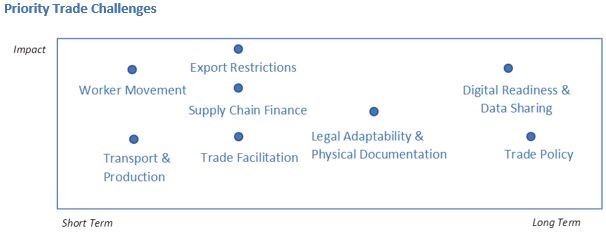
Image: World Economic Forum’s
Beyond the immediate need for supplies, questions are being raised about the risk inherent in current supply chain structures. Over recent decades, supply chains have globalized, specialized and become leaner or just-in-time. They are more efficient, less risky in certain areas, but potentially more exposed to a breakdown of cooperation.
Through this period, supply chain managers have encountered numerous shocks, often coming away a little wiser, with a stronger supply chain. The Great East Japan Earthquake and tsunami, Thailand’s flooding, the Eyjafjallajokull volcano, the maritime piracy upsurge, the e-coli-infected vegetable outbreak – all these shook supply chains across whole regions.
A 2012 World Economic Forum survey of supply chain professionals ranked disruptions most likely to provoke significant and systemic effects on supply chain networks. The list included pandemics, natural disasters, extreme weather, conflict, demand shocks, ICT breakdowns, and export/import restrictions. Other than natural disasters and weather, the others are possible to influence, if not fully control. Given this, it’s extremely discouraging, from both human and economic perspectives, to see the growing list of export restrictions being placed on medical supplies.
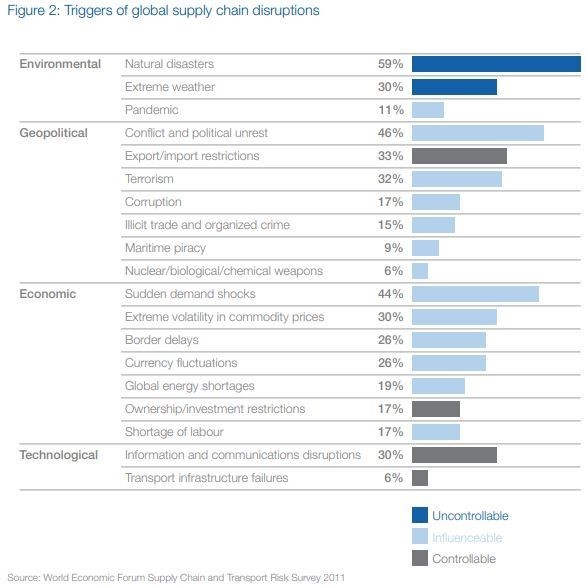
Image: World Economic Forum’s
However, the triggers of supply chain disruption are hard to predict, and sometimes neither controllable nor influenceable. The robustness of networks is paramount to ensuring demand can be met with supply even in extraordinary times. COVID-19 and related responses are delivering an extraordinary shock both on supply and demand sides to the global economy – by shuttering production and cutting consumption – even as demand for healthcare materials soars.
Both governments and business have responded to past difficulties with efforts to improve supply chain resilience. A critical element of this is information. Indeed, the same survey found that four of the top five global supply chain vulnerabilities relate to visibility along long supply networks.
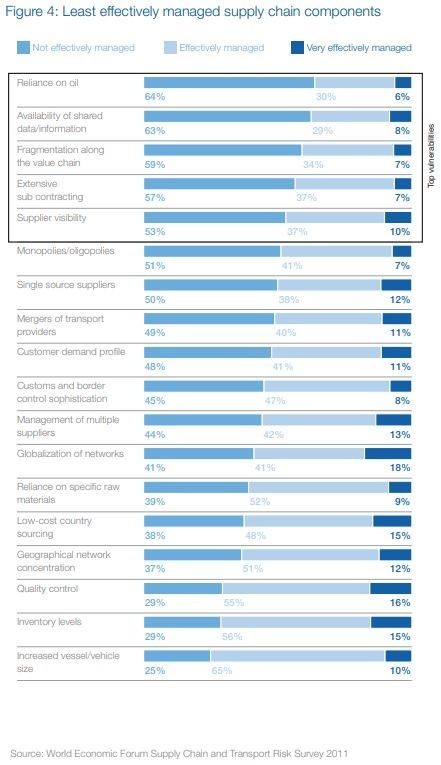
Image: World Economic Forum’s
Supply chain planners have made good progress in decreasing fragility, not least by increasing information and better aligning risk with responsibility. Risk managers reflecting on previous disruptions highlighted five priority strategies to improve further: Risk quantification, scenario planning, data sharing, trusted networks and multi-stakeholder input to legislation.
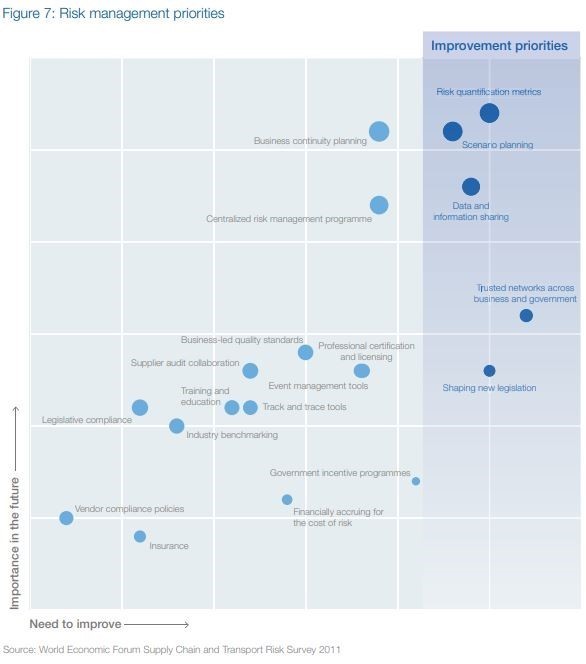
Image: World Economic Forum’s
As governments, medical professionals and logisticians respond to the current crisis, these five recommendations from past supply chain shocks are worth remembering.
- Improve the international and interagency compatibility of resilience standards and programmes.
- Ensure that supply chain and transport risks are assessed as part of procurement, management and governance processes.
- Develop trusted networks, made up of suppliers, customers, competitors and government officials, that are focused on risk management.
- Improve the visibility of network risks through information sharing and development of standardized risk assessment and quantification tools.
- Improve risk communication before and after disruptions to create a more balanced public- and private-sector discussion.
The global economy and international trade is currently experiencing a massive shock, with steep demand reductions in many areas, and spikes in others. A drastic reduction in foreign investment is happening. As demand and supply for medical equipment are most mismatched in developing countries, they will suffer the brunt of supply chain breakdowns. We need to avoid aggravating this via trade or investment restrictions. Communications and flexibility are needed in the short term for crisis response.
It is not too soon to think hard about restarting economies and building back a resilient and responsive trade system able to cope with the next disruption whatever it may be. Decoupling and reshoring, though superficially tempting, are overly simplistic proposals. Rather, demonstrating that as nations we care about those outside our borders will strengthen our response today and secure resilient supply chains for tomorrow.
License and Republishing
World Economic Forum articles may be republished in accordance with our Terms of Use.
Recent Comments