

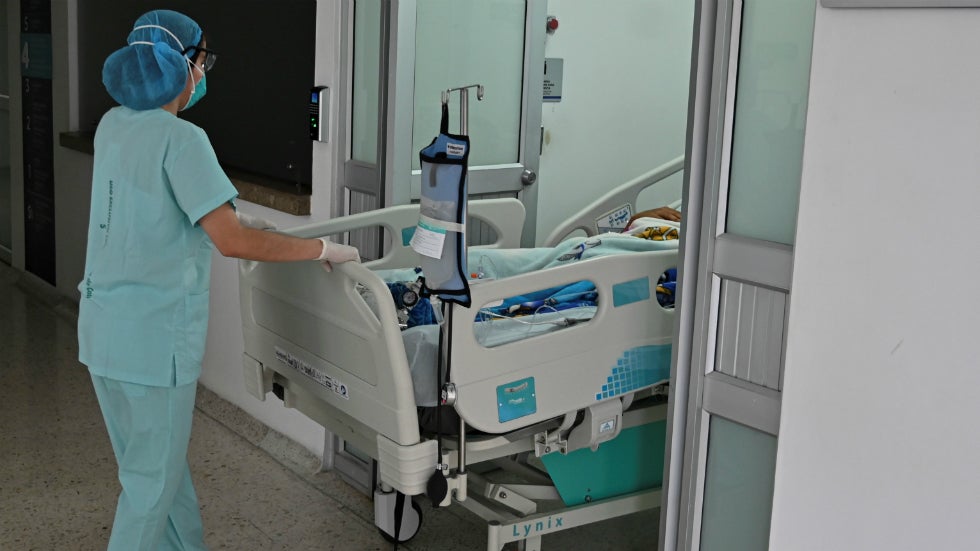

Sometimes it takes just one telephone conversation to be brutally reminded of the enormity of a situation — and this, for a case that already was incredibly consequential to begin with. It happened last week when I spoke to a friend, an intensely dedicated doctor in Orange County, Calif., who, in addition to keeping his practice open to treat patients, is volunteering many hours at the local hospital.
My “Ah ha!” moment didn’t come from his description of the challenges that the medical profession faces in its heroic battle against the coronavirus pandemic. Yes, he shared really grim stories about the conditions under which he and his colleagues are operating, from a shortage of masks, ventilators and even certain gowns to the real fear that our health care system is about to be overwhelmed and crippled by a tsunami of cases.
Sadly, these stories, as depressing and worrisome as they are, didn’t come as a surprise. The images from Italy over the past two weeks or so, coupled with the more recent loud warnings from officials and medical professionals in New York, had prepared me for them. What really shocked me — and, with hindsight, it shouldn’t have — was his response to the question I asked after hearing about the conditions on the ground and his incredible commitment to patients’ well-being (for which I thanked him and his colleagues profusely).
When asked how he’s holding up, he volunteered another set of worries that spoke directly to issues that are much more familiar to me as an economist and an observer of policies and markets. In addition to his sheer exhaustion from long hours, he faces a set of really difficult business decisions. Yes, business decisions.
As the owner and chief operator of a small business, a highly respected and successful doctors’ practice, he is worried about something as basic as meeting payroll — previously, an unthinkable problem. This has become a pressing reality for him because of a devastating combination of business blows from seemingly all directions at once.
His operating costs have increased as he tries to buy masks and other material needed to protect his staff from an incredibly contagious illness. His revenues have fallen as some patients postponed visits to the practice, fearing exposure to infection. The ability to switch to telemedicine, while ongoing and also involving additional costs, is far from just the flipping of a switch.
All of this is resulting in a massive drain on his cash reserves at a time when access to bridge financing is extremely limited. And the hit he is suffering is less than those of many of his colleagues who also have seen revenue from previously normal activities, such as elective surgeries, evaporate following the health care system’s correct directive to delay those in order to make more hospital capacity available for the expected onslaught of coronavirus patients.
What my friend is experiencing is a microcosm of what is happening to many businesses around the country and the world.
Otherwise viable, dynamic businesses are seeing a short-term, and potentially highly reversible, shock that risks turning into a much bigger disaster. Or, in economic terminology, the threat is that “liquidity problems” — the underlying ability to pay, but just not at this time — will become solvency ones, resulting in unemployment and bankruptcies that both worsen the current recession and make the recovery slower and far from complete.
The historic $2.2 trillion package approved by Congress and signed by President Trump Donald John TrumpCuomo grilled by brother about running for president: ‘No. no’ Maxine Waters unleashes over Trump COVID-19 response: ‘Stop congratulating yourself! You’re a failure’ Meadows resigns from Congress, heads to White House MORE last week aims to address this issue. But it also faces at least two challenges in going from design to execution.
First, implementation is far from automatic. Some pipes are in place — unemployment benefits being an example — but others have to built on the fly. Second, in as much as the relief package can help to contain the economic damage and limit financial market failures — and it will — it doesn’t have the power to reactivate economic activity. That falls to medical progress in identifying and containing the spread of the virus, better treating the ill, and enhancing immunity.
Having said that, there is no time to waste in moving from economic design to execution. Every effort needs to be deployed to get money out urgently to households and businesses that, while still employed and operating, have experienced near-catastrophic declines in earnings. The immediate use of existing infrastructures in both the public sector (e.g., the IRS) and the private sector (e.g., the banks), as imperfect as they are, constitutes an important bridge in the building of better ones that take longer to activate — an overall approach that the Federal Reserve, repeating its 2008 crisis management experience, is using by resorting to asset managers to act as agents for some of its emergency programs.
Prioritization of certain sectors, starting crucially with strategically important ones such as health care, is a must — not a nice-to-have element. And, when it comes to conditionality, these sectors should get the lightest treatment, notwithstanding the inevitable risk of some slippages. Finally, overall responsibility for every one of these tasks — including sorting out the inevitable tensions that will occur in the interagency process, or in aligning public and private incentives and actions — should be explicitly and publicly assigned to senior individuals in the administration.
In moving on all of this, three principles of effective crisis management should guide implementation at the 30,000-foot level:
- Simplification of complexity in an action-oriented manner;
- Resisting the temptation of making the delayed “best” the enemy of the more immediate “good”;
- To the extent that a mistake ends up being made (and no one wants this to happen, but we all are operating in incredibly uncertain, unsettling times), better that it be a mistake of over-reaction in supporting the most strategic sectors than one of under-reaction.
Undoubtedly, what I heard last week from my friend is just a small indication of how we all are collectively facing a generation-defining moment. But it is an extremely potent indication, as it comes from our dedicated first-responders in this global disaster who, every day, take enormous personal risks to help others.
It’s an example that should be remembered every day as all of us — governments, companies, households and nonprofits — do whatever it takes to collectively overcome this deadly virus and the damage it is inflicting on people, society and the economy.
Mohamed A. El-Erian is chief economic adviser of Allianz, the parent company of PIMCO where he served as CEO and co-CIO (2007-2014), and president-elect of Queens’ College Cambridge. He chaired the Obama administration’s Global Development Council from 2012 to 2017. A frequent guest on CNBC, a Bloomberg Opinion columnist and a contributing editor to the Financial Times, he is the author of two New York Times best-sellers, “The Only Game in Town: Central Banks, Instability and Avoiding the Next Collapse” (2016) and “When Markets Collide” (2008). Follow him on Twitter @elerianm.
Recent Comments