

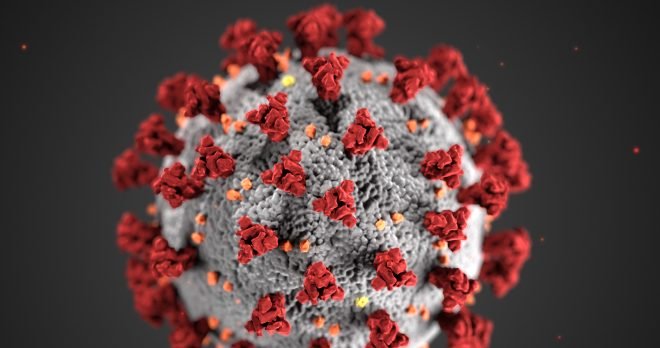


This illustration of coronavirus disease 2019 (COVID-19). CDC illustration
The COVID-19 pandemic underlines the importance of international cooperation to contain the deadly virus but also spotlights the dangers of over-reliance on global supply chains in manufacturing everything from cars to pharmaceuticals, three international relations scholars said on Tuesday.
“Pandemics require cooperation among sovereign nations; responsible governments share the information,” Eric Brown speaking from the Hudson Institute in Washington, D.C. said — a point that the three stressed.
The panel also agreed that during the initial outbreak in Wuhan, China covered up the scale of what happened.
In light of what’s happening to the global economy, Michael Doran said, “we do have to talk about bringing the supply chain back into the U.S.” and resting it with trusted allies and partners.
“Give credit to [President Donald] Trump to identify China as a major competitor” from the start of his administration and has begun “moving supply chains back to the United States” so it would not be reliant on potential adversaries in a crisis, even one of health not armed conflict, Doran said.
“It’s not just the industrial supply chain” in manufacturing automobiles or aircraft that is vulnerable but also pharmaceuticals, he said.
And when the Chinese manufacturing sector, including pharmaceuticals, began to shut down as the contagion spread shuttering plants and the government imposed strict quarantine rules on the infected region, the repercussions were felt globally.
Recovering from its slow acknowledgment of what havoc the virus was created, Doran said the Chinese government “seems to have put together a pretty good effort to control the virus” later. But that success came at a heavy price to civil liberties that should note of caution to democratic governments facing COVID-19 outbreaks.
Beijing used “Orwellian tools … to monitor every individual’s movements” from CCTV cameras and sophisticated tracking of cell phones to contain the outbreak and measures to block citizens’ movements.
China had a system in place to do that, not originally intended for use in health emergencies.
Long before the outbreak, Chinese Communist Party leaders through the government “have been investing very heavily in techno-control,” Brown said. The idea was to be “surveilling the population to control them politically.”
Before the pandemic, the idea of techno-control of a given population, he added was appealing to autocratic regimes or governments leaning that way. Now, the sales pitch includes the necessary monitoring of public health.
The Chinese “have been very intent on exporting … this technology of the future” and are now tying it to medical aid it is offering other nations, including Italy, Serbia and others in Europe, who are in their own struggle with COVID-19.
While Beijing is drawing broadcast time and headlines for these offers of medical assistance and effective monitoring, Brown and Doran said the United States needs to do a far better job of telling the world what it is doing to help other nations combat COVID-19 from sending medical supplies to financial aid.
Both noted the $2 trillion emergency spending bill ups the U.S. commitment to help its citizens in the crisis but other nations as well.
Brown said it was the right thing to push back against China “in the first weeks” against Beijing’s claims that the American Army was responsible for the outbreak in Wuhan.
The same is true in pushing back against Iran’s claims that American caused the pandemic and is choking off medical supplies to its people, Doran said. “This is certainly not the moment to let up the pressure” on the regime. He said there is nothing blocking Tehran from buying all the pharmaceuticals, other medicines and equipment it needs to contain the pandemic.
What makes the pandemic so critical to Iranian leadership’s rhetoric is where the first large-scale reports came from. The epicenter in Iran is Qoms, “the religious center” of the country and “its most pro-regime city.”
The regime’s halting response and the deaths of a number of prominent clerics in Qoms has been to cancel Friday public prayers, close off the city from religious visitation, a major source of income for the region and for the government and hold back news on the true state of affairs there.
Ayatollah Khamenei, the supreme leader, and others in the hierarchy followed China’s lead and blamed the United States. “They have been trying to deflect [responsibility for] the crisis from the government. Iran just covered up the crisis in the early days.”
Doran added, “to this day, they are lying about their number of dead;” and not believing what it is hearing but witnessing personally, “the population is holding the government responsible” for its failures.
Iran’s proxies, like Hezbollah in Lebanon, also are being stressed by the pandemic felling their fighters and the continuing downward spiral of Iran’s economy that is choking off its financial support of their operations across the Middle East.
But the economic impact of the pandemic goes beyond supply chains. It has led “to an implosion of Belt and Road,” China’s infrastructure-building initiative “from Bangladesh to Nigeria,” Brown said.
Instead of the promised highways, airfields, ports and dams that were to lift dozens of nations across Asia, the Middle East and Africa up economically, they have been left with “more suffering from mammoth debts” owed Beijing.
These nations “are suffering from Chinese weakness, not [benefitting] from Chinese strength” as these projects tumble into default.
He added this would be an opportune moment for the United States government and the private sector to step forward and offer necessary development aid to these nations that are bearing the double burden of disease and debt.
A key takeaway not directly related to controlling the pandemic will be the public and private sectors’ “move to more flexible manufacturing” with eyes on how to better employing artificial intelligence and robotics domestically and with allies to keep plants functioning, Nadia Schadlow said.
“The private sector needs to look at [the manufacturing supply chain] in a different way” than it has in the recent past, relying on supplies and parts from all over the globe. She added, open societies “are more likely to find answers more quickly” than authoritarian ones because they encourage creativity and cooperation.
Recent Comments