
Tech News, Magazine & Review WordPress Theme 2017
  • Home
  • Supply Chain Updates
  • Global News
  • Contact Us
  • Home
  • Supply Chain Updates
  • Global News
  • Contact Us
No Result
View All Result
No Result
View All Result
Home Supply Chain Updates

COVID-19: The global food supply chain is holding up, for now

usscmc by usscmc
April 3, 2020
COVID-19: The global food supply chain is holding up, for now
Share on FacebookShare on Twitter

In a new report, “COVID-19: Potential impact on the world’s poorest people: A WFP analysis of the economic and food security implications of the pandemic”, the UN agency said that global markets for basic cereals are well-supplied and prices generally low.

However, it said, given the highly globalized nature of food production and supply, commodities need to move from the world’s ‘breadbaskets’ to where they are consumed – and COVID-19-related containment measures are starting to make this more challenging.

Looking for a fun & smart game for your kid?🧠👉Freerice is a trivia game with educational quizzes on more than 20 subjects. Get your kid playing to:

🧮learn something new
🏆challenge friends to a game
🍚help WFP end world hunger

Spread it 📢 https://t.co/tLX25KZaUQ pic.twitter.com/fU1RmTUG4x

— World Food Programme (@WFP) April 3, 2020

“Disruptions are so far minimal; food supply is adequate, and markets are relatively stable,” said WFP Senior Spokesperson, Elizabeth Byrs, noting that global cereal stocks are at comfortable levels and the outlook for wheat and other staple crops is positive for the rest of this year.

“But we may soon expect to see disruptions in food supply chains”, she said, explaining that if big importers lose confidence in the reliable flow of basic food commodities, panic buying could ensue, driving prices up.

‘Behavioural change’ could rock markets

Elaborating, a seasoned grain market analyst at the Food and Agriculture Organization (FAO), quoted anonymously in the report, said the problem is not supply, but “a behavioral change over food security”.

“What if bulk buyers think they can’t get wheat or rice shipments in May or June?  That is what could lead to a global food supply crisis,” the analyst said.

For low-income countries, the consequences could be devastating, with long-term repercussions, with coping strategies coming at the expense of such essential services as health and education.

It recalled that when a food price crisis struck in 2008, the world’s poorest households – which typically spend the largest share of income on food – suffered disproportionately.

Using the economic pillar of the Proteus food security index – and taking into account dependency on primary commodities such as fuel, ores and metals for export earnings – the report said that countries in Africa and the Middle East are most vulnerable.
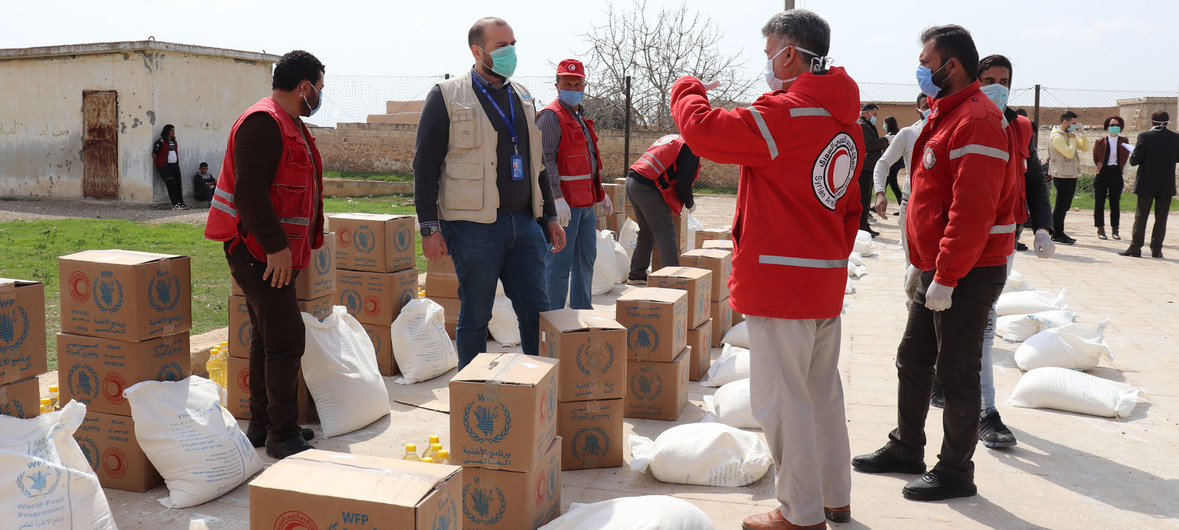


WFP/Khudr Alissa

The World Food Programme is working with partner organization the Syrian Arab Red Crescent to distribute food to the most vulnerable people in Deir Hafer near Aleppo, and to ensure they are aware of COVID-19.

Africa most vulnerable

Africa accounts for the majority of the almost 212 million people in the world who are chronically food insecure and the 95 million who live amidst acute food insecurity, the report noted.

Ms. Byrs added that labour shortages could disrupt the production and processing of labour-intensive crops in particularly, especially in vulnerable countries in sub-Saharan Africa.

Other potential sources of disruption include blockages along transport routes – a particular concern for fresh produce – and quarantine measures that could impede farmers’ access to markets, he explained.

Going forward, the WFP report said that it is essential to monitor food prices and markets, and to transparently disseminate information – thus helping to strengthen government policies while also averting public panic, and social unrest.

It added that in places where food insecurity is caused by restricted access, rather than lack of availability, cash-based transfers – which can often be made through contactless solutions – should be considered as a standard response.

“Planning in-kind food assistance is essential”, the report continued, noting that supply chain disruptions are likely to affect higher-value items first.  Such items involve more tiers of suppliers, human interaction and dependency on few suppliers – putting specialized nutritious food more at risk than staples.

usscmc

usscmc

No Result
View All Result

Recent Posts

  • How Hapag Lloyd captured a major market share in the Container Shipping Industry in USA
  • Why USA’s East Coast is the Favorite Destination for Manufacturing Companies
  • How Trade Relations Between the USA and UK Improved After Keir Starmer Became Prime Minister
  • Tips and Tricks for Procurement Managers to Handle Their Supplier Woes
  • The Crazy Supply Chain of Walmart Spanning Across the Globe

Recent Comments

  • Top 5 Supply Chain Certifications that are in high demand | Top 5 Certifications on Top 5 Globally Recognized Supply Chain Certifications
  • 3 Best Procurement Certifications that are most valuable | Procurement Newz on Top 5 Globally Recognized Supply Chain Certifications

Archives

  • July 2024
  • June 2024
  • May 2024
  • April 2024
  • March 2024
  • February 2024
  • January 2024
  • December 2023
  • November 2023
  • October 2023
  • September 2023
  • August 2023
  • July 2023
  • June 2023
  • May 2023
  • April 2023
  • March 2023
  • February 2023
  • January 2023
  • December 2022
  • November 2022
  • October 2022
  • September 2022
  • August 2022
  • July 2022
  • June 2022
  • May 2022
  • April 2022
  • March 2022
  • February 2022
  • January 2022
  • December 2021
  • November 2021
  • October 2021
  • September 2021
  • August 2021
  • July 2021
  • June 2021
  • May 2021
  • April 2021
  • March 2021
  • February 2021
  • January 2021
  • December 2020
  • November 2020
  • October 2020
  • September 2020
  • August 2020
  • July 2020
  • June 2020
  • May 2020
  • April 2020
  • March 2020
  • February 2020
  • January 2020
  • December 2019
  • November 2019
  • September 2019

Categories

  • Global News
  • Supply Chain Updates

Meta

  • Log in
  • Entries feed
  • Comments feed
  • WordPress.org
  • Antispam
  • Contact Us
  • Disclaimer
  • Home
  • Privacy Policy
  • Terms of Use

© 2025 www.usscmc.com

This website uses cookies to improve your experience. We'll assume you're ok with this, but you can opt-out if you wish. Cookie settingsACCEPT
Privacy & Cookies Policy

Privacy Overview

This website uses cookies to improve your experience while you navigate through the website. Out of these cookies, the cookies that are categorized as necessary are stored on your browser as they are essential for the working of basic functionalities of the website. We also use third-party cookies that help us analyze and understand how you use this website. These cookies will be stored in your browser only with your consent. You also have the option to opt-out of these cookies. But opting out of some of these cookies may have an effect on your browsing experience.
Necessary
Always Enabled
Necessary cookies are absolutely essential for the website to function properly. This category only includes cookies that ensures basic functionalities and security features of the website. These cookies do not store any personal information.
Non-necessary
Any cookies that may not be particularly necessary for the website to function and is used specifically to collect user personal data via analytics, ads, other embedded contents are termed as non-necessary cookies. It is mandatory to procure user consent prior to running these cookies on your website.
SAVE & ACCEPT
No Result
View All Result
  • Home
  • Supply Chain Updates
  • Global News
  • Contact Us

© 2025 www.usscmc.com