

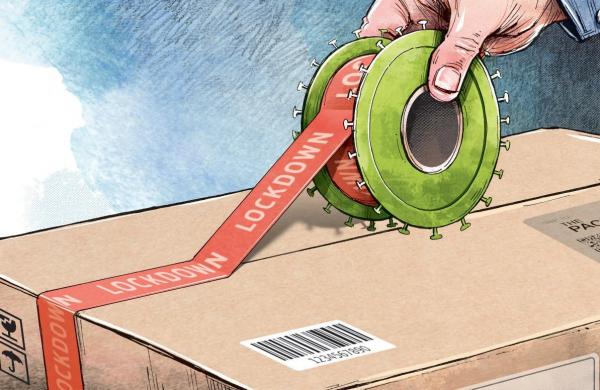

The coronavirus pandemic is forcing Indian manufacturers to re-examine their supply chain assumptions. The supply chain strategy that made the most sense in pre-Covid-19 days no longer seems particularly smart.
Whether it is a big manufacturer or a small one, the basic theory of supply chain management over the past three decades focused on two goals. The first objective was to find a supplier who offered the best combination of price, reliability and quality to the original equipment manufacturer .
The second requirement was to work out the most efficient logistics so that the bare minimum raw material inventory could be maintained. An entire consulting industry grew to help manufacturers implement just-in-time inventory management. The basic idea has been to squeeze out all excess cost and inefficiency from the system.
For a vast number of manufacturers in India (and around the globe), the most reliable supplier of cheap and acceptable quality components or inputs has invariably been some company in China. From mobile phone companies to drug makers and from television manufacturers to toy sellers, too many Indian companies put the bulk of their component eggs in the Chinese basket.
The just-in-time inventory concept also meant that they held the bare minimum quantity of components and other inputs/raw materials in their premises or warehouses. While this is excellent for cash flow management—after all, idle inventory ties up a lot of cash that could be used elsewhere—it also ensured that any disruption to the supply chain would bring manufacturing to a grinding halt.
That is pretty much what started happening by the second week of March. First, the shutdown of Wuhan and the Hubei province put a spanner on all sorts of things—from APIs needed for pharmaceuticals to photoelectronic devices. It was not just the lockdown in Hubei. Beyond that, India’s lockdown announcement and lockdown announcements in different countries around the world also stymied cargo movement in ports and airports, quite apart from freight clearing and movement on highways. Global freight movement got affected as loading and unloading in docks became a problem.
During the national lockdown, some Indian factories got permission to continue operating at half or lower capacities because they were classified as makers of “essential products”. In general, food, hygiene and pharmaceutical companies got the nod to continue operating. However, unless the manufacturer was sourcing its inputs and components entirely from India, the factory could not resume.
This was one reason many pharmaceutical manufacturers, especially the smaller ones, could not work because they depended on APIs from China. One manufacturer of high-grade medical masks (N99) stopped work despite permissions because one of its filters was sourced from China. It was not just about importing critical components—sometimes even basic inputs were being imported by some companies because of the price and reliability offered by Chinese suppliers. Finding replacements at a short notice was impossible during the lockdown.
However, the supply chain disruption has not been limited to those who source inputs from China alone. Practically every company that depends on inputs from overseas has had to deal with supply chain disruption. Beyond that, even those depending on domestic inputs from multiple states have faced problems because, during the lockdown, each state has taken a different stance on what was allowed and what was not. Maharashtra and Gujarat allowed “essential goods” companies to be started early in the lockdown. But if they depended on any component or part from Andhra Pradesh, Assam or Telangana, they faced problems because these states enforced the lockdown far more stringently.
Consultants such as Bain & Co, McKinsey, PWC, KPMG and others have already started helping clients work on their supply chains to not only get back to full operations quickly but also build supply chain resilience for the future.
The steps include quickly working out alternate sources of supplies and building up an ecosystem of suppliers and partners who can help make up for shortfalls instead of being overly dependent on one supplier. For some big companies, it has also meant alternate manufacturing nodes. Others are contemplating the pros and cons of maintaining a slightly higher level of raw material inventory despite the costs involved.
Prime Minister Narendra Modi has often talked about India becoming a big manufacturing hub that can supply the world. While that requires systematic policy changes and long-term planning, the coronavirus pandemic could help in forcing big Indian manufacturers to look at sourcing more components from within the country than they did earlier. The Indian automobile industry has successfully shown that it can depend on Indian auto component makers. There is no reason why other industries cannot look at the domestic option afresh. And if they cannot find Indian sources, most medium and large companies will now be forced to look for alternate suppliers in countries like Vietnam, Korea and Taiwan among others to de-risk their supply chains.
Companies with financial muscle may go a step further. Over the past decade, a few companies have been strategically picking up a stake in some critical component makers. This is a worldwide trend. In the future, this is likely to accelerate as companies rush to protect their manufacturing productivity from global risks.
Prosenjit Datta
Senior business journalist
(Email: [email protected])
Recent Comments