

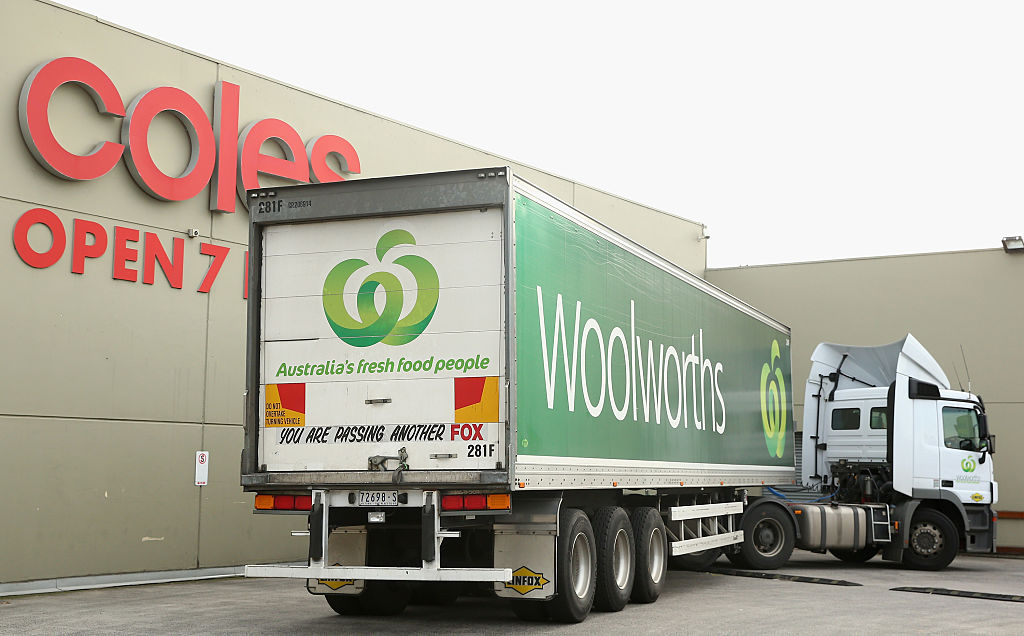

In 2016, over 500 National Union of Workers (NUW) members at Polar Fresh — the major cold storage distribution warehouse for Australia’s largest supermarket, Coles — went on strike. The strike made use of secondary boycott tactics, drawing on the solidarity of other warehouse workers to ensure that the supermarket giant couldn’t outsource the work to others.
Conspicuous gaps quickly appeared on Coles shelves across Victoria and beyond. In three days of striking, the workers secured victory. In a dramatic backdown, Polar Fresh was forced to create 120 new, secure jobs while also granting workers employed indirectly by labor-hire agencies the right to convert to directly employed, permanent positions. A year on, and with no jobs lost, the number of casual workers at the warehouse has fallen from 170 to 30. Paid breaks, registered days off, double pay for any overtime beyond two hours, and a pay raise of $4 per hour over four years were also won.
Bosses at Coles and Polar Fresh were incensed by the strike — and they weren’t the only ones. The state’s peak body for agribusiness, the Victorian Farmers Federation, also condemned the strike. Its members were outraged at the thought of their produce rotting in trucks while workers blockaded cold storage facilities across Melbourne.
The NUW had made the decision twelve months earlier to organize farm workers throughout Australia. The horticulture industry was long overdue for such a drive and, moreover, the prospect of farmworker unionization raised the possibility of covering horticulture, dairy, and poultry — from farming to processing, warehousing, and distribution — under a single union. If one union were able to organize the whole supply chain, its workers could wield enormous industrial power. After all, the workers at Polar Fresh caused chaos simply by shutting down Coles’s cold storage facilities. Imagine what workers uniting across the entire fresh-food supply chain could do.
The recent amalgamation of the NUW and United Voice (which covered hospitality, among other industries) into the new United Workers Union (UWU) is seeking to forge these lines of solidarity.
All the right groups have had their feathers ruffled, not least of all because the horticulture industry has been culpable for creating some of the most exploitative and oppressive conditions in Australia. This is beginning to change.
You don’t have to dig deep to discover the atrocious conditions that prevail in Australia’s horticultural industry, which supplies the country’s two largest retailers, Coles and Woolworths.
Although the legal minimum wage in the industry is $24.36 an hour, highly experienced and skilled workers commonly earn as little as $12–14 an hour; new workers survive on as little as $5–10 per hour. The contractors who supply these farms with workers often use piece rates to mask just how low the pay is.
Farms typically pay contractors by check for the fulfillment of an order or for clearing a block of grapes, an orchard of apples, or a field of asparagus. Contractors, whose businesses are usually established on the back of dishonest accounting, then use informal networks to gather a day-to-day workforce. These workers are usually paid in cash, once a week, in a brown paper envelope. In many farms, multiple layers of subcontracting puts vast distances between the farm or corporate aggregator who supplies the supermarket from the worker who picks the fruit or vegetables.
Farmworkers are like the Uber drivers of the countryside. As day laborers, they are required to provide their own drinking water, uniforms, and tools. A lack of amenities forces most to go to the toilet in the field. If injured, workers have to look after themselves: state-funded WorkCover insurance is practically unheard of in the informal economy. Workplace laws won by unions and workers over the last hundred years simply do not exist in Australian farms.
Indeed, the terms of employment on farms are reminiscent of indentured labor. Workers are usually forced into employer-owned accommodation and transport, and rather than obtain their own food, they are required to pay a food bond.
The fruit-growing region of Sunraysia is an epicenter of exploitation. When the NUW began making inroads there in 2017, workers in Shepparton (a nearby regional center) reported some of the worst housing conditions in the country. In one case, the union met with fifteen men sharing a three-bedroom house. In the middle of winter, a sign read: “do not turn the heater on or risk eviction.” Asbestos walls were visibly crumbling, and rodents and cockroaches scurried through the house. A vile smell confirmed the obvious: the house was unfit for human habitation.
As a condition of their employment, these workers had been obliged to rent the house — and at exorbitant rents — which was owned by the contractor. Despite hating the place, the workers dared not leave for fear of losing their job and risking deeper poverty or deportation.
The 100,000 workers picking and packing fruit throughout Australia are primarily migrants from Southeast Asia and the Pacific. Permanent workers on structured visa programs are a minority; around three quarters of all farm workers are either temporary visa holders or hold no valid work visa at all. It is estimated that as many as half the overall industry is undocumented.
For most, their jobs are arranged while still in their home country. This way, when they arrive in Australia, they have no networks aside from their contractor. This also leaves workers vulnerable to wage theft.
This is what union member Danial Jalil experienced when he first arrived in Australia. Living on less than $100 a week, Danial survived by fishing in the Murray River each night alongside his workmates. One day, he and his friends returned home to discover their passports, a laptop, and other electrical goods had been stolen. The workers were particularly shocked when their contractor turned up with a group of youths and told them he had “negotiated” with them to return the passports for the price of $500 each. With little other choice, Danial and his coworkers paid up.
In these conditions, abuse is rife. In the Sunraysia region, the union met with a Malaysian woman in her thirties who spoke no English. Aira Firdaus, an NUW organizer fluent in Bahasa Melayu, translated her story. This worker told the union about a farmer in Robinvale who raped her behind a row of vines while workers picked grapes just meters away.
The owner of the farm, accompanied by her contractor, had simply walked over to her, picked her out from the group, and demanded she accompany him behind the nearby vine. As an undocumented worker, she saw no way to report the assault.
Organizing temporary migrant workers is undoubtedly a challenge — and one that is sadly shirked by many unions. However, after making contact with Ni-Vanuatuan tomato pickers in Guyra, the NUW/UWU has begun to tackle the problem head on. Thanks to the efforts of Samson, a long-term union activist with the Vanuatu National Workers Union (VNWU), as well as the union’s head, Ephraim Kalsakau, a partnership was brokered. Now in its fourth year, the agreement organizes transitory workers from Vanuatu as members of both unions.
The relationship was solidified in early 2017 when, in the space of one night, 150 Nivans working in a tomato greenhouse in Adelaide joined the union. When their employer threatened to fire them if they refused to leave the union, they stood firm, winning better rights than any other seasonal workers in Australia, including the automatic right to return every season.
The NUW/UWU and VNWU have since worked together on a number of important campaigns. As fights often don’t conclude before the end of a season, when workers return to Vanuatu, this relationship is crucial. In 2018 and 2019, you could often look under the tree at the VNWU office in Port Vila and see groups of seasonal workers speaking in Bislama with local VNWU organizers while their Australian organizers joined the meeting via phone amplified by loudspeaker.
These initiatives are all the more vital in the context of the history of blackbirding, a practice that saw over 60,000 workers from Vanuatu, the Solomon Islands, Fiji, Papua New Guinea, Tuvalu, Kiribati, and the Loyalty Islands kidnapped and brought to Australia to work on plantations in Queensland. Thousands of these workers died and were left in unmarked graves.
Ni-Vanuatuan seasonal workers have endured terrible treatment in the years since. After the 1901 adoption of the White Australia policy — the racist set of immigration policies designed to lock Asian and Pacific Islanders out of the Australian workforce — these workers, as well as those who had survived blackbirding, were forcibly deported. The memory of this tragic history motivates the fight against the return of such conditions today.
As well as being dehumanizing, the combination of exploitation, oppression, and precariousness is also potentially explosive. Without traditional support networks, these workers have been pushed to organize. Without a visa, you can’t use the courts to tackle wage theft or mistreatment: this pushes workers to collective power.
Workers in tomato greenhouses and mixed vegetable farms around East Gippsland, Cranbourne, and the Mornington Peninsula in Victoria and the northern suburbs of Adelaide were among the first to organize. They threatened to publicly expose their mistreatment through the mainstream media and, in so doing, tarnish the brands of Coles and Woolworths.
This was enough to intimidate farmers — who feared losing their contracts with these major supermarkets — into capitulation. A workforce made up of Vietnamese, Cambodian, Hazara, Nepalese, Rohingyan, Taiwanese, and Malaysian migrants won an overnight increase of $10 an hour. In addition to reclaiming a percentage of stolen wages, the win built the first sustainable union structures in Australian farms in living memory.
This gave many workers the confidence to transform their vulnerabilities into weapons and to speak of their victories with their own voices, in their own languages.
For example, union member Anh Nguyen came from Vietnam to Australia to work at a lettuce and herb farm in Pearcedale. He experienced wage theft and was exposed to dangerous chemicals without protection. Standing up alongside his workmates won them not only a $10-per-hour wage increase, but also a collective agreement, secure jobs, and union recognition.
Anh described the victory like this:
The union gave us confidence that our workplaces needed us more than we needed them. Workers began to listen to us delegates and stand up to our bosses. One day, my management were instructing our quality assurance workers to pour chemical products on the lettuce while we were working. We could feel our eyes sting, our throats burn, and we were even vomiting. I decided enough was enough, I went around to ask . . . my workmates to walk off the job. Then I walked to the middle of the packing shed and shouted, “Everyone out!” The workers followed me to the lunchroom, and the scared manager meekly asked if we would come back to work as normal. I told him if he ever poured chemicals while workers were in the room again, he could expect the same. We will come back to work if there is no harm to our health. We worked out a system to protect our health and safety that day, and four years on, the company still respects the right of our union delegates to decide when it is safe to return to the packing shed after chemicals are poured. This experience showed me that the power to create a permanent change has to come from us and through our collective actions.
Alongside union support, these victories also build the confidence needed to stand up against intimidation. In Sunraysia earlier this year, a contractor owed a group of Malaysian and Fijian workers over $4,000 in unpaid wages. Union organizers had previously accompanied the workplace leader Babra to meet the contractor at his house, forcing him to back down and pay what was owed. This time, Babra decided she could do it alone, and she took four of her undocumented workmates with her to another contractor’s house. Although the contractor pulled a knife on the workers, they held their nerve and left the house with the money they were owed.
As she later explained to a conference of union delegates:
When we first came here, we felt like victims, moving from one exploitative contract employment relationship to the next, but being members of the union gave us the confidence that if we stuck together and demanded what was ours, then the contractors were just people, too, and even those with knives and reputations weren’t as tough when approached by a group of workers rather than an individual worker.
In just four years of actively organizing farm workers, members of the NUW/UWU have gained some big wins. Yet the sheer scale of the exploitation in the industry means that the fight back often takes place just one region or one site at a time. This, too, is set to change.
These organizing efforts have brought farmworker exploitation to national attention. In 2015, Australia’s national broadcaster, the ABC, aired an episode of Four Corners focusing on exploitation in the Coles and Woolworths supply chains. This gave workers at the Covino Farms in Sale (Victoria) and Perfection Fresh in Two Wells (South Australia) a national platform with which to talk about exploitation and harassment in the industry. In turn, this helped to pressure state governments into announcing new laws restricting labor-hire licensing, as well as outlawing unscrupulous contractors.
The November 2019 merger of the NUW and United Voice into the UWU builds on this success. While the NUW organized workers on site, the UWU is in a position to bypass farmers to pressure the major supermarkets at the apex of the supply chain. A key demand is for Coles and Woolworths to require their suppliers to meet “prequalification” criteria, ensuring union induction and establishing a grievance procedure.
This also opens new scope for organizing workers across regions and sectors. Last month, the union brought delegates together in Melbourne for a training session. Sixty delegates from twelve countries and seven regions of Australia drove or flew to attend. After one delegate who works at a lettuce farm in Bairnsdale, was fired for attending, the assembled workers made a decision to protest a busy Coles store in the central business district. The delegates marched from the union office holding banners in many languages and chanting, “We feed you, we pick your fruit, we are not slaves.”
Elsewhere around the country, more than a thousand farmworkers attended forums this year, including in Robinvale (Victoria), Shepparton (Victoria), Springvale (Victoria) and Elizabeth (South Australia). At these forums, workers confronted representatives from Coles, Woolworths, and the Victorian Labour Hire Authority, as well as their major institutional investors, about the brutal treatment they receive from farmers and contractors when they join the union. More recently, they joined workers from the Polar Fresh cold storage distribution center (now directly owned by Coles) at the company’s annual general meeting. There, workers pressured Coles to both recognize the union and to give workers a voice in their supply chain.
In the late nineteenth century, the Australian workers’ movement was transformed by syndicalists who overcame the antiquated craft union model in order to organize whole industries. The organization of the whole food supply chain forms a new chapter in this history.
Recent Comments