


A nest of genetically-engineered mice, a research study to observe the behavior of fires in space, and an experiment that could lead to brewing beer in microgravity are among more than 5,700 pounds of cargo inside a SpaceX Dragon capsule awaiting launch from Cape Canaveral to the International Space Station Wednesday.
Scientists will use the mice to study an experimental drug that could combat muscle and bone loss in astronauts and other vulnerable populations.
Eight of the 40 mice launching to the space station have been genetically-engineered to lack myostatin, a protein that acts to limit muscle growth in animals. The muscle-bound, myostatin-free mice — or “mighty mice” — will be joined by four other groups of rodents, including groups that will be given an experimental drug in space to block myostatin activity and promote muscle growth.
All 40 mice will return to Earth alive on the Dragon capsule in early January. Scientists will administer the same myostatin protein blocker to some of the mice after they are back on the ground to assess how the drug affects their rate of recovery.
“The focus of this project is going to be to determine whether getting rid of myostatin in mice that we send to the International Space Station can prevent, or at least mitigate, the loss of muscle due to microgravity,” said Se-Jin Lee, professor at the Jackson Laboratory and University of Connecticut School of Medicine, and principal investigator for the rodent research experiment.
The drug trial to be administered to the mice on the space station also inhibits activin, a protein that regulates bone mass.
“By blocking activin with this drug, bone density increases significantly,” said Emily Germain-Lee, a co-investigator on the experiment and professor at University of Connecticut School of Medicine. “And as you probably know, astronauts who spend a lot of time in space lose not only muscle mass, but also bone mass.
“Anything that can be done to prevent muscle and bone loss would be very important to maintaining the health of astronauts during space travel,” Germain-Lee said. “But … loss of bone mass is also a huge health problem for people here on Earth. There are actually lots of diseases that lead to bone loss in both children and adults. And, of course, osteoporosis is a big health issue for people who are elderly or bedridden.
“By testing this experimental drug in life subjected to microgravity, we hope to be able to test the therapeutic strategies for combating both the bone loss and muscle loss that occur in lots of different conditions,” Germain-Lee said.
The resupply launch Wednesday will signal the start of SpaceX’s 19th cargo mission to the space station, ferrying more than a ton of experiment hardware inside the pressurized compartment of the company’s Dragon spacecraft. The supply ship will also launch with provisions for the space station’s six-person crew, spare parts, tools, an ultra-sensitive Japanese Earth-imaging camera, and a flock of small tech demo CubeSats.
SpaceX ground teams were loading time-critical payloads late Tuesday into the Dragon capsule mounted to the Falcon 9 rocket at Cape Canaveral’s Complex 40 launch pad. Technicians planned to close the Dragon spacecraft’s hatch and raise the 213-foot-tall (65-meter) launcher vertical at pad 40 before dawn Wednesday.
The Falcon 9 will be filled with super-chilled kerosene and liquid oxygen propellants beginning 35 minutes before liftoff. The countdown clock will tick down to a precise launch time of 12:51:58 p.m. EST (1751:58 GMT), roughly the moment the Earth’s rotation brings the Falcon 9 launch pad under the space station’s ground track.
Nine Merlin engines will drive the Falcon 9 northeast from Florida’s Space Coast. The 12-foot-diameter (3.7-meter) first stage will accelerate the rocket for two-and-a-half minutes before shutdown and separation.
The Falcon 9’s second stage will fire a single Merlin engine to power the rocket into orbit. Meanwhile, the first stage will perform a series of burns using a subset of its engines to slow down for landing on SpaceX’s drone ship parked in the Atlantic Ocean around 210 miles (340 kilometers) east of Jacksonville, Florida.
The Falcon 9 booster — a brand new vehicle in SpaceX’s rocket fleet — will aim to land on the ocean-going drone ship less than eight minutes after liftoff. Less than a minute later, the upper stage will inject the Dragon supply ship into orbit, setting the stage for deployment of the station-bound cargo capsule at T+plus 9 minutes, 35 seconds.
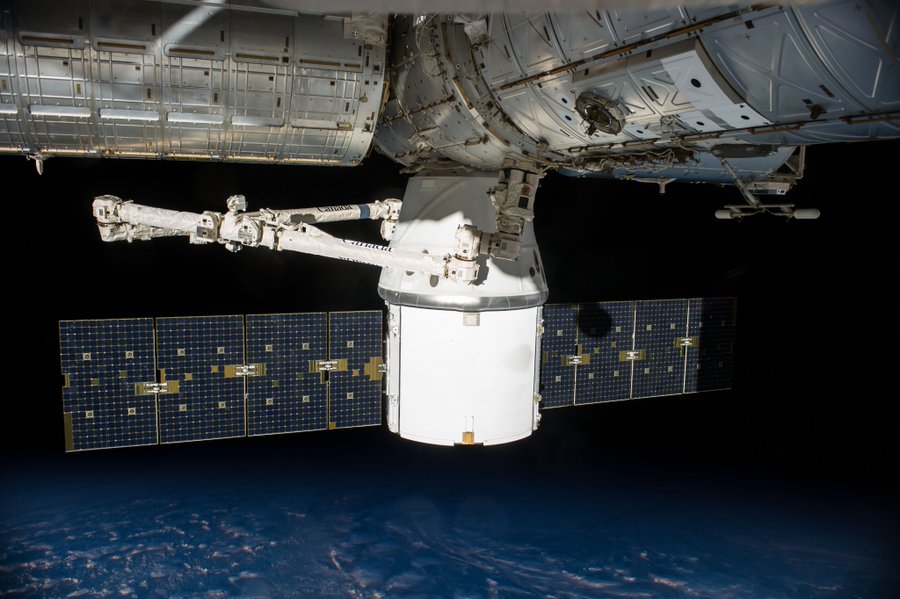
The Dragon will unfurl its solar panels a few minutes later, prime its propulsion system, and begin a choreographed sequence of thruster firings to approach the space station. The cargo freighter will arrive at the station early Saturday, assuming an on-time launch Wednesday.
Italian astronaut Luca Parmitano and NASA flight engineer Drew Morgan will man the space station’s Canadian-built robot arm to capture the Dragon supply ship Saturday. The robotic arm will position the Dragon spacecraft on the station’s Harmony module, where astronauts will open hatches and begin unpacking the cargo inside the supply ship’s internal compartment.
The Dragon cargo capsule set for launch Wednesday will make its third voyage to the space station, following two previous round-trip flights in 2014 and 2017.
Here is a break-down of the Dragon spacecraft’s 5,769-pound (2,617-kilogram) supply load. The figures below do not include the mass of cargo packaging, which is included in NASA’s overall payload mass:
- Science Investigations: 2,154 pounds (977 kilograms)
- Vehicle Hardware: 675 pounds (306 kilograms)
- Crew Supplies: 564 pounds (256 kilograms)
- Spacewalk Equipment: 141 pounds (65 kilograms)
- Computer Resources: 33 pounds (15 kilograms)
- Unpressurized Payloads: 2,037 pounds (924 kilograms)
The Dragon spacecraft will carry an experiment for Anheuser-Busch to test the malting ability of barley seeds in microgravity. The company eventually wants to brew beer in space.
Gary Hanning, director of global barley research at Anheuser-Busch, said the company’s malting experiment is the third in a series of investigations looking at how the environment of space affects brewing processes.”
“This series has been constructed to look at the impact of space environment on the germination process of barley,” Hanning said. “So the germination processes is taking seed and creating the new plant from that, and so that’s a very key step in the life cycle of any plant, and particularly important to malting barley. So much of our research on earth is focused on seed germination and the environmental impacts that would affect seed germination, as well as physiological effects.”
Hanning said Anheuser-Busch’s experiments in space have given the company’s research team a new perspective.
“From our previous studies on the space station, we’ve noted that the gene expression — that’s the genes that are turned on or turned off and to what degree — are different on the space station then they are on Earth,” he said. “We think it’s a response to the stress, because it’s an abnormal environment, so there’s a stress related there. So ogene expression is a part of that cascade of events as part of germination.”
The experiment launching on SpaceX’s next cargo mission will look at hardware solutions to support barley malting on the space station.
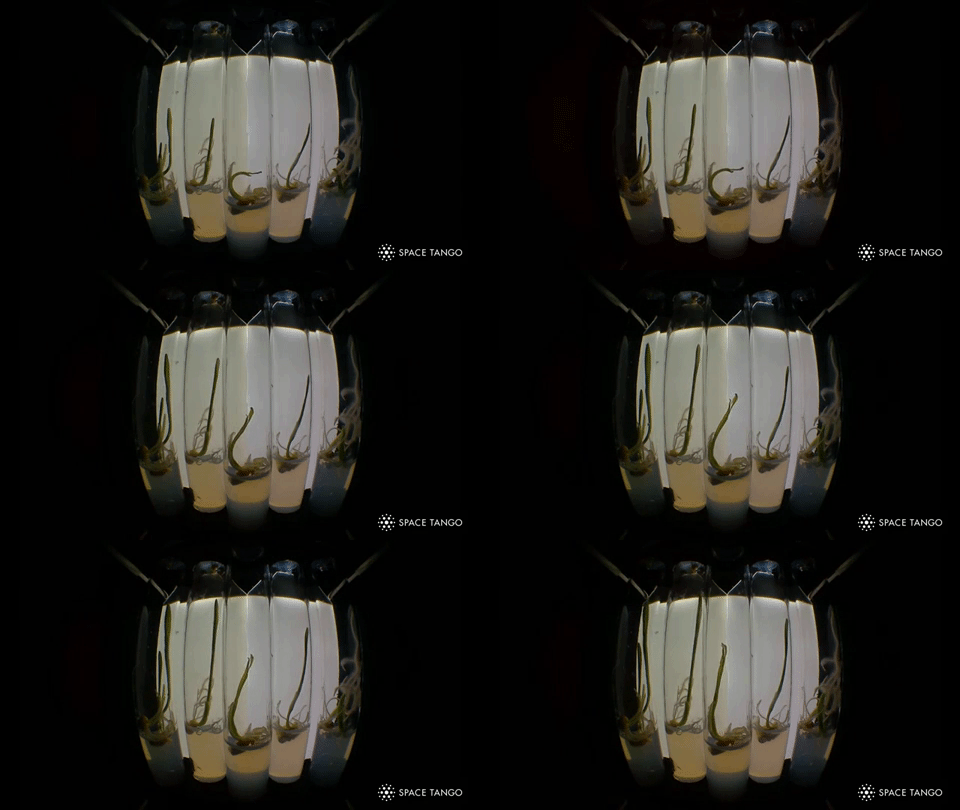
“Malting is basically a biological process,” Hanning said. “It is to convert barley into a product called malt, which is used in a lot of food and beverage applications. Malting is actually a three-step process,” he added, beginning with the steeping, or hydration, of barley grains, followed by germination and drying.
The Anheuser-Busch experiment will launch with just 2.5 ounces (70 grams) of barley grains, separated into two units.
Another research payload aboard the Dragon spacecraft will allow scientists to observe flame behavior in confined spaces in microgravity. The combustion package includes solid fuel samples that will be ignited inside a protective enclosure on the space station.
“We want to study how solid materials burn in different confined conditions, and how fire interacts with its immediate surroundings,” said Ya-Ting Liao, a professor of mechanical and aerospace engineering at Case Western Reserve University.
“It turns out this is a very hands-on experiment,” said Paul Ferkul, an investigator on the confined combustion experiment. “We’re talking with the astronaut, we’re interacting with him, we’re telling him what to do, how to set the parameters. And he, in turn, tells us how it’s looking, what he’s experiencing, and the astronauts are very glad to do this.
“It’s way outside their usual routine on the space station, so that helps us a lot because they’re enthusiastic for our work, and they make very good investigators because of that.”
The Dragon capsule’s external cargo bay is loaded with a Japanese Earth-imaging instrument with high spectral sensitivity. The Hyperspectral Imager Suite, or HISUI, instrument will image Earth’s surface in 185 spectral bands, allowing scientists to distinguish between the composition and type of a range of vegetation, soil, rocks, snow, ice, and human-made objects like buildings, roads and other structures.
Using the robotic arm, the HISUI instrument will be mounted to a fixture outside the station’s Japanese Kibo lab module. It’s a follow-up to the Japanese-developed ASTER instrument on NASA’s Terra satellite, which launched in 1999.
A new lithium-ion battery for the space station’s solar array truss is also stowed inside the Dragon capsule’s unpressurized trunk. It will replace a battery flown to the station by a Japanese HTV cargo ship last year.
That battery was damaged by an electrical short soon after it was installed on a spacewalk.
Other equipment slated for delivery to the space station include a robotic tool stowage platform to store leak detectors outside the space station, and upgrades to allow scientists to make subtle measurements of gravity using the Cold Atom Laboratory, a research facility inside the orbiting lab.
Several CubeSats are also flying inside the Dragon capsule, including the first nanosatellite built in Mexico to deploy from the space station.
Email the author.
Follow Stephen Clark on Twitter: @StephenClark1.
Recent Comments