


From the deployment of digital twins that replicate critical rail assets and improve train timetabling, to improved, condition-based maintenance using the industrial internet of things (IIoT), modern rail networks increasingly employ disruptive digital solutions in an effort to drive safety and efficiency.
However, sometimes a simple lick of paint is all that’s required, as German rail company Deutsche Bahn (DB) is demonstrating with a project aimed at tackling the problem of overheating rails during heatwaves.
During intense summers exacerbated by climate change, conventional rails absorb heat and the steel expands, causing stress on both the rails and trackbed. DB’s solution involved painting around 1km of the rail track on the high-speed line between Hanover and Würzburg’s with an environmentally friendly white paint in order to reflect the sun rays, and reduce overheating and rail deformation.
“Currently, we are testing a water-based emulsion paint, the same paint the Italian railway is using,” a DB spokeswoman tells Future Rail. “Due to its white colour and its specific pigmentation, the painted rail has a higher reflectance and lower heat absorption than a normal (brownish) rail.
“Our tests indicate a temperature reduction of up to -7 Kelvin compared to normal conditions.”
Stroke of genius: initial experiments and colour hardness testing
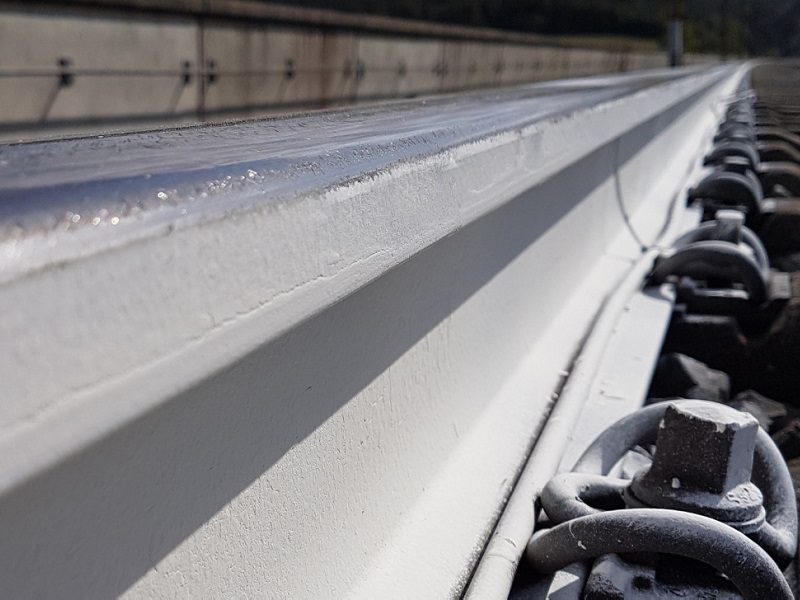
Direct exposure to sun during the intense summer months can increase track temperatures to as much as 55°C, especially if there is no cooling during the night. If these temperatures persist for longer periods, rails can be placed under high stresses that can exceed the strength of the material.
The German Government takes the problem seriously. To prevent steel expansion during summer, rails are welded at temperature of 23°C. Additionally, rail inspections before and during heatwaves are intensified to monitor safety and ensure that track engineering work complies with regulations.
DB pursued the idea of painting rails white after promising results from an experiment to evaluate the effect of the white paint on a test track at Königsborn, which began in July. The rails were shown to reflect more light and therefore become much less hot than their conventional counterparts.
“Due to its white colour and its specific pigmentation, the painted rail has a higher reflectance and lower heat absorption than a normal rail.”
DB then painted the high-speed Hanover-Würzburg line in order to investigate the paint’s durability and wear properties, as well as its application over longer distances. Following the results of the project during the course of a year, DB will possibly look to extend it to other routes in the country.
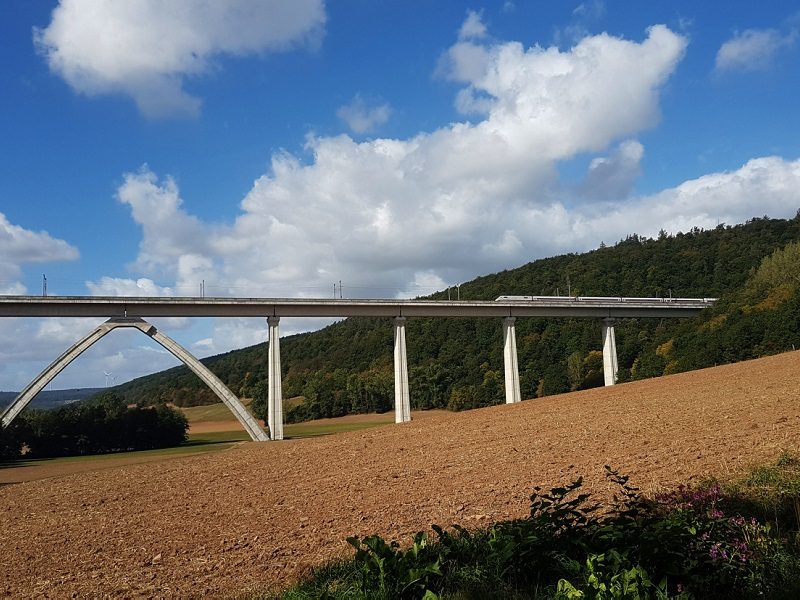
Further ‘colour hardness testing’ is currently taking place at Pfieffetalbrücke bridge near Melsungen in central Germany. The 61m-high and 14m-wide concrete bridge is considered to be ideal as the track is exposed to high levels of solar radiation all year round and has a high frequency of trains.
“By testing the white paint on the Pfieffetalbrücke, we aim to understand the durability of the painting under changing weathering conditions and under constant traffic,” explains the DB spokeswoman. “For that, the colour intensity and thickness has been measured and photographed in regular time steps since September 2019, and the final results will be evaluated in mid-2020.”
DB painted one track in the area of the bridge white, while the other was left in its existing form, allowing for a direct comparison between the temperatures measured in the steel of both lines.
Mutually beneficial: investing in expertise and data sharing
In addition to testing the efficacy of the white paint, DB has set up a special working group comprising a geography professor, two certified foresters and a water management engineer, as part of its new natural hazard management framework. They have been tasked with making the rail network, railway stations and technology robust enough to meet future challenges posed by climate change.
“Our tests indicate a temperature reduction of up to -7 Kelvin compared to normal conditions.”
“For this purpose, past events and incidents are analysed, and counter and preventive measures are developed on the basis of the results,” says the DB spokeswoman.
“The experts use digital aerial photography or forecast values based on satellite-based methods and geo-information systems, and inspections or faults are documented. Using all this data, learning systems can identify priority areas.”
DB also places an emphasis on industry-wide collaboration, organising exchanges between European railways and specialists such as infrastructure managers, as well as integrating “external knowledge about start-up companies or cooperations with institutes from science and technology”.
Future proof: Deutsche Bahn’s Strong Rail strategy
DB is also investing in bionics – using biological methods and systems found in nature to inform modern technology and engineering – aimed at counteracting the effects of heat on infrastructure.
For example, in a pilot study based on the cooling principle of a cactus, DB equipped a concrete switchboard with a kind of corrugated board, reducing indoor temperature by an average of 7°C.
“This works by changing the shadow and sun sides, which naturally create a cooling air circulation,” the DB spokeswomen explains. “Thanks to the good results, it is now being examined whether the idea for retrofitting older concrete switchboards is generally efficient.”
“DB is also investing in bionics aimed at counteracting the effects of heat on infrastructure.”
“Also for cooling, DB is testing the use of an innovative material called aerogel, which can insulate two to three times better than insulating materials made of styrofoam (EPS).
“Since the pores of the aerogel are only a few nanometres in size, the heat conduction, which takes place via the movement of the air molecules, is reduced. This means that a 10cm-thick layer of aerogel achieves the same result as a 25cm-thick EPS layer.”
The material can be used in many ways; for example, as granules, facade paint, nonwoven plates or plaster. One litre of this material weighs just 70g–100g, making it ten times lighter than water.
Other projects that form part of DB’s overarching ‘Strong Rail’ strategy include extensive vegetation management to make it more weatherproof, while in September, the operator inked a five-year deal with RWE’s 295MW Nordsee Ost wind farm offshore Germany for the supply of green electricity.
Recent Comments