

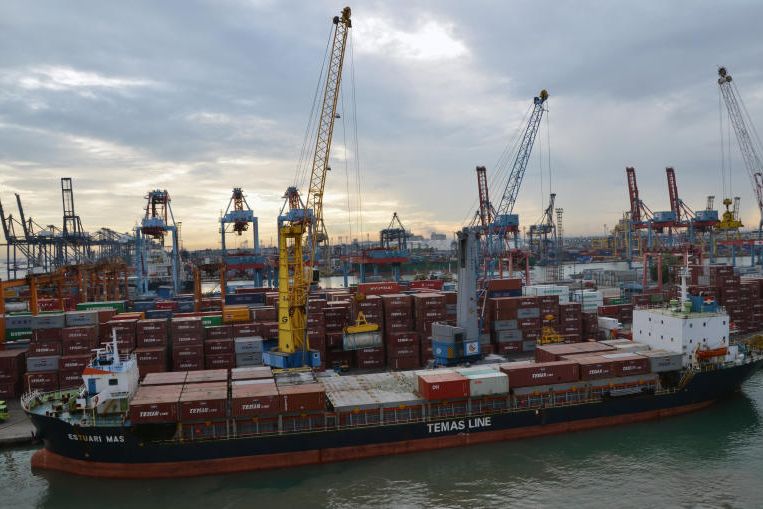

JAKARTA (THE JAKARTA POST/ASIA NEWS NETWORK) – The Indonesia shipping industry is abuzz with news that the Transportation Ministry intended to cooperate with a ride-hailing app to apply container shipping digitalisation into the app.
The aim is to simplify container shipments, make it transparent and to avoid monopolistic practices.
The government reportedly held an initial discussion with a ride-hailing app company regarding the idea.
What are the main problems with this idea and is it the right solution for the industry?
Although the idea sounds brilliant, the container shipment business is very complicated and involves multi-layers of stakeholders.
At least three problems with the idea are complicated stakeholder arrangement, punctuality and port infrastructure issues.
Processing a container to be shipped is not as simple as ordering a Gojek (motorcycle taxi) or food on an app.
There are at least six different types of stakeholders for consideration when shipping a container from one port to another.
There is the port authority, the port operator, the shipping agent, the harbormaster, customs and the shipper.
Nevertheless, a freight forwarder can handle the whole primary process. Also, if we want to ship cargo from a warehouse, the stakeholder structure becomes very complicated.
There is an addition of third-party logistics that provide the service to truck goods to/from the warehouse/final destination.
Each leg of the shipping process from one door to the destination door has a different period. It depends on the type of cargo.
For example, if shipping sensitive cargo (meat, dairy, chemical products), there is another examination stage involving the quarantine team of the Agriculture Ministry.
These are the various stakeholders that need to be considered for the future application designer. The future application planner should deal with the different parties that have different interests and authority.
The second issue is the punctuality of the service. We know that a ride-hailing app is created to fulfil our needs in the speed of services in both food and motorcycle pick up.
In terms of container shipments, it is quite challenging to order instantly and get your container delivered within the predicted time range.
In practice, our country continues to experience lengthy dwell times in the port. So it is more imperative to solve the current issues in the field through several steps.
The solutions are information alignment of different stakeholders in the port, deregulation of licensing procedures, fees for long-stay containers in ports and the application of “first come, first serve” for the ships.
Applying these solutions would lead to better efficiency in port services, rather than building an integrated app, which would require further discussion and lengthy administrative procedures.
Last, there is the problem of port infrastructure issues. This includes two types of infrastructure: hard and soft.
The hard infrastructure of a port (such as berths, draft, information technology system and handling equipment) should be uniform in dimension and specification nationwide to provide uniform services in the app.
It can be presumed that most ports in the eastern part of the country lack handling equipment in terms of quantity and quality, compared to infrastructure in the western part.
This results in longer service times in the eastern regions with higher costs due to the low capacity of berths and equipment. Also, an app requires stable electricity and data connections.
For the soft infrastructure, there is also a lack of human resources in the eastern regions to manage such an app.
An app would require updates on each shipping stage to be inputted by an administrator (the port operator, shipping agent, etc).
Training would be required to ensure updated and reliable data management for the app.
Once these three problems are solved, the main shipping issues in Indonesia could be solved.
The writer is the Maritime economics manager at Royal HaskoningDHV. The Jakarta Post is a member of The Straits Times media partner Asia News Network, an alliance of 24 news media organisations.
Recent Comments