

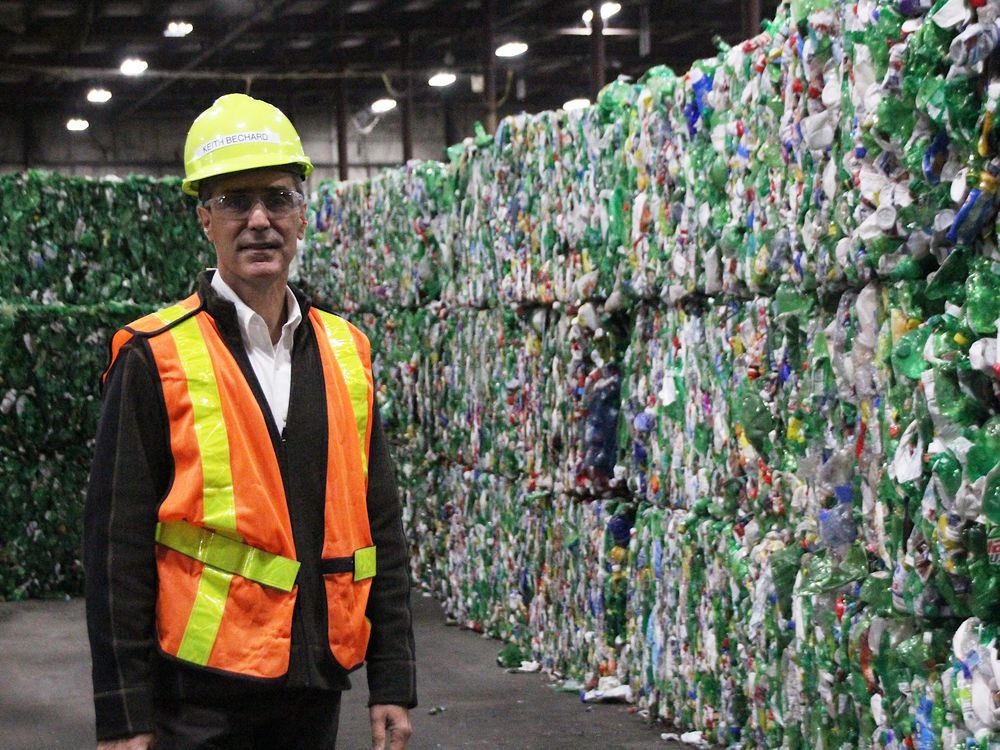

China’s sweeping ban on the world’s plastic waste – and a cash crunch from nosediving revenues – is forcing Southwestern Ontario’s municipalities and their partners to rework their approach to recycling.
But experts expect a couple of painful years in this region as more mills and sorting facilities open and improve capacity to catch up with the surge in demand, says Jay Stanford, London’s director of environmental programs.
The issue, he said, is the ripple effect of China’s “National Sword” ban in 2018, when the country, which had handled roughly half of the world’s recyclable waste, stopped accepting various plastics while requiring 99.5 per cent purity.
No paper mixed with plastic, no leftover food.
For years, mixed paper and plastic bales – often strewn with garbage – were sent to China, said Joe Hurska, the Canadian Plastics Industry Association’s vice-president of sustainability.
With the bulk of recyclables being shipped overseas, local processors, starved for supply, quickly dwindled, creating a vacuum across North America, he said
When China slammed shut its doors last year, and few local processors able to handle the material, many of the dirty bales from Southwestern Ontario began to be landfilled instead.
Given the increased costs and requirements for clean product and better sorting, “that’s where unfortunately materials are being redirected because it is … a cheaper management option always,” said Jo-Anne St. Godard, executive director of the Recycling Council of Ontario.
What’s left over has created a material overload for the few local recyclers that remain, Hurska added.
Since this handful of Ontario recyclers can afford to be picky amid a glut of supply, prices for bales of recycled material have plummeted, Stanford said. Once a source of revenue for municipalities, which used the cash to offset processing fees, the money is no longer there.
“What we call the basket of goods, the amount being paid for a tonne of recyclables … we’re closing in on between $85 and perhaps as low as $80 per tonne,” Hurska said.
Go back two years and that was closer to $120 per tonne, he said.
“That’s a ripple effect that’s impacting North American markets everywhere.”
This sharp drop in revenue – and often costlier contracts with Canadian processors facing the same market conditions – has forced Southwestern Ontario municipalities to change their approach.
Many have put tighter restrictions on what can actually be piled in blue boxes.
Earlier this year, Stratford put a recycling ban on certain hard-to-process items, including milk cartons, drink boxes, aluminum foil, and paint cans. At the same time, the city’s recycling contract more than doubled from $90 per tonne of collected material to $185.
The story is similar in Sarnia, which inked a new $7.73-million contract that began this past July while banning certain plastics. The new deal with Halton Recycling – a 30 per cent hike over the previous contract – is complicated by a $100,000 per year drop in the sale of recyclables.
“The whole industry itself learned from this experience that recycling is not waste and you can’t just accept anything and everything, mix it together and make it disappear,” said Francis Veilleux, president of the Bluewater Recycling Association, which bales the recycled materials from Stratford and other municipalities.
The current system in Stratford is working, added Veilleux, noting plans are to expand the list of acceptable recyclables as markets develop in the future. The city is also pushing residents to “reduce,” as well as reuse and recycle.
“A lot of people have forgotten, when you talk about the three Rs program, the first R was always reduce,” Ed Dujlovic, Stratford’s director of infrastructure, said earlier this year. “… There’s going to be a lot of (future) discussion about reducing the amount of materials, whether it be for landfill or for recycling.”
The Ontario government’s plan to completely shift blue-box liability to producers in 2020 – replacing a 50-50 split with municipalities – will also be a critical move in reducing waste, said Mike Chopowick, director of policy with the Ontario Waste Management Association.
“That means moving to a model where the companies that are manufacturing, producing and selling products, packaging and goods are doing so in a way that the products and packaging are easier to recycle – and that they contain more recycled content,” he said.
“Really that’s going to be the key to fixing the recycling problem in Ontario.”
It’s estimated 20 to 30 per cent of materials in blue boxes end up in landfill, he said, because the material isn’t accepted via the program or the recyclable material is too contaminated, like a pizza box covered with sauce.
About 70 per cent of the total waste stream ends up in landfill, he said.
“It’s an absolute fact at some point we’ll need more disposal capacity to handle that as well.”
As a response to the Chinese ban, more mills and recycling facilities are starting up in the U.S. to fill the vacuum, Stanford said, providing potential new markets for Southwestern Ontario’s recyclables.
That takes time though.
“That’s going to take a good couple of years to strengthen,” the environmental director said.
We may be at a tipping point where some materials just can’t be recycled anymore, added St. Godard, noting many flexible plastics from commercial and industrial sources are going straight to landfill because the market doesn’t exist to recycle them.
Places like ReVital in Sarnia – a processing facility that uses recyclables to make plastic used in auto parts – are the exception, she said.
“But I think generally the restrictions and prohibitions, combined with the diminishing landfill in Ontario, that combined pressure is really giving us pause to say, ‘What are we producing? What are we putting onto the marketplace? How are we consuming?’
“I think it’s a bigger picture here that I think we need to take stock of.”
Recent Comments