


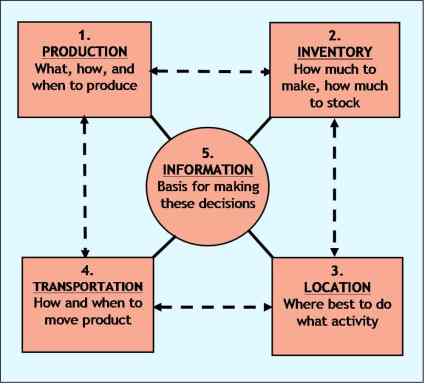
Third-party organizations that supply goods and services to a business are so commonplace these days that we often forget how crucial it is to have these suppliers effectively managed to optimize market performance. From the graphic, you see the actions involved in getting products to end-users but recognize that various parties contribute to these actions and getting everyone to work together involves more than simply ordering independent firms to do your bidding. Instead, you must gain cooperation, which isn’t easy, and employ effective communication to ensure seamless information flow between businesses. Today, we discuss the 5 pillars of effective supply chain management to guide you through the process of improving your supply chain and achieving improved market performance.
What is supply chain management?
Let’s start by understanding the definition of supply chain management. Although you’ll find various definitions online, they all look something like this:
Supply chain management (SCM) is the active management of supply chain activities to maximize customer value and achieve a sustainable competitive advantage. It represents a conscious effort by the supply chain firms to develop and run supply chains in the most effective & efficient ways possible. Supply chain activities cover everything from product development, sourcing, production, and logistics, as well as the information systems needed to coordinate these activities. [source]
So, who’s a part of a supply chain?
Well, everyone who provides a value-added product or service to a firm. We used to break up these actions into pieces, as you can see in the graphic below.

This movement from a fragmented approach to meeting customer demands for physical products resulted in massive inefficiencies, as firms did their own thing and as internal functional groups worked to optimize the performance of their own functions regardless of the performance as a whole. This fragmented approach met some coordination with the transformation to material management and physical distribution, which was later subsumed into logistics. However, today’s notion of supply chain management build a system to integrate the entire process from raw materials to products in the hands of users.
Hence, a firm’s supply chain includes firms providing raw materials and subassemblies, transportation, warehousing, retailing, and anyone else who touches anything related to the product.
Efficiency in the supply chain
An important aspect of almost every supply chain is the fact that members of the chain represent independent firms with their own goals and priorities. Also, just like every other chain, a supply chain is only as effective as its weakest link. Therefore, loading up on one raw material when there’s an insufficient supply of another represents waste as you must store and protect the plentiful raw material until needed based on the limiting factor of the other raw materials.
Instead, your goal is to match supply and demand to the greatest extent possible at the least total cost. For instance, if you optimize the production of your finished product ahead of demand, you must store finished goods, which ties up capital you might use for other business functions, such as expanding advertising to increase demand. You want to maximize the efficiency of the entire chain, rather than individual elements involved in the chain to achieve efficiency.
Supply chain management
As I hope you understand from the earlier sections of this post, supply chain management requires cooperation and collaboration, neither of which happens naturally. Instead, you must first build the right supply chain designed to achieve your goals, then manage that chain to ensure everyone works together effectively. Supply chain management also involves using incentives to ensure everyone does their part and distributing profits equitably across the supply chain.
Here are the 5 pillars of supply chain management you must harness to achieve your goals.
1. Supplier information management
You must have unrestricted information flows from one member of the supply chain to others in the chain to allow effective planning by each member. JIT (just in time) manufacturing offers an example of how information flows. An order comes in to the manufacturer, which triggers an order to suppliers of raw materials and physical distribution arrangements confirmed with shippers on both ends of the manufacturing process.
You must store this informational data systematically, check it for accuracy, verify the data, and ensure unfettered access to necessary data while hiding proprietary data behind strong firewalls.
2. Supplier lifecycle management
Supplier lifecycle management is the end-to-end approach used to manage external vendors or suppliers. You must manage outside chain members in a way that is both transparent as well as organized. The overall purpose of this vendor relationship management process is for an organization to recognize the value offered by their suppliers and harness that value by making them key players in the procurement processes.
As an example, US automakers took years to develop a new car model that involved their engineers prototyped the automobile, then sent RFP (requests for proposal) to suppliers to get bids. That process was unwieldy. To speed up the process, manufacturers started involving suppliers early in the development process and built prototypes incorporating ideas offered by suppliers. Not only did this speed up the development process, but it strengthened relationships between suppliers and manufacturers and lower costs based on ideas shared by suppliers. Offering a share of savings with suppliers who shared ideas further enhanced the quality of ideas.
Over time, lifecycle management means making the tough decision to “fire” a partner or replace a low performing chain partner.
3. Supplier performance management
Once you established the value your various vendors and suppliers have for your organization, you must ensure vendors maintain this value. This is where supplier performance management comes in – your suppliers a set of KPI’s and targets to reflect expectations of performance. Involving your supply chain in setting these KPIs increases their commitment to achieving the KPIs and their satisfaction with you as a partner.
KPIs to assess performance might include things like price fairness, quality assessments, and delivering on time or meeting on-time delivery expectations. Finding a supplier who consistently performs well for your company is critical, especially when you are perfecting new product development for areas such as packaging and transportation, among other things.
4. Supplier compliance management
Supplier compliance management entails ensuring that your vendor or supplier ships or dispatches all purchase orders in a way that meets agreements at a price and quality that meets performance measures.
It is imperative that your suppliers satisfy your company’s policies and procedures. These requirements are typically specified in supplier-retailer agreements and contracts. The supplier compliance management processes and protocols simply ensure that these requirements are met in an acceptable manner.
5. Supplier relationship management
Supplier relationship management, also known as SRM, is a systematic approach to assess and attach value to your supplier’s contributions within your organization. Supplier relationship management faced many changes in the last few years, mostly due to changes in the global scale of the economy (such as being able to use suppliers from all over the globe) and major growth in technology. This technological growth afforded many companies an effective and efficient system for measuring supplier relationship management processes.
Conclusion
At the end of the day, implementing an effective supplier management system for your organization largely depends on the specific goals and targets set out by your owners, shareholders, and senior management. No one knows your organization quite the same way as these stakeholders. As long as you are all on the same page in your understanding of your organization’s needs, you can easily prioritize them into a system best fit for implementing resilience into your supply chain.

Recent Comments