

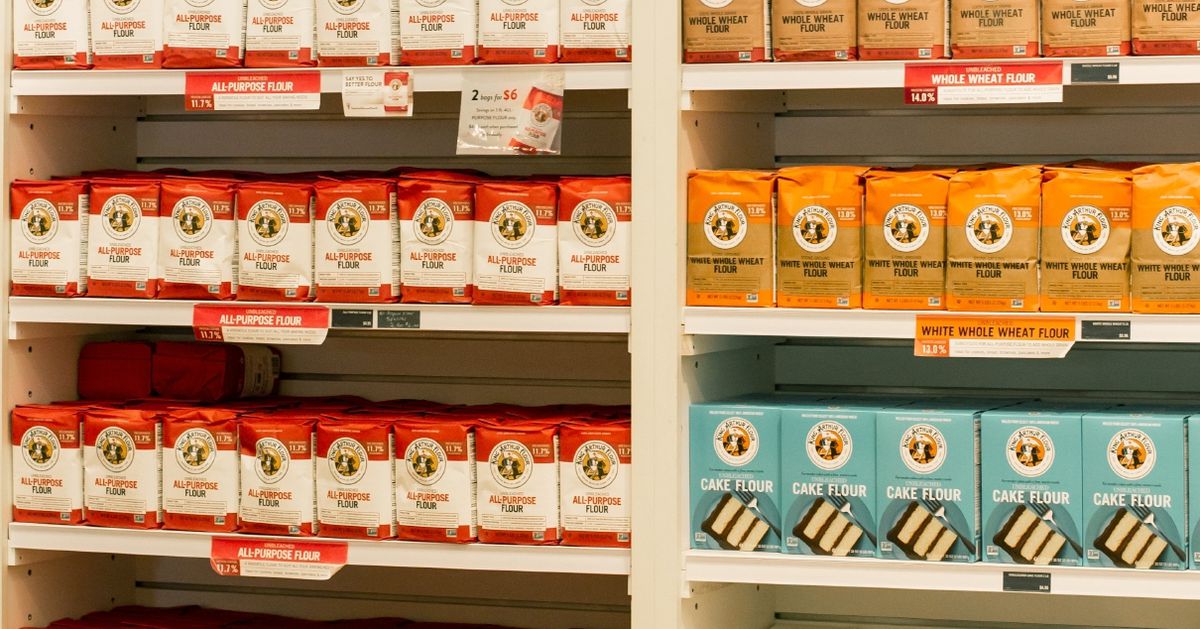

In March of 2020, King Arthur Flour was cruising to the end of its winter season, when mill partners slowed production to do maintenance and the company ran its leanest inventory of the year. Home baking runs in predictable, seasonal cycles, bubbling up a bit in the spring, dipping in the heat of the summer, and then going full steam ahead as cooler weather and holiday celebrations hit, a season known at King Arthur as “fall bake.” The winter months that follow are a fallow season for home ovens and domestic flour consumption alike. Or, they should be. As the first rounds of coronavirus lockdowns hit, something both unexpected and predictable happened: The flour started flying out the door. Brad Heald, King Arthur’s director of mill relations, says that when stay-at-home orders came down, the company’s entire stockpile of flour, one which should have lasted weeks and weeks, was obliterated. “COVID hit and it took 10 days to wipe us out,” he says.
The same thing was happening across the industry. Big national brands and niche millers alike all flew off the shelves. Unlike toilet paper or beans, the flour wasn’t being hoarded: Home baking across the country exploded, even when the grocery stores were barren and home bakers turned to pop-up restaurant grocers or split 50-pound bags. Of the scary moments during the pandemic’s outbreak, the flour shortage was hardly the worst. But it was eerie, especially as the weeks stretched on and this essential staple failed to reappear on grocery shelves, recalling wartime shortages otherwise never seen in America.
The thing is, the great flour shortage wasn’t a flour shortage at all. Our national grain stockpile wasn’t depleted, and flour still flowed in train cars and trucks and pallets. For King Arthur, the impact in the early months was small. The virus hadn’t yet reached the mills it works with, clustered in breadbasket states; Heald says none of their mill partners had staff out sick with COVID-19 or waiting on test results until much later. In the spring and summer, everyday people couldn’t buy flour because of tight bottlenecks in a national logistics system built around the logic of consumerism. The problem wasn’t the flour. The problem was getting it into bags.
Think about it this way: Most of the flour Americans consume is not in homemade baked goods. It’s in artisan sourdough and Wonder Bread; doughnuts and croissants and grocery-store sheet cakes; Spaghetti-O’s and Oreos. Only about 3 percent of the flour produced in America goes to the home baker market. The rest is used by bakeries and the food manufacturing industry. Our food supply does not particularly depend on people being able to buy five-pound bags of flour to bake at home.
There are about 160 registered flour mills in the U.S.; King Arthur works with about 30 for both its professional and consumer business. Of those 30, only about eight to 10 could package flour for consumers, and at the end of March, that handful of mills was suddenly at the center of everyone’s attention. In the ensuing scramble, King Arthur called up its milling partners and made a significant commitment: They would purchase whatever they could produce at maximum capacity for the rest of 2020. “That decision was made early on based on the amount of product being drawn, and when you get into fall bake, we get that surge anyway,” Heald says. This guarantee, built on years of strong relationships, secured King Arthur’s supply of flour as competitors from across the industry battled for milling and packing capacity. For a few weeks, King Arthur’s mill partners fulfilled as many orders as they could. But every mill’s lines were built to dump the flour into the same kind of bag — light yet strong paper, folded top — and when the bags ran out, the stresses multiplied exponentially.
According to Heald, there are only about seven major companies that produce five-pound flour bags, and there was no way for them to keep up. “Even though we could get flour, we would run the mill out of packaging. They would do everything they could for us in late March, but by April 15 they’re out of packaging and they’re waiting. The bag suppliers were just hit with multiple millions and millions of orders, and their lead times start to get longer and longer,” Heald says. “They started out at the end of April saying, ‘Okay, we have a six-week lead, no, we have an eight-week lead, no, we have a 12-week lead’ — it ended up being a 16-week lead just to get packaging.”
In response, King Arthur cut their two-pound bags entirely. A longtime professional contact of Heald’s worked for a company that had decided to build out its packaging lines before the pandemic, and King Arthur jumped in to claim some capacity when it came online in time for the height of fall bake. The company also rolled out three- and eight-pound bags of flour in a stand-up poly pouch, which could be filled on a different kind of line, some of which weren’t currently in use or running under capacity. “That allowed us to get more flour into the market when we were waiting on packaging and capacity on the lines that do the standard paper bag,” Heald says. “We ran a half a million of those three-pound bags, beginning in June.”
And despite all of the logistical challenges, King Arthur sold a lot of flour in 2020. A lot. Bill Tine, a representative for the company, says the overall flour category has grown over 18 percent year over year (and it’s climbing in November and December). King Arthur has grown over 50 percent. Tine says its logistics team worked heroically; Heald and his team had weekly calls with every partner, trying to find every possible efficiency they could to get more flour to eager customers. For all of 2019, the company sold the equivalent of 23.7 million five-pound bags of flour. From April 1 to November 20, the company sold the equivalent of 43.1 million, and that’s only to the consumer market.
“To squeeze all that in less than eight months,” Heald says, and then pauses. “We’re just now starting to see light at the end of the tunnel. We’re saying, Our inventory levels are okay, is it time to back this thing off? Does COVID surging mean we’re going to have another event now through February? Do we want to bring down our weeks of supply? How low do we dare go so we don’t lose our place? We’re at a crossroads.” Heald says he can’t share the exact number of weeks’ supply King Arthur currently has in its warehouses, but says it’s four times the amount they had in January 2020, and that all of the retail stores have packed their warehouses to the brim with flour, too.
King Arthur’s internal projections predict robust flour sales well into 2021, and Tine is optimistic about a new culture of home baking taking root long term — one heavy on yeast. Traffic on the brand’s sourdough recipes is up 460 percent year over year, and pizza recipes are up by 275 percent, while cookie recipes are up just 67 percent. The biggest age group growth has come from the 18- to 34-year-old category, and communication with the free baker’s hotline has exploded, both over the phone and social media. The next recipe Tine sees jumping out on the website traffic dashboard? Cinnamon rolls.
On one hand, it’s grim to wonder if the ongoing massive surge in COVID-19 cases across America will lead to even more sourdough and, perhaps, cinnamon rolls. But there’s a reason “fall bake” happens as the light disappears and the air grows cold and biting. Home baking is a profoundly unnecessary activity on any practical level; there is a professional nearby who is probably better at it than you, and there are large, far-off factories that produce breads and sweets with a cloying appeal that gets the job done. For those who enjoy it, baking’s utility is entirely emotional — but emotional utility can’t be underestimated in an ongoing mental health crisis. A loaf of bread or a handmade pizza represents tangible accomplishment, with a process absorbing enough to banish the world and its tragedies. As the tragedies pile up this long and dark winter, at least this time, probably, the flour won’t run out.
Recent Comments