


Authors: Tim Lang, City, University of London; Erik P Millstone, University of Sussex, and Terry Marsden, Cardiff University
We were not surprised concerns about food shortages that emerged when France and over 40 countries imposed travel or truck movement bans on the UK after rocketing COVID-19 cases were linked to a new variant of the SARS-CoV-2 virus.
Soon after the Brexit referendum we warned that just-in-time delivery systems are easily disrupted, and that leaving the EU, from which the UK derives a third of its food, opened new risks and highlighted old failures that needed addressing.
T Milton/Shutterstock
What goes up must come down
This crisis has been brewing for years and lessons from past and present failures should be drawn.
Failure 1:
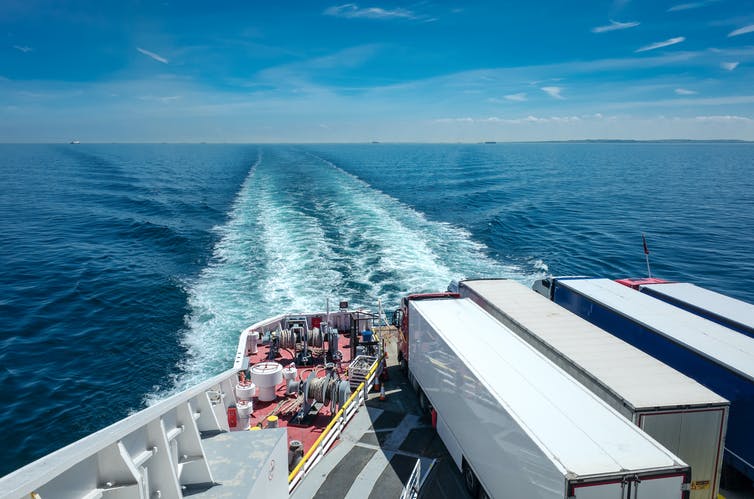
As lorry queues quickly built up, triggering Operations Stack and Brock (emergency parks for and controls on wagon movement) the UK could only beg France to lift the ban.
This exposed how the British government failed to understand what underpins current UK food security. The government already seemed stuck in the 19th century when the UK had a giant navy to protect food supplies. When the UK announced four patrol boats would cruise the Channel to protect its fishing if there’s a no-deal Brexit, this simply showed a weak grasp of 21st century logistics reality.
The EU and trucks provide the UK with food security. One day of blockage led to abrupt falls in the stock exchange and pound to euro exchange rates. Urgent appeals had to be made to consumers to stay calm.
Failure 2:
The UK government reacts but does not prevent. There has been poor and overly-secret contingency planning. In food, as in life, problems don’t only come one at a time. And the UK government over-relies on industry (especially retailers) to sort things out. We call this the “leave it to Tesco et al” default policy.
When governments close traffic movements, not even the nine retailers who account for 90%-plus of the UK food retail market can solve the problem. The UK food industry has repeatedly warned the government not to disrupt its just-in-time logistics, but the government hasn’t listened.
Failure 3:
Because the government relies on the food industry to feed the nation and sees little need to direct what it does, it has been complacent. It underestimates the “multi-whammy” that food systems face. This is not just Brexit + Covid, but + climate change + deep social inequalities (rising food poverty) + weak state mechanisms (not helped by loss of EU institutional support) + regional divisions + economic austerity and recession: we need changes, not business as usual.
Failure 4:
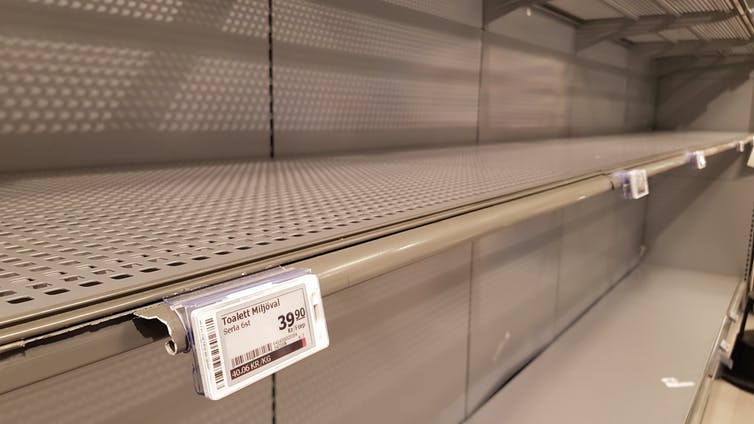
Politicians may say they support consumer choice but the government’s understanding of consumerism is feeble and its trust is wafer-thin. Only a week ago, it was privately urging retailers to stockpile food while telling consumers not to do so.
Any sensible country would ensure a modicum of domestic stocks if only for psychological reasons. Sweden advises households to do so.
Pataporn Kuanui/Shutterstock
Failure 5:
During the summer this year, Henry Dimbleby, a food entrepreneur who was asked to lead a now much delayed food strategy, said the government should ensure people on low income in dire food difficulties receive urgent help.
He was ignored until Marcus Rashford, a Manchester United footballer, captured and articulated public concern.

MDI/Shutterstock
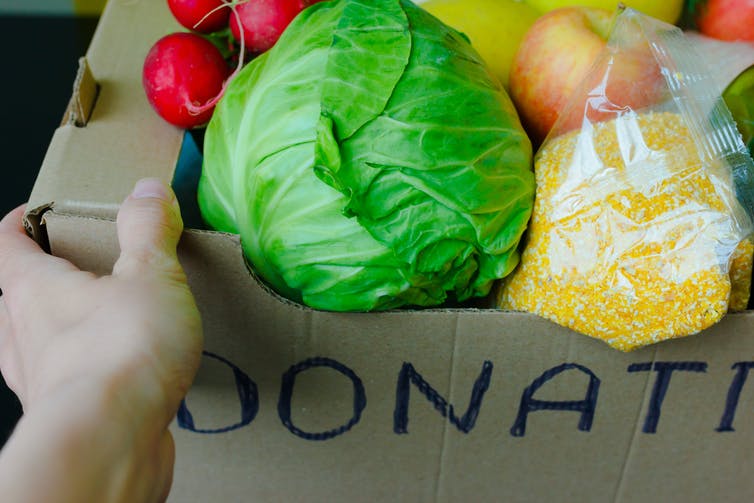
Academics had long warned about food. Instead government saw charity as the answer. It isn’t and the Conservative governments keep having to be reminded of what Churchill learned in World War 2. Even UN advisers have warned the UK about unacceptable food poverty, yet the reaction has been fury and dismissal.
Failure 6:
UK ministerial attention has been elsewhere. Leaving the EU, its focus has been on replacing Common Agricultural Policy subsidies and re-purposing them to protect ecosystems services.
Biodiversity is vital, of course, but the new Agriculture Act 2020 barely mentions food. The government has no agri-food strategy except perhaps to import more from elsewhere, with its hopes for a benign US trade deal dashed by Joe Biden’s election. It was already under pressure from campaigners wanting high food standards entrenched in law with whoever the deals are done in future.
Lack of preparedness
Switching to other food sources would take years. So, what should the UK government do now? Firstly, it should finalise an EU-UK food trade deal. Whatever it gets, there will be vastly more paperwork at borders. Government recognises (but never said this would be needed in the Referendum) that some 50,000 customs officials are needed yet, approaching January, only 20,000 have been trained.
A Brexit deal would give some certainty, avoid the worst tariffs, but still inevitably cause border friction and customs arrangements. The country’s leaders should come clean with the UK public about this.
Habrovich/Shutterstock
UK food industry shake-up
British farms should be incentivised to grow more field crops from spring 2021. Business-as-usual in farming is already unacceptable but in 2021 would be folly. Feeding people well is not an alternative to regenerating ecosystems but central to it. That change must start now.
A food strategy is needed right now, not in spring or summer when one is due (and, even then, only for England).
Will government listen? Perhaps not. Some believe Brexit will resolve all problems. But current food disruptions and anxieties should puncture that rhetoric. If not, policy incoherence will continue and deteriorate, when what is needed is rapid building of food system resilience on multiple fronts.
The British public is slowly realising the UK no longer has the power the government said it had over events. “Take back control” may have been a brilliant campaign slogan for Brexit but is hard to implement in terms of food supply. That requires international as well as national teamwork rather than going it alone. If the nebulous notion of sovereignty is to determine supermarket stocks, active governmental planning is urgently required.
Food crises shook UK established politics in the mid 19th century, again in World Wars I and II, and over mad cow disease in the 1990s. Again this might be happening today. Certainly food poverty and trade disruptions are very likely to continue. 2021 is not the conclusion of Brexit, only its start.
Tim Lang, Professor of Food Policy, City, University of London; Erik P Millstone, Professor of Science Policy, University of Sussex, and Terry Marsden, Professor of Environmental Policy and Planning, Cardiff University
This article is republished from The Conversation under a Creative Commons license. Read the original article. Image credit: Leoanna/Shutterstock
Recent Comments