


Pacific Gas & Electric is asking state regulators to approve another massive round of energy storage procurements, including its first large-scale contract for behind-the-meter batteries to serve grid needs.
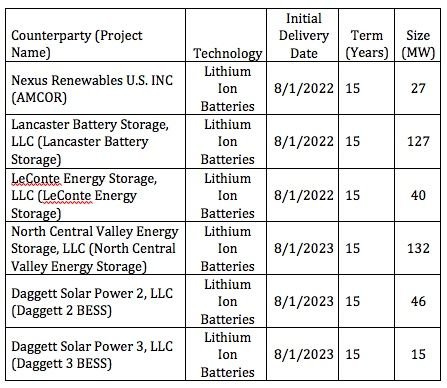
The six projects announced Wednesday add up to 387 megawatts, or 1,548 megawatt-hours, of energy storage, including two utility-scale solar-storage systems in Southern California and three standalone battery installations across the state.
But the 27-megawatt/108 megawatt-hour behind-the-meter battery project represents a departure from PG&E’s current roster of utility-scale storage contracts. The 15-year agreement calls for Nexus Renewables U.S., part of Ontario, Canada-based Nexus Renewables, to deploy a fleet of batteries at multiple sites in PG&E service territory, and provide them for grid services starting in August 2022.
PG&E’s announcement cites this deployment as an “AMCOR project.” Amcor is an Australian-based company that makes packaging materials for foods and beverages, pharmaceuticals, personal care and other products, and has several facilities in PG&E’s Northern California service territory.
PG&E did not immediately respond to requests for more information on the sites that would be targeted for the behind-the-meter battery fleet.
This foray into behind-the-meter battery aggregation comes as part of PG&E’s efforts to meet the California Public Utilities Commission’s call for energy storage to help balance the state’s increasingly solar power-influenced grid.
Last year, the CPUC ordered the state’s utilities and community choice aggregators (CCAs) to procure a total of 3.3 gigawatts of new resources by 2023 to help make up for the capacity to be lost from the pending closure of natural gas-fired power plants along Southern California’s coast.
PG&E and fellow investor-owned utility Southern California Edison have been inking massive battery and solar-storage contracts to meet this 2019 mandate, as have the state’s community choice aggregators (CCAs).
California’s rolling blackouts in August have driven regulators to seek out new resources, including batteries, that can be brought online quickly to store grid power for evening peaks in grid demand, when the state’s solar generation fades away yet customer demand for electricity remains high.
PG&E’s first procurements in May contracted for 423 megawatts, or nearly 1.7 gigawatt-hours, of energy storage projects. Those projects are set to come online by August 2021, as are the seven solar-storage projects adding up to 770 megawatts, or more than 3 gigawatt-hours, of storage capacity that Southern California Edison contracted this spring.
PG&E’s latest contracts for lithium-ion battery systems with four hours of storage duration are scheduled to come online in 2022 and 2023, as the chart below shows:
California’s growing need for multi-purpose behind-the-meter batteries
The 27 MW aggregation is the first large-scale behind-the-meter battery project for PG&E, but not for the state as a whole. Southern California Edison has contracted for 180 MW of behind-the-meter batteries under a 2014 plan to replace the capacity lost from the closure of the San Onofre nuclear power plant.
Behind-the-meter batteries can serve multiple functions, from emergency backup power and managing on-site power consumption to reduce utility bills or increase the value of solar, to providing system capacity to transmission operators or local grid relief for utilities. California is a focus of these efforts to “stack” behind-the-meter battery values, and to create the new regulatory models to manage their interplay with existing energy markets and utility billing and tariff structures.
SCE recently contracted for a 5 MW behind-the-meter battery aggregation from Sunrun, set for 2023 delivery. The leading U.S. residential solar provider is also aggregating 20 MW of solar-storage systems for three Northern California CCAs, for use as grid resources and to assist vulnerable customers with backup power during wildfire-prevention power outages.
California’s increasing wildfire threat is forcing utilities to shut off power to high fire risk areas, with PG&E customers facing the brunt of the outages. The threat of blackouts has also driven California customers to add batteries to their solar systems at a rapid pace, aided by a CPUC mandate to direct lucrative Self-Generation Incentive Program (SGIP) battery funds to customers deemed most vulnerable to losing power.
PG&E emerged this year from a 2019 bankruptcy caused by tens of billions of damages from wildfires caused by its grid, and is working with the CPUC to find clean energy microgrid alternatives to the mobile diesel generators it’s deploying to back up blacked-out communities.
In the long term, California will need a massive amount of new energy storage to meet its goal of 100 percent carbon-free energy by 2045. Most of the new solar power coming online in the coming years will be matched with batteries to better integrate solar’s generation profile with grid needs. Eventually, the state could need tens of gigawatts of longer-duration storage to cover the gaps in generation capacity from the closure of its last fossil fuel-fired power plants.
PG&E’s existing storage projects include a 300-megawatt/1,200-megawatt-hour project by Vistra Energy and a 182.5-megawatt/730-megawatt-hour project from Tesla being built near a natural-gas plant in the Monterey County community of Moss Landing.
Recent Comments