

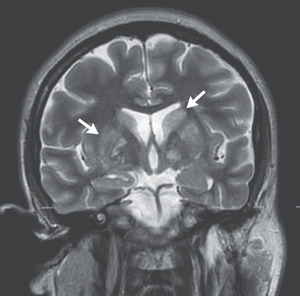

Dr. Howard M. Heller: This 24-year-old man presented with a 3-week history of indolent progression of headache and respiratory and gastrointestinal symptoms. Four days before admission, he had received a diagnosis of Covid-19. He did not have a fever, and the results of physical examination were consistent with signs of meningeal inflammation. He had very slight absolute lymphopenia and mild anemia. Lumbar puncture was notable for an elevated opening pressure, and CSF analysis showed lymphocytic pleocytosis, a slightly low glucose level, and a normal protein level.
There are numerous epidemiologic, clinical, and laboratory clues in this case. We need to sort out which of these might be “red herrings,” or distractions unrelated to the diagnosis, and to avoid anchoring and being misled by other clues.
Covid-19
Could this patient’s illness be attributed to Covid-19? During the Covid-19 pandemic, this diagnosis has certainly been on the minds of clinicians and patients. This patient’s oxygen saturation was normal while he was breathing ambient air, and a chest radiograph showed no opacities. If he had a decreased oxygen saturation with activity and diffuse ground-glass opacities on chest radiography, then CT of the chest would be appropriate, since it is a sensitive method for the diagnosis of Covid-19 pneumonia.
Covid-19 has been associated with a hypercoagulable state that can lead to pulmonary emboli, but this patient had a normal d-dimer level, a finding that makes pulmonary emboli unlikely. In addition, Covid-19 has been associated with encephalitis, but Covid-19 encephalitis usually occurs in the presence of severe pulmonary disease and is typically associated with frontotemporal hypoperfusion, leptomeningeal enhancement, or evidence of strokes on MRI.1,2 Venous sinus thrombosis can occur in patients with Covid-19, but there is no evidence of venous sinus thrombosis on MRI in this patient. I think Covid-19 is a coincidental diagnosis in this case and is not the most likely cause of the neurologic illness.
Tickborne Diseases
Whenever we hear the words “landscaper” or “hiking in New England,” we tend to anchor on tickborne diseases, especially in the spring. As a landscaper, the patient was not able to work from home during the shutdown for the Covid-19 pandemic. When headache is the predominant symptom, we need to be concerned about cerebral vasculitis and Rocky Mountain spotted fever. However, in the absence of fever and rash 3 weeks into the illness, this diagnosis is unlikely.
The patient did not have leukopenia, thrombocytopenia, or elevated aminotransferase levels, so anaplasmosis is not a major diagnostic consideration. He had mild anemia but normal aspartate aminotransferase and lactate dehydrogenase levels; these findings point us away from an infection that causes hemolysis, such as babesiosis. Furthermore, neither anaplasmosis nor babesiosis would cause the central nervous system (CNS) findings seen in this patient.
Borrelia miyamotoi can cause severe, sometimes relapsing, febrile illness and lymphocytic meningitis. Powassan virus can cause encephalitis and meningitis, but these manifestations usually involve the temporal lobes rather than the basal ganglia. No cases of infection with Powassan virus or any arbovirus were reported in Massachusetts during the first 6 months of 2020, when this patient’s illness occurred.
Early disseminated Lyme borreliosis can cause lymphocytic meningitis, and increased intracranial pressure with pseudotumor cerebri has been described, but these manifestations are more common in children than adults.3 Lyme encephalitis can lead to a variety of MRI findings but not the abnormalities described in this case.4,5 Another occupational hazard for landscapers is sporotrichosis, which can cause lymphocytic meningitis, but this patient did not have the skin lesions typically associated with this infection.6
Sexually Transmitted Infections
Although this patient’s sexual history is not particularly suggestive of sexually transmitted infections, we need to consider this possibility, since some patients are initially reluctant to share details of their sexual history. The sexually transmitted infections that can cause lymphocytic meningitis include acute human immunodeficiency virus (HIV) infection, syphilis, and herpes simplex virus type 2 infection. The patient did not have any relevant findings on examination, such as oral or genital sores or an erythematous rash.
Other Infections
Given that this patient had recently immigrated to the United States, we need to consider possible diagnoses linked to Central America. Tuberculosis can cause meningitis with mononuclear pleocytosis, but with this infection, the CSF protein level is typically much higher than the level seen in this patient. In addition, he had no calcified granulomata on chest imaging; on brain imaging, we would be likely to see signs of meningitis or tuberculomas but not cystic-appearing lesions located in the basal ganglia. Cysticercosis is typically associated with either multiple, scattered enhancing cysts surrounded by edema in patients with active disease or calcifications of old cysts. Toxoplasmosis often involves the basal ganglia but typically causes ring-enhancing lesions with edema in immunocompromised patients. Chagas’ disease can cause meningoencephalitis and focal lesions during reactivation of infection in immunocompromised patients. Paracoccidioidomycosis is endemic in Central America, but neurologic involvement is uncommon and ring-enhancing lesions are usually seen. Coccidioidomycosis commonly causes meningitis, even in immunocompetent people, and although it is not endemic in Central America, we are not told how the patient traveled from Central America to Massachusetts; many immigrants undergo an arduous journey through the Sonoran Desert in northwestern Mexico. Both histoplasmosis and cryptococcosis can cause lymphocytic meningitis and are possible diagnoses in this case.7 Finally, because the patient did not have a fever and his inflammatory markers were not markedly abnormal, we need to consider noninfectious causes, specifically CNS lymphoma.
Cryptococcosis
The condition that is most commonly associated with a cystic, grapelike appearance in the brain, especially in the basal ganglia, and typically causes a very high intracranial pressure is cryptococcosis.8 Cryptococcal meningitis can occur in seemingly healthy people, but it usually occurs in people who are much older than this patient; it most commonly occurs in immunosuppressed patients, especially in the presence of advanced HIV infection. This patient had no identifiable risks for HIV infection or relevant findings on examination, such as thrush or lymphadenopathy. Hypergammaglobulinemia is a hallmark of the humoral dysregulation associated with HIV infection, especially at the late stage, but this patient’s globulin level and albumin:globulin ratio were normal.9 In addition, his history was not suggestive of hypogammaglobulinemia or another underlying immunodeficiency. Given that this patient’s presentation is most consistent with cryptococcal meningitis, I suspect that he also has a new diagnosis of advanced HIV infection. To establish these diagnoses, I would perform a CSF test for cryptococcal antigen and a fungal wet preparation. If cryptococcal disease is identified, the patient will need to undergo evaluation for an underlying immunodeficiency, including an HIV test. If the HIV test is negative, characterization of T-cell subsets by flow cytometry should be performed to rule out idiopathic CD4+ lymphocytopenia.
Recent Comments