

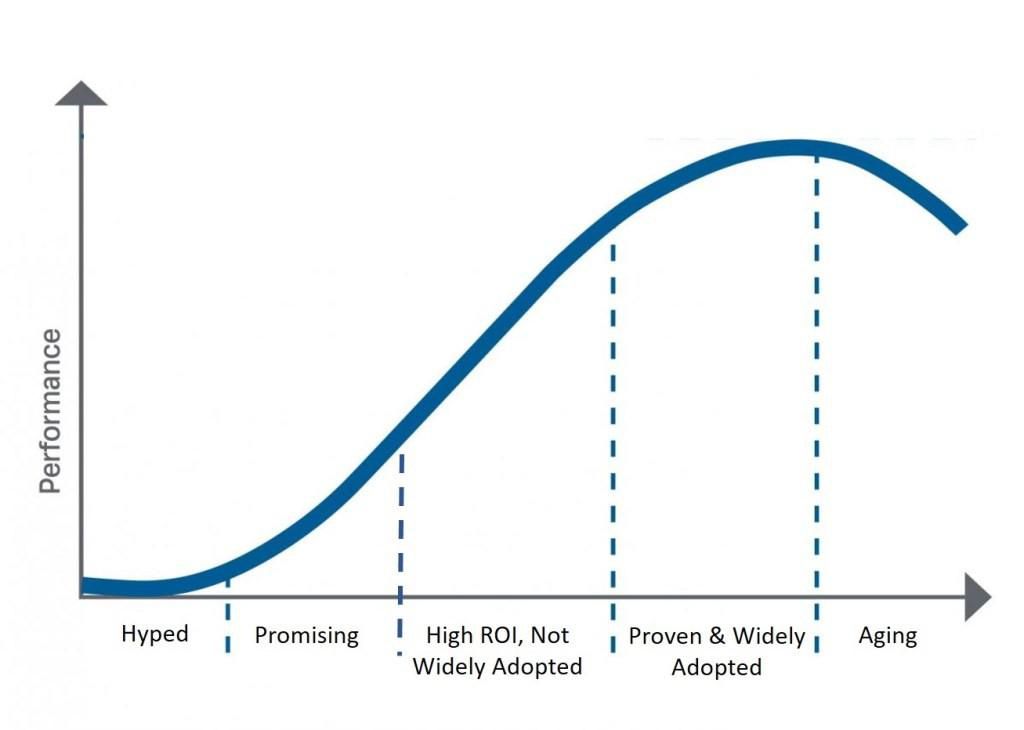

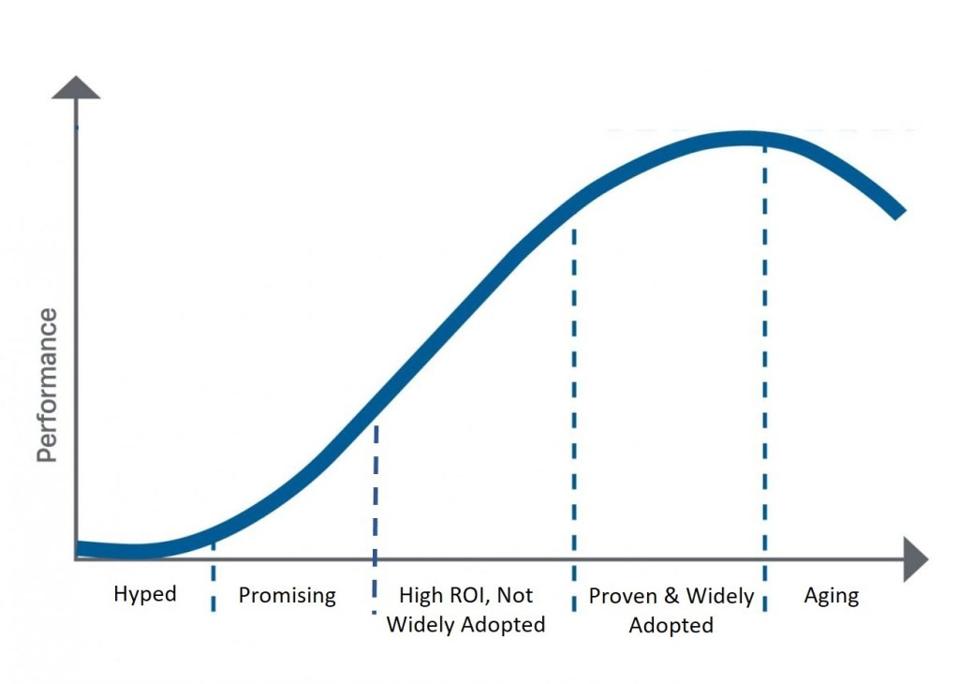
The Technology Maturity Curve
Steve Banker
There are some young supply chain technologies that are getting a lot of buzz. But how mature are these technologies? Do they have a proven ROI? Are they worth piloting? Or can companies safely ignore them?
There are also promising technologies that we expect will deliver great value. But we can’t document the ROI or other benefits at this point.
Finally, there are technologies that do generate value that few people have heard of.
In this article, the main hyped, promising, and solid solutions but widely adopted technologies in supply chain management are discussed.
Hyped Technologies
Hyped technologies are getting a lot of publicity but have little proven value. These seem like technologies in search of a solution.
Hyped technologies are getting a lot of publicity but have little proven value. These seem like technologies in search of a solution.
5G
5G is the fifth generation of wireless technology. With 5G, you’ll see exponentially faster download and upload speeds. Latency, or the time it takes devices to communicate with each other wireless networks, will also drastically decrease. The benefits are clear for consumers that want to download movies on their smart phones and watch them. But will there be benefits for supply chains?
The theory is that as more and more devices throughout the supply chain and manufacturing process become part of the ‘Internet of Things,’ they will produce an incredibly rich data stream that will send signals in real-time to trigger a wide variety of events. For example, using a 5G network, a parts tote could communicate that the tote is 80% depleted for this SKU which would trigger a re-order of the necessary parts. This would be a trigger across the supply chain which would result in warehouse movements, maybe LTL, consolidation, and finally distribution and delivery of re-supplies.
5G is not getting as much attention as it did last year, but we are still at the hype stage here. Despite television commercials that suggest 5G is already here, the 5G wireless networks is still being built out across the U.S. ARC is not hearing providers of supply chain technology leveraging this network to provide new value to their customers.
Blockchain
We continue to see companies pitching their blockchain solutions in the supply chain realm. Often these are here today, gone tomorrow startups. Blockchain is said to be a strong solution for traceability or to provide payment to linked supply chain partners after their part of a chain of linked activities has been completed. We have continued to ask blockchain providers for the names of customers that are using their technology every day as part of their newly entrenched way of doing business. Blockchain providers cannot provide these references. That is a sure sign that the technology is still in the hype stage.
Promising
Promising technologies seem like they would offer robust ROI or other tangible benefits. It is highly logical that the promised benefits will appear. But these technologies are so young, that ARC has not been able to talk to references and verify that the promised benefits are real.
Artificial Intelligence (AI)/Machine Learning (ML) Platforms
These platforms allow companies to ingest massive amounts of historical and real-time streaming data, clean and prepare it, and see if applying machine learning or AI algorithms and techniques to that data will provide valuable predictions for their business.
In the supply chain realm, leading supply chain software companies are actively working to embed existing applications with AI and machine learning. For most companies this is a less risky and more cost-effective way to access the capabilities of AI.
But there are very big global corporations, corporations with revenues of over $10 billion, that have digital centers of excellence. These companies do believe that custom AI/ML applications can be built that provide value in black spaces not currently covered by existing supply chain applications. Further, for Logistics Service Providers, excellence is supply chain management is how they differentiate themselves. For them building a custom AI/ML application that their competitors do not have could make a lot of sense. Certainly, several of the largest 3PLs are doing work here and claiming they are getting good value. However, it is hard to know how credible those claims like like self-serving marketing messages.
We are also moving to blended solutions that are partly an application framework and partly an AI/ML platform. Anaplan, a supplier providing supply chain planning (SCP) and other business applications, introduced PlanIQ. PlanIQ pulls in data from Anaplan and automatically tests several AI/ML algorithms before selecting the model optimized to generate the strongest forecast for a customer’s unique use case. PlanIQ includes Amazon Forecast. Amazon Forecast is based on the same ML technology used by Amazon.com.
Autonomous Trucking
Startups have been pouring money into tests, but we are still some years away from seeing fleets of autonomous trucks on the road. And in some cases, investment dollars are beginning to dry up for this technology. One of the biggest names in autonomous truck technology was Starsky Robotics. It was at the forefront of putting autonomous trucks on the road. Its list of accomplishments is staggering. In 2016, it became the first street-legal vehicle to be paid to do real work without a driver behind the wheel. In 2018, it became the first street-legal truck to do a fully unmanned run. In 2019, it became the first fully unmanned truck to drive on a live highway. And now, even with these accomplishments, due to a lack of funding, the company shut down this year. The best guess on when we might see autonomous trucks delivering loads without drivers in the truck to take over in case something goes wrong in 2024. That is what the folks at TuSimple are projecting and they seem like straight shooters to us. But even in 2024, these trucks will not be running across all lanes nationwide. Rather there will be a focus on delivering across targeted lanes for select customers. What seems clear, however, is that the ROI of autonomous trucks could be very, very good.
Digital Twin Model Builders
River Logic is using an AI expert system that drives a graph database to aid in automating the building of the digital twin of the value chain. In traditional supply chain planning (SCP) solutions, the model has to be configured step by step – this is a product’s bill of material, this is the routing, this a production machine’s setup time. But River Logic is touting their solution as one where the AI system designs and builds the graph database and relationships and selects and applies relevant business rules and logic based on a visual drag and drop diagram that lets users draw out their value chain – greatly speeding up model building and SCP implementations, including full representation of financials as they are incurred by the business. Furthermore, behind the scenes the AI expert system composes and generates a full mathematical model of the client’s value chain, allowing advanced scenario optimizations to be quickly formulated and operationalized.
Infor also uses a graph database for their Multienterprise Supply Chain Business Network known as Infor Nexus. The Nexus network connects businesses to their entire supply chain—from suppliers and manufacturers, to brokers, 3PLs, and banks—paving the way for enhanced supply chain visibility, collaboration, and orchestration. Infor makes the point that a graph database’s ability to infer relationships helps to keep the model up to date. A company may assume that a supplier’s component built in Wuhan China moves through the port of Shenzhen and takes 22 days on average to reach the port of Long Beach in California. But in reality, it may be that often the components often flow through a port in Xiamen and take 25 days to reach California. In short, the graph database can help keep the supply chain model accurate. This is critical for effective performance.
High Value, But Not Widely Adopted
Next Generation Control Towers
A robust supply chain control tower is built on a cross-functional end-to-end digital twin of the supply chain. It includes visibility to how events across the extended supply chain will impact the ability to fulfill orders to customers. The digital twin models the constraints in transportation, warehousing, production and then can produce optimized plans to handle the inevitable exceptions that arise. In the past a supply chain control towers tended to be focused more on handling transportation exceptions or be more focused on orchestrating around exceptions rather than using true optimization to maximize service at the lowest cost. In order to get the data, clean it, and normalize it, most of these modern control towers are being built using data lakes.
Robotic Automated Storage and Retrieval
In the last few years a form of goods-to-person automation has come to market. These “robotic shuttle systems” are a hybrid of traditional shuttle systems and free roaming robots. There are a handful of providers currently offering solutions that fit into this categorization. And each one approaches the problem in a different manner. However, they all offer the benefit of high storage density and a high degree of flexibility due to the dynamic movement of bots. This bot agility removes throughput and sequencing constraints, providing increased productivity potential. These solutions align with the operational needs of many industries. However, they are coming to market just as demand is accelerating for same-day fulfillment of online orders. This spike in demand is especially prevalent in e-grocery fulfillment. These solutions may be fulfilling your next online order of apples and bread.
Robotic Process Automation (RPA)
Robotic process automation is software that is used to automate high volume, repeatable tasks. Over time enterprise systems develop better automation and users can do their job more effectively. But companies using legacy systems may have opportunities to use an external RPA solution to automate the work inside the legacy system. RPA’s do this by performing the same computer keystrokes and opening the same modules humans do. We know of a 3PL that received good payback by using RPA to automate the highly manual tasks associated with planning optimization in their legacy transportation management system (TMS). It is also used to examine carrier websites for appointment scheduling.
Descartes is embedding RPA into its routing solution. Descartes points out that for all but the simplest route planning problems, creating the best plan is not as simple as loading data and hitting the “optimize” button. Instead, the best planners go through multiple steps to generate optimal results. Essentially, RPA can model the steps that the best planners take to produce superior results.
My colleagues Chris Cunnane and Clint Reiser made contributions to this article.
Recent Comments