


OMAHA, Neb. (AP) — U.S. factories have been cranking out goods during much of the pandemic at rates that are remarkably close to normal. However, manufacturers are concerned they may not be able to keep pace until most of the country is vaccinated because the coronavirus continues to surge in areas where many plants are based.
Safeguards that were put in place after the initial wave of the virus appear to have prevented the large outbreaks that sickened hundreds of workers and forced automakers, meat processors and other businesses to halt production last spring. But with the nation’s COVID-19 death toll eclipsing 300,000 and the virus spiking in communities that surround the plants, industry and union officials say it may be impossible to keep the virus out of factories.
“We are seeing an increase in the number of positive (test) rates like you’re seeing in the surrounding communities,” said Gary Johnson, chief manufacturing officer at Ford Motor Co., which has about 56,000 hourly factory workers nationwide.
Federal Reserve statistics show that U.S. industrial output is about 5% below levels in February, before the pandemic hit. It fell by 16.5% between February and April but has rebounded since, led by auto manufacturing.
Beef and pork production have both been running just below last year’s levels, Iowa State University agricultural economist Lee Schulz said.
But as it will be months before many people will be able to get vaccinated, factories will remain vulnerable.
“Even though we are doing OK now, this virus can spread rapidly in areas,” said Mark Lauritsen, director of the food processing and meatpacking division for the United Food and Commercial Workers International union. “I worry every day that this virus will explode in one of our plants again, even with all the precautions that we’ve taken.”
At auto plants and factories in other industries where the United Auto Workers union represents workers, cases have risen slightly since around Halloween, but nearly all have been traced to outside of the plants, said UAW President Rory Gamble.
Since reopening in May after an eight-week shutdown, three workers from Fiat Chrysler factories near Detroit have died from the virus, raising fear among thousands of workers.
Gamble said much of the fear has come from misinformation about workers catching the virus in factories, which is not true.
“They need to have a complete understanding that we’re doing everything we can to keep them safe,” Gamble said. “Because they have a right to be afraid.”
The statistics on the pandemic’s impact on the meatpacking industry offer plenty of reason to worry. The UFCW union, which represents roughly 80% of the nation’s beef and pork workers and 33% of its poultry workers, estimates that at least 19,800 meatpacking workers have been infected or exposed and 128 have died of COVID-19.
Employees such as Donald Nix, who works at a Tyson Foods pork processing plant in Waterloo, Iowa, agonizes about the virus that sidelined him for 27 days in the spring with a fever, body aches and severe headaches.
Nix, 51, is concerned because co-workers keep getting sick. During the spring, more than 1,000 of the plant’s 2,800 workers were infected and at least six died. “My workplace is still high risk. My job is still high risk,” he said.
But the giants of the meat industry — Tyson Foods, Smithfield Foods, JBS and Cargill — contend that the safety measures that were put in place after the major outbreaks last spring have enabled them to limit the spread of the virus.
“We made substantial investments in personal protective equipment, social distancing safeguards, and other increased health and safety measures across our business. We’ve seen a dramatic reduction in active cases involving our team members since last spring,” Tyson CEO Dean Banks recently told investors.
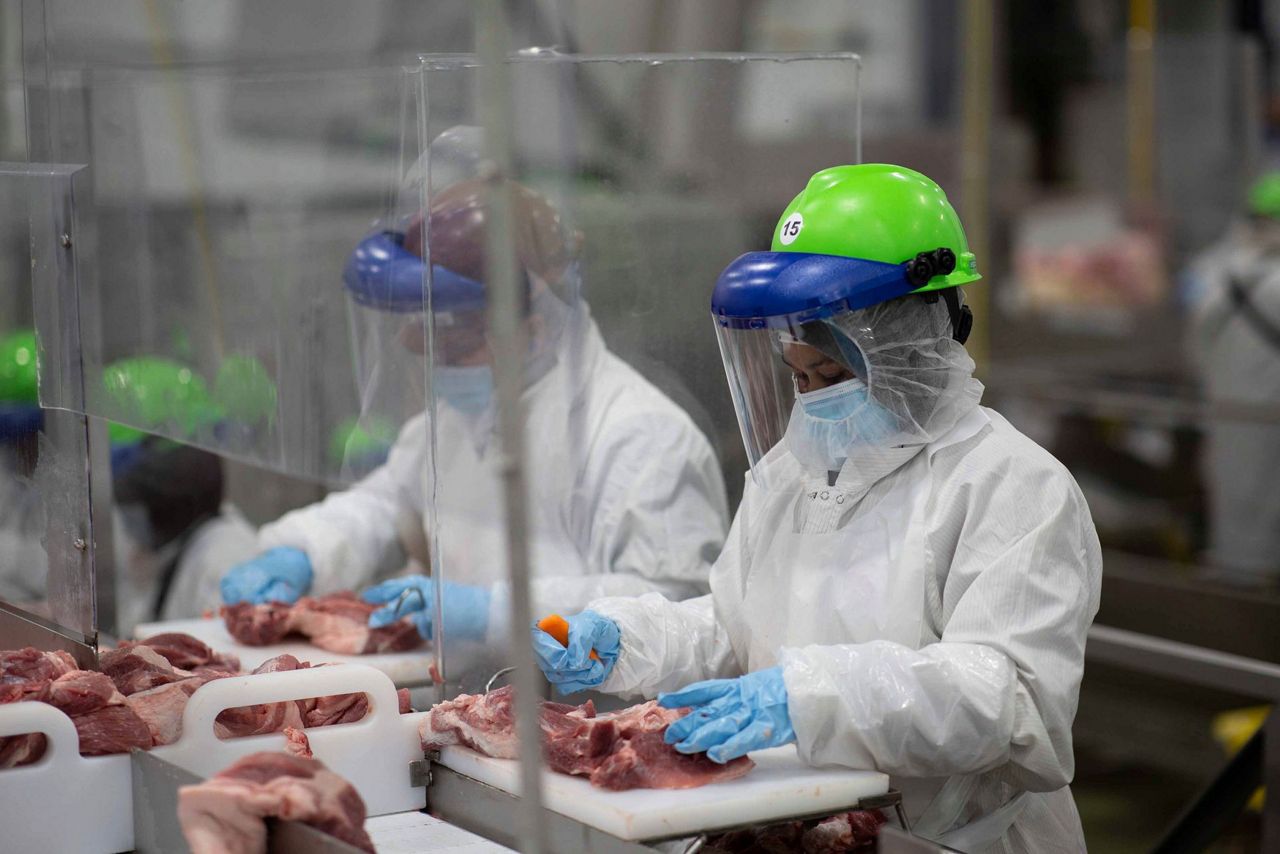
Measures include wellness questionnaires before work, temperature checks, plastic screens between work stations, increased cleaning of the plants, random testing, and the required use of masks and other protective equipment. The industry spent roughly $2.5 billion on those improvements and additional pay for workers in the first six months, said Will Sawyer, a protein economist at Cobank, an agribusiness bank.
At Ford, factories are operating at about 98% of their pre-pandemic production. Most workers who have symptoms or have been exposed to the virus stay home until the danger of infecting others has passed, limiting its spread in the plants, Johnson said. The automaker hires temporary workers to take their place, allowing it to keep assembly lines running.
Auto and meatpacking companies say generally less than 1% of their workforces are catching the virus. Automakers and the UAW are urging workers to wear masks in public outside the plants.
Members of the UAW, which represents 150,000 workers employed by General Motors, Ford and Fiat Chrysler, said the companies largely have stuck to their precautions and protocols.
“I know of people who have had it and tested positive, but as far as I know, they’re doing what they’re supposed to as far as quarantining and getting people tested,” said Andrea Repasky a forklift operator at GM’s pickup truck factory in Fort Wayne, Indiana.
People she passes at the plant always wear protective gear correctly, she said. Management posts how many people test positive on each shift, and the numbers have been relatively small, even with a minor surge after Thanksgiving, she said.
Ford, General Motors, Toyota and others are starting to see minor problems with smaller parts companies having to shut down factories due to virus outbreaks or government restrictions, especially in Mexico. Ford’s Johnson said a truck driver shortage is affecting parts deliveries. The company has lined up just-in-time freight to get parts to keep plants running, he said.
Ford had to delay production of its new Bronco SUV from spring until summer because of virus-related parts shortages that the company wouldn’t specify.
Toyota said it has come close to halting assembly lines due to a lack of parts, but so far has managed to avoid it.
“There have been a few close calls for sure,” said spokesman Scott Vazin. “Any given day, we’ve got up to 10 parts we’re closely monitoring on red alert.”
The UFCW’s Lauritsen said he hopes the industry will continue working hard to limit the spread of the virus.
“We can’t get complacent just because things seem to be holding right now,” Lauritsen said. “We know that plants of any kind — anytime people get together in large groups — can act as a super spreader with this virus.”
___
Krisher reported from Detroit.
___
Follow Josh Funk and Tom Krisher on Twitter at https://twitter.com/funkwrite and https://twitter.com/tkrisher.
Copyright 2020 The Associated Press. All rights reserved. This material may not be published, broadcast, rewritten or redistributed without permission.
Recent Comments