



23rd December, 2020
by
Patrick Schmitt
Despite having had a stormy 2020 due to wine sales being down, Portuguese cork producer Amorim was determined to fulfil a promise – to eradicate TCA. António Rios de Amorim tells Patrick Schmitt MW about achieving that aim.
 For the head of the world’s largest cork producer, António Rios de Amorim, 2020 was a milestone year, and, as he revealed to db over the phone in November, for more than one reason.
The first relates to a major anniversary for the company, a Portuguese force producing 5.5 billion stoppers annually, which reached its 150th birthday in 2020. Clashing with a pandemic, needless to say this has not been a good time for celebrating, something António acknowledges with dry understatement: “We will have to find a more adequate time to pop some corks,” he says, having mentioned the need to cancel a series of events. The other relates to a promise made by the Amorim chairman to db in July 2018 during a discussion in Portugal. Sitting in the one of the rooms of the historic Amorim family house, António said that Amorim would “eradicate TCA by 2020”, referring to the wine-spoilage compound that can originate in cork.
But let’s not forget that Amorim was already a long way down the line of dealing with TCA when António made the promise. At that point, it had a steam-cleaning process for cork called ROSA, which stripped the material of any potential wine spoilage bacteria, as well as NDtech – a pioneering screening system for single-piece stoppers, which tests each cork for TCA, and, as a result, offers customers a ‘non-detectable TCA guarantee’.
Individual guarantee
However, this latter breakthrough was reserved for a special class of top-end stopper, simply because the quality-control technology was applied to each cork individually, a time-consuming process that simply couldn’t be applied to billions of stoppers. And it was always António’s plan to scale up this TCA-free promise. As he said 18 months ago: “We will have non-detectable TCA performance for all the corks we put in the market by 2020.”
He says that the pandemic had not prevented Amorim “executing the plan we had”. Noting that it was possible to remove wine-spoilage compounds from the cork granules used for agglomerated corks, he says that the challenge concerned single-piece natural stoppers.
He explains: “The issue was not with technical stoppers, but natural stoppers, and although we will have passed 80 million corks through NDTech this year, we need to secure our entire production, and for that, we need to develop something that is not so expensive.”
Although António does not want to divulge the details of this development, understandably considering the competition in the closures sector, he tells db that Amorim has used “batch-based technology” to remove TCA from cork, and that the new process is ready now. This means Amorim delivered on its commitment, if only just before the close of 2020. He says: “We have cured TCA on all product ranges we have, so we have executed our plan. This technology is called Naturity, and that’s because there are no artificial elements used in the process.”
way as to remove the wine-spoilage compounds without distorting the natural properties of the material. But the big difference is the scale of the application. Cork Supply produces around 600m stoppers annually, making it almost 10 times smaller than Amorim. In other words, Amorim may not be the first to make the claim, but the impact of its development will be much greater. So, even if the incidence of TCA is very low today, Amorim’s technology will mean that the number of spoiled wine bottles potentially making their way onto the market will drop dramatically – by the millions.
TCA may have been dealt with by Amorim, but the company can’t control Covid-19. And while the effect of the pandemic has been minimised at the company’s production facilities, it has affected the demand for stoppers. Speaking of the former, António recalls how the Amorim factories never stopped running, and he never missed a day in the office. “While some of our administrative and sales people started working from home, the rest of our employees had to come to work every day to produce the corks, and so too did the whole of the top management, who came to the company and visited the production lines every day.” Talking about the need to lead by example, he adds: “If the management are present, then the rest of the team follows. We never stopped operating or serving our thousands of customers in various geographies of the world.” He assures db that from the end of March he had “made the workplace Covid-secure, and every worker had a mask”.
As for the demand, that has dropped. Indeed, the market for corks provides a loose reflection of the impact of the pandemic on wine sales, with Amorim seeing its greatest declines in the sparkling sector, one that, being closely tied to celebrations and events, has been hit hardest by Covid-19. Considering the numbers for 2020 compared with 2019, while stoppers sales for wine have dropped globally by around 8%, for sparkling it is nearer 12%, and for Champagne around 30% – in line with the decline in shipment figures reported by the region.
Having started the year in growth, and seen varying performance throughout 2020, António expects to end 2020 with around a 6% fall-off, which is less than expected when the first lockdowns began in Europe. He also predicts a quick comeback for cork sales. “We would like to recover our 2019 sales figures in 2021, and once the sanitary crisis is over, and we think it will be cured halfway through 2021, there should be growth, and we expect to increase by 4-5%,” he says. “That’s what we are working towards, and that’s because we have to project, but it’s a goal,” he adds, noting the challenge of forecasting at the moment for one month ahead, let alone a whole year.
The dominant seal
Downtrading in the drinks market has hampered cork sales, with the material being the dominant seal further up the price ladder. “In 2020, there has been a step backwards in respect to premiumisation,” says António. “The wines that are selling are the more basic, and bag-in-box has been a winner in 2020,” he adds. While he predicts a return to the pre-pandemic premiumisation trend, to the benefit of cork, he doesn’t believe that wine consumption will increase in mature markets.
Aside from consumers trading up to better and pricier wines, he thinks cork will benefit from another consumer-driven development, the demand for sustainable products. “Sustainability has been suspended with this crisis, but it will come back stronger out of this pandemic, and we think cork can capitalise on that green wave,” he believes, noting the material’s strong environmental credentials – cork forests are a natural ecosystem and biodiversity hotspot, as well as an important carbon sink, while the material itself is recyclable and biodegradable.
In any case, he tells db that drinkers prefer cork. “If you listen to the consumer, then you would never put plastic or a screwcap on a bottle – clearly the consumer preference is not for that,” he says. Major retailers and wine producers are starting to realise the benefits of corks in their approach to bring down their carbon footprints, he maintains. “Cork can play an important role in sustainability and the carbon footprint of a bottle,” he adds. He says the material represents an important store of carbon, that can be used in calculations to offset carbon dioxide emissions in transport and manufacturing.
Following a study commissioned by Amorim, but independently conducted by Ernst & Young in December 2019, it has been revealed that a single natural cork stopper is proven to capture up to 309g of CO2, while a sparkling wine stopper can retain even more at 562g (due to the greater amount of cork used in its production). According to Amorim, this means that cork closures can lower the carbon footprint of glass bottles, which release between 300g and 500g of CO2 on average during the production process, depending on their weight.
While the carbon stored in cork will eventually biodegrade if the stopper ends up in landfill, António is working on programmes to encourage the more widespread recycling of corks. “For us it’s a waste to throw it away, as they say, there’s no such thing as waste, simply products in the wrong hands,” he says, mentioning the huge number of uses for cork granules, from flooring to shoes.
Meanwhile, the focus of his efforts now are the cork trees themselves, Quercus suber, whose bark provides the raw material for stoppers. This material, which is prised off the trunk without damaging the tree, regenerates in nine-year cycles, although the first harvest can’t take place before the oak is 25 years old – with only the third harvest (after 43 years) deemed good enough for stopper-making. With Amorim trialling higher-density drip-irrigated plantations, it’s hoped that the company can bring down that initial wait to around 10 years, making cork trees a more appealing investment for landowners. This is important, as António wants to secure
an increased supply for the future.
Beneficial impact
The other area of emphasis concerns further laboratory work into the beneficial impact of cork on a fine wine’s ageing process. It’s hoped that by understanding the material’s impact on a wine’s evolution, it will shine a positive light on cork as a tool for the maturation of fine bottles. Already, it has been shown that phenolic compounds that are naturally present in cork stoppers will migrate into wine in a linear fashion over time to form new compounds, and these have been shown to reduce colour deterioration and astringency in wine. These newly discovered compounds have been given a name: corklins. “Why is it that if you buy a great bottle of Bordeaux in 2002, they say drink it after 2008? What happens in the bottle in those six years, and what is the contribution of the cork?” he asks. “The focus of our research in the past few years has been TCA, now we need to move on and consider the value cork brings to a bottle of wine; how can cork make your wine taste better?”
What about the issue of variations in the ageing process within the same batch of wine, which are often blamed on cork? “All the international press were blaming premox [the premature oxidation of wine] on cork, but now it has been shown that cork can play a role in this, but a minor one compared with other factors,” he says. “But, yes, we always need to improve, and the issue of bottle variation is something we are working on for the high-end natural stopper, and we are making long strides to address the issue. But the issue of bottling does need to be put into the equation.” This references the variable amounts of oxygen pick-up in a bottle’s headspace when filling and sealing the containers on a bottling line.
So what’s been the biggest change during the 150 years since Amorim was founded? After all, the material and its use to stopper wine has remained the same. “The change has been huge,” he says, “The use of technology in the past 20 years becoming an intrinsic part of our development to ensure the reliability and better performance of our product.
“There is a second change too, and that concerns our management, who are very professional; 30 years ago, you needed to be called Amorim and have worked for the company for 30-40 years. Now we are a professionally managed company with new people and new concepts.”
In other respects, however, there has been consistency. “What has not changed is our passion for cork, and our ambition to grow and be a better company, but those are the only two things, everything else is completely different.” As part of this improvement, he mentions sustainability, including social responsibility, with the manufacture of cork stoppers being vital to the skilled agricultural practice of harvesting the bark from Portugal’s cork forests.
The product is also, of course, critical for wine producers, who must bottle the fruits of their latest vintages. “When we saw the impact of the pandemic we knew we had to continue to operate, we are responsible for the livelihoods of 30,000 customers,” he says.
“The whole company came together, and this is a moment; the memory of our 150-year celebration will be the resilience of our people, and the sacrifices made, so the company did not fail our beloved customers.”
He concludes: “That will be our take-away, because everything else about this year is not worth remembering.”
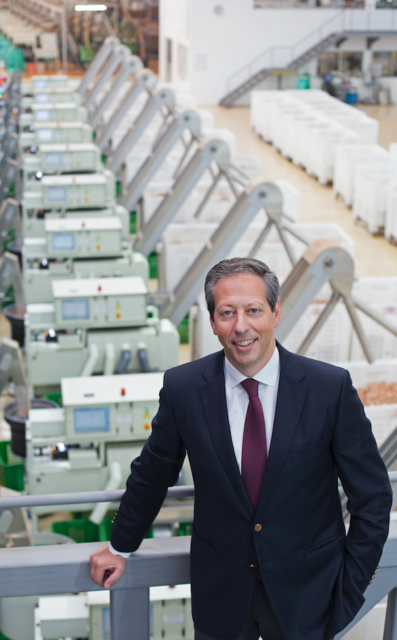
António Amorim was born in 1967 and graduated from Birmingham University, with a degree in International Commerce, having concluded post-graduate studies in management at INSEAD, Stanford and Columbia Universities, as well as in Oenology at the University of Bordeaux. Having started his internship at the family holding company, Amorim-Investimentos e Participações, in 1989, he was later appointed managing director of Amorim Hotéis (hotels) which, in a joint venture with Accor (the world’s leading hotel operator), launched the Novotel and Íbis chains in Portugal. Between 1993 and 1995, he was also chief operating officer of Amorim’s real estate division, developer of landmark projects such as Lisbon’s Torres de Lisboa office complex and Porto’s Arrábida Shopping Center. In 1996, he was appointed chief executive of the cork stopper division of Amorim’s industrial branch, and in March 2001, became chairman and CEO of the entire cork operation. Since then, he has embarked on a massive research-and-development programme and major investments in new plant development and vertical integration, from raw material supply to finished product. Amorim was president of the European Cork Confederation between 2003 and 2010 and, in 2012, completed his third and final consecutive term as president of the Portuguese Cork Association. In January 2006, António Amorim was awarded the Medal of Industrial Merit by the president of Portugal.
Recent Comments