



Craig Harrison
Craig Harrison has worked on the waterfront since 1991, and was elected the National Secretary of the Maritime Union of New Zealand in 2020.
Comment
We are an island nation dependent on trade to survive, but have practically no shipping fleet. Now a global pandemic is revealing the fallout from 1990s deregulation, writes Maritime Union leader Craig Harrison
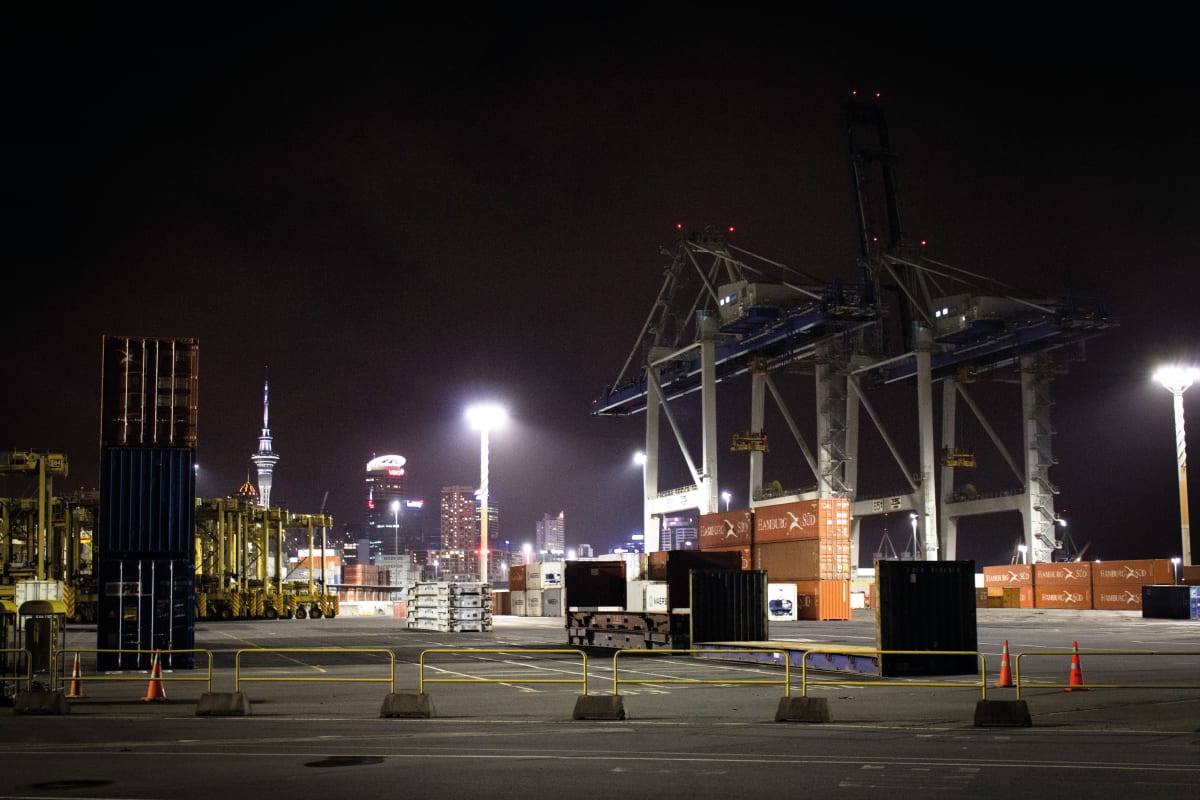
As a wharfie and the leader of the maritime union, a lot of people are asking me why our ports are jammed and there’s delays getting freight from ships to shops.
Clearly, Auckland’s attempts to cut staff in favour of automation are a big part of the problem this year, but there’s a more fundamental problem: we are utterly dependent on a handful of international shipping lines to move our seafreight.
Covid-19 has thrown international shipping into disarray. We’re seeing fewer ships coming in and they are coming less regularly, which means more domestic freight on the road.
 Should domestic freight be shipped only by New Zealand registered vessels operating under New Zealand law? Click here to comment.
A key part of this problem is our lack of domestic-flagged coastal shipping. The reason we’re reliant on expensive and carbon intensive methods to shuttle freight around our country is because nearly all of our domestic sea freight is shipped by international ships as a sideline to their main, imported, cargo. The backlog at POAL and the congestion, the increased costs, and difficulty in getting goods to market it’s causing are just the latest manifestation of that vulnerability.
If those big ships choose only to visit a major port and skip our regional ports, then the freight piles up and we have no effective way to remove it around the country ourselves.
So how did an island nation that is dependent on trade to survive, find itself with practically no shipping fleet?
We had 34 New Zealand flagged ships in 1994. Today we have just one Kiwi flagged container ship. That’s an incredible loss.
We used to protect our coastal shipping by requiring domestic freight to be shipped only by New Zealand registered vessels operating under New Zealand law. We did this because we recognised shipping was vital to our economic interests.
When that protection was removed in the deregulation of the 1990’s, the fleet dwindled in the face of international companies, running crews who weren’t protected by New Zealand’s minimum employment standards.
We had 34 New Zealand flagged ships in 1994. Today we have just one Kiwi flagged container ship. That’s an incredible loss.
Coastal shipping – the “blue highway” – is cheaper than other forms of domestic freight transport, has much lower carbon emissions, and has none of the externalities of road transport such as congestion and road maintenance. It also offers security for regional supply chains when road transport is unviable such as when the Kaikoura quake closed state highway one (and the main trunk rail line).
Changing the law back is simple, there’s one line of legislation that allows for foreign flagged ships to carry domestic freight as of right. Change it so domestic freight has to be carried by Kiwi-flagged ships …
Additionally, many of the classes of vessels that run coastal routes can also sail trans-Tasman and Pacific routes. That’s a hugely valuable backstop to international shipping.
Restoring our Kiwi-flagged coastal shipping fleet would give us independence and security when global supply chains are in chaos.
Changing the law back is simple, there’s one line of legislation that allows for foreign flagged ships to carry domestic freight as of right. Change it so domestic freight has to be carried by Kiwi-flagged ships, with crews operating under New Zealand employment law and pay rates
We won’t be able to rebuild our domestic coastal shipping overnight – but there are no fundamental barriers. We’re talking to the industry about what they would need to make this work and it’s clear that a staged process will be needed. The money is there to build the industry back up quickly, but there are issues around crewing – our support for training has diminished with our fleet.
A Government that wanted to rebuild the security of our seafreight, reduce our carbon footprint, and support regional jobs and economies should be able to re-establish New Zealand flagged coastal shipping within a matter of years. All it needs is a Government with the will to do it.
Labour has long talked about restoring coastal shipping – this term, we want to work with them to make it happen.
Recent Comments