

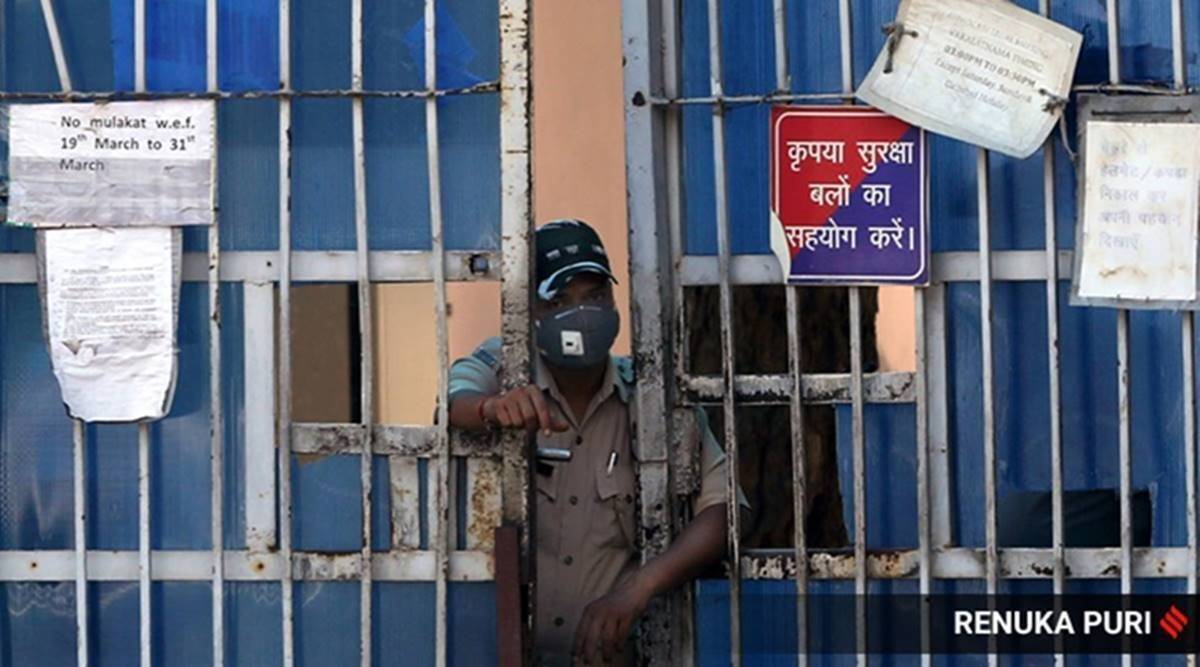

Two recent incidents of Stan Swamy and Gautam Navlakha show up the state of our prisons today. Both are undertrial prisoners in the Bhima-Koregaon case. Both had to move the courts for the simplest of necessities. One, to get a sipper cup and a straw because he is an 80-year-old man with Parkinson’s and the other to wrest a pair of glasses to replace a broken pair. It led to the Bombay High Court into making an observation that workshops should be conducted for the prison staff to sensitise them.
Why did these matters have to go to the courts? It is, perhaps, an indication of the fact that there is little space for ground-level staff to make operational decisions. Officials do not want to get into trouble, especially in cases of political prisoners arrested under national security laws.
The law on provision of basic facilities to prisoners is clear — it lies squarely with custodial authorities. The Nelson Mandela Rules 2015 issued by the UN and the Model Prison Manual 2016 by the Bureau of Police Research and Development, Ministry of Home Affairs, have elaborate provisions regarding the care, treatment and rehabilitation of prisoners. A plethora of Supreme Court and high court judgments reiterate that prisoners are human beings with basic rights. In essence, the law emphasises that as far as under trial prisoners are concerned, they enjoy all other rights, save those restricted by virtue of their being incarcerated.
Yet, violations are an everyday routine. They get highlighted when there is a mishap with a high-profile person, like a Rajan Pillai whose death in Tihar Prison due to lack of medical care led to the high court awarding compensation; or if a public-spirited individual like Sheela Barse files a PIL; or because of a judge who, as in the recent case of “Re Inhuman Conditions in 1382 Prisons”, sees the need for systemic change. Notorious criminals, too, like Charles Sobhraj and Sunil Batra, who had the gumption to take matters to the Supreme Court, have played their part in prison reforms over the years.
But standard setting doesn’t mean compliance. Our prisons are full of people in compromised states. Around 70 per cent are undertrials and more than 75 per cent come from marginalised sections. They know little about the law. Even if they are aware, they have little recourse to any complaints mechanism and must fall back on an uneven legal aid system. If at all a prisoner can reach the judge, they are either too busy in their routine work or too enmeshed in the local culture to act. Financial, infrastructural, and human resource shortfalls that range from 20 to 40 per cent also play their part in adding to staff stress and inmate misery.
The Supreme Court issued orders to state governments to take steps to prevent the spread of the coronavirus in prisons through a suo moto PIL filed in March 2020, leading to more than 68,000 prisoners being released on bail or parole so far. But a pre-pandemic comparison between 2017 and 2019 shows that overcrowding increased from 116 to 119 per cent. Overcrowding in individual prisons stands much higher; some prisons are more than three times crowded than their official capacity.
Despite efforts at clearing cases, an acute shortage of judges and court infrastructure ensures an accelerating accumulation of cases in courts. Between 2019 and 2020, the numbers crept up from 3.5 crore toward 4 crore, an over 10 per cent rise. According to the India Justice report 2019, it takes an average of three years for the case to traverse the high court and six years in the subordinate courts.
It doesn’t have to be this way. There are pathways to accountability and to reform. But since both supervisor and policy maker know the on-ground constraints and the biases within the culture, much is excused or pushed under the carpet. Reform attempts like the constitution of Undertrial Review Committees mandated by the Supreme Court work patchily. In most prisons, the Board of Visitors meant to function as an oversight mechanism are not even constituted.
The policy rhetoric wants prisons to be places of reform and rehabilitation. Their neglect by the executive and oversight bodies ensures they act as warehouses for the poor and the marginalised. But the constitutional ordering of this country requires that pandemic or no pandemic, justice must not wait. Prolongation of these so-called criminal cases is unconscionable, as is forcing vulnerable people into remaining in hotspots of increased infection and fatal risk.
Daruwala is senior adviser, Commonwealth Human Rights Initiative, and Raghavan is professor, Centre for Criminology and Justice, School of Social Work, TISS
Recent Comments