


HAMBURG, Germany/ATHENS — Global conglomerate China COSCO Shipping is gearing up for a fight as it seeks to tighten its grip over the Greek port of Piraeus, the once-sleepy harbor that it has turned into the Mediterranean’s busiest hub for sea freight.
COSCO, which has invested hundreds of millions of dollars into Piraeus since first responding to an appeal for support from Greece in 2008 amid the global financial crisis, is now working to bring cruise ships and trains to the port and expand its offerings there into shipbuilding and repairs.
But rising disquiet in Greece and the wider EU over COSCO’s methods and strategies could hold back the group’s ambitions of taking Piraeus further up the ranks of Europe’s busiest ports from its fourth place finish in 2019.
“We haven’t seen and we aren’t going to see anything good coming from the Chinese and COSCO,” said Greek shipowner Evangelos Marinakis last month at an extraordinary meeting of the Piraeus City Council.
A council member himself, Marinakis voted with the body to order COSCO to halt sending construction trucks through the city and require it to move heavy materials by water.
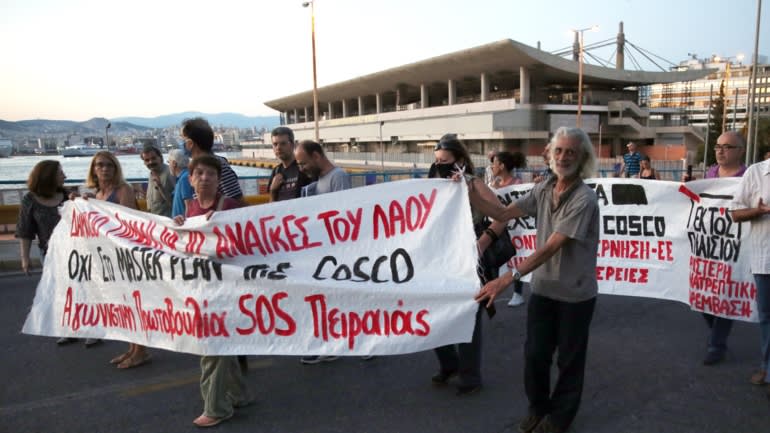
Demonstrators protest against COSCO’s expansion plan for the Port of Piraeus in June 2020. (Athens News Agency)
Growing debate over COSCO comes as the group has petitioned Greece’s state-asset privatization agency to turn over a 16% stake in the Piraeus Port Authority that would raise its ownership stake to 67%.
Under an agreement reached with the government in 2016, COSCO is entitled to get the additional shares in August 2021 if it completes another 300 million euros ($365.8 million) worth of specified investments, including a cruise terminal.
COSCO acknowledges it is not on track to complete the projects on time but argues it should still get the shares because holdups with the issuance of government permits have led to delays.
Local tensions extend beyond the nuisance of COSCO’s construction vehicles. A plan to expand shipyard services has stirred opposition from small local operators. Piraeus’ chamber of commerce and the country’s shipping chamber joined to successfully block COSCO from holding operational control over a new electronic port access system.
“COSCO with its actions and inaction has united against it a wide spectrum of political and social actors in the city,” said Vassilis Kanakakis, president of Senavi, a union of shipyard contractors. “This has never happened before.”
The Greek parliament has sought answers from the government about how COSCO’s operation of the port is affecting workers and small businesses there and how well the company is living up to its obligations under its concession agreement.
After the company issued a long statement last week in response to the issues raised by the legislators, 40 of them criticized the government on Monday for leaving the matter to COSCO to handle.
“Is COSCO acting like a state within a state?” said Giannis Ragousis of the opposition Syriza party.
COSCO also faces new detractors further afield.
In two recent reports, the EU Chamber of Commerce in China took aim at core elements of COSCO’s business model in Piraeus: the interweaving of the conglomerate’s liner and port businesses and its buildup of feeder services that carry smaller cargoes to Piraeus from other European ports — some part-owned by COSCO — where they are loaded onto COSCO’s intercontinental ships for carriage to Asia and vice versa.
“It is also important to note that the rapid growth of both capacity and actual throughput has largely been achieved by COSCO using Piraeus as a hub for international relay,” EuroCham said in one report. In the other, it noted that in China, “International relay may only be carried out by Chinese-flagged vessels operated by wholly owned Chinese companies.”
The group, whose vice chair heads up the China operations of COSCO rival Maersk, has proposed that Brussels consider blocking non-EU ships from relay services as leverage to push Beijing toward reciprocity in this area. Shipping is among the areas where the EU is seeking concessions as part of a last-minute rush to seal a bilateral investment treaty with China before year-end.
With the European Commission also considering a new competition framework to counteract foreign government subsidies, EuroCham is concerned about the inside workings of COSCO as a state-owned enterprise.
“Chinese shippers use ports built and run by SOEs using steel and cement provided by SOEs; they use vessels built by the (country’s) newly created shipbuilding behemoth… using steel made by SOEs, which is produced using iron and coal from SOEs; all of which is financed by SOE banks,” the group complained. “European firms are simply not able to keep up.”
In its annual report, COSCO Shipping Holdings, the conglomerate’s Hong Kong-listed transport arm, called the “synergy between ports and shipping businesses” in Piraeus a model for what it plans to do in Abu Dhabi and at Chancay, Peru. EuroCham though is not alone in questioning its fairness.
“The key issue is that COSCO has a large shipping fleet which can channel everything to its own port,” said Frans-Paul van der Putten, a senior research fellow at Clingendael Institute for International Relations in the Netherlands. “This results in a market dominance that ultimately changes the way goods are transported into Europe’s economic center.”
Asia/Europe routes represented COSCO Shipping’s fastest growing segment last year, with cargo volumes carried up 27.9% from 2018.
According to data company Alphaliner, COSCO now vies with Mediterranean Shipping Co. for No. 2 in Asia/Europe capacity, behind only Maersk. Tight capacity on such routes has seen shipping rates soar to all-time highs in recent weeks.
Jefferies analyst Andrew Lee predicted Dec. 14 that new records will continue to be set through at least Chinese New Year in February due to shortages of shipping containers and port congestion. The Ocean Alliance — of which COSCO is the biggest member, alongside its Hong Kong subsidiary Orient Overseas (International), France’s CMA CGM and Taiwan’s Evergreen Marine — is ahead of its two rival groupings on Asia/Europe routes.
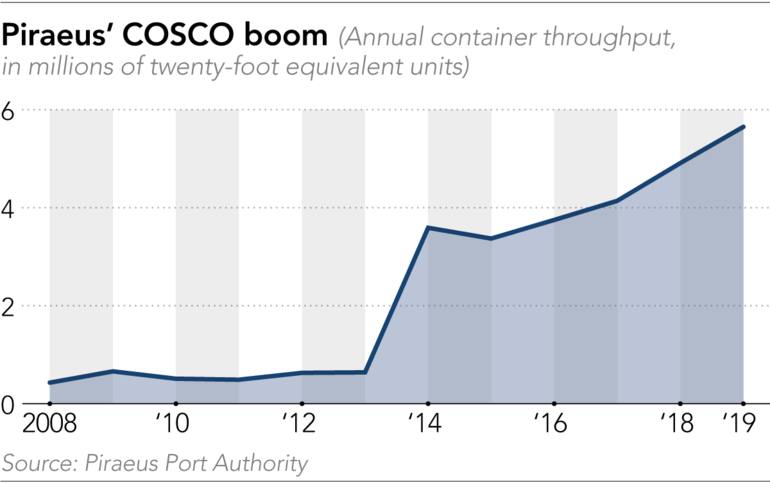
Freight throughput at Piraeus rose 17% last year to the equivalent of 5.16 million containers. COSCO Shipping Ports, also Hong Kong-listed, called the move over 5 million a “historical breakthrough” and “unprecedented leap” in its last annual report, crediting higher traffic from the Ocean Alliance. Its profits from the port, its busiest outside China, rose 42.3% to $33.9 million, excluding the impact of an accounting change.
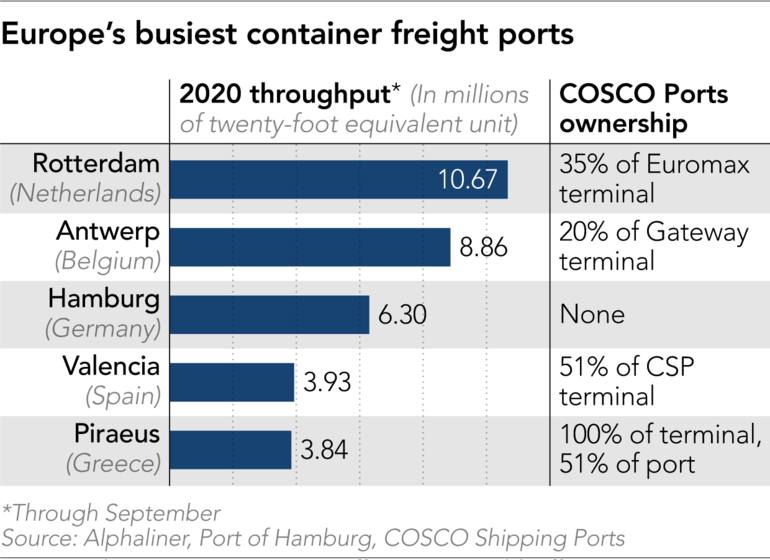
Piraeus is the only EU harbor where the company has a controlling stake in the overall port rather than specific terminals.
COSCO Shipping Ports’ portfolio though includes significant stakes in terminals in Rotterdam, the Netherlands and Antwerp, Belgium, two of ports still ahead of Piraeus in Europe’s rankings. COSCO also has majority interest in a terminal at Valencia, Spain; that port experienced slightly less decline in freight traffic in the first nine months of 2020 than Piraeus, after falling behind it in 2019.
COSCO has increasingly turned its focus inland as well. A year ago, the group took a strategic stake in a rail freight terminal in Budapest and a majority interest in Piraeus Europe Asia Rail Logistics. This will strengthen COSCO’s ability to channel shipments between Central Europe and Piraeus.
Hamburg, Europe’s third-busiest port, is taking notice. Steffen Leuthold, a spokesman for Eurogate, which operates a container terminal there, said the company is following developments at Piraeus “very closely.”
“We are certainly seeing the medium- and long-term risks of Mediterranean container ports gaining a strategic edge deriving from the expansion of hinterland connections in the Balkans or Alps,” he said.
Recent Comments