

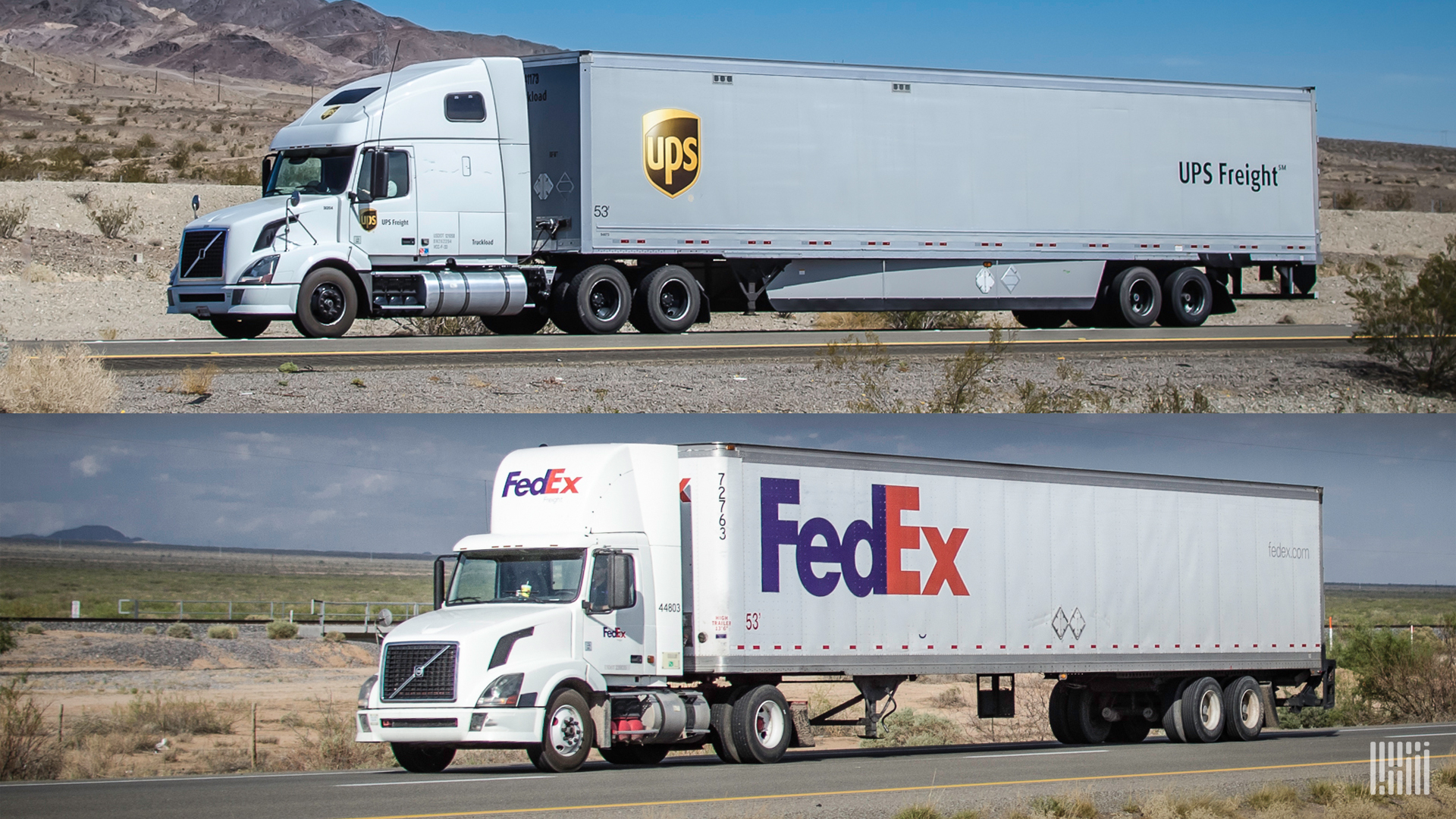

For years, delivery surcharges — the fees that carriers charge on top of their base rates — have nicked and cut parcel shippers’ budgets. But what occurred in the past may be nothing compared to what lies ahead, at least for unprepared shippers.
For the record, UPS Inc. (NYSE:UPS) and FedEx Corp. (NYSE:FDX) have announced 4.9% general rate increases (GRI) on parcels tendered by noncontract customers. But that number means little to the millions of the carriers’ core contract customers. Indeed, a complex array of rate and surcharge changes will result in most of those shippers absorbing harder hits than from the benchmark GRI, unless they can bargain down the carriers on many of the levies.
Virtually all of UPS’ rate and surcharge changes took effect last Sunday. At FedEx, most of the adjustments kick in this Monday.
Of the 28 UPS 2021 surcharges analyzed by Shipware, LLC, a consultancy, 26 are increasing by 5% or more. Only a 4.84% “delivery area surcharge” (DAS) for commercial air services and a 1.67% additional-handling charge for packaging will fall below the GRI threshold, according to the Shipware analysis. Delivery area surcharges will apply to deliveries to specific ZIP codes designated by the carriers.
UPS will hike its ground residential surcharge by 8.54% and its DAS for ground residential services by 7.5%, according to Shipware data. “Extended” delivery surcharges to more rural areas will climb more than 9%, according to UPS data reviewed by Shipware.
FedEx, meanwhile, will increase the residential surcharge on its Home Delivery product by 8.75% and its ground delivery area surcharge by 6.82%, according to data from AFMS LLC, another parcel consultancy. In addition, FedEx will charge a 6% late fee for payments not received within a standard 15-day window, the carrier’s first late fee, AFMS said. UPS already charges late-payment fees, and FedEx has often touted its lack of such penalties as a competitive advantage.
The carriers will also reshuffle their ZIP code matrices in moves that could affect millions of customers. According to Shipware, UPS will add 711 ZIP codes to its DAS network, meaning those ZIPs will now be hit with surcharges. An additional 515 UPS ZIPs will be added to UPS’ DAS extended network, while 121 will migrate from DAS to DAS Extended, Shipware said.
At the same time, UPS will shift 1,082 ZIPs from a DAS Extended classification to DAS. It will also remove 433 ZIPs from DAS classifications, according to the data.
According to a recent AFMS presentation, about 25,000 of the 42,000 U.S. ZIP codes served by both carriers have some form of delivery area surcharge associated with them.
On a per-piece basis, each surcharge increase is measured in cents. However, for big shippers and retailers, the cumulative increases equate to millions of dollars in excess costs. Most of the pain will be felt by customers shipping low-weight, e-commerce shipments via ground, as well as by shippers of big, bulky items that are typically nonconveyable, are costly to handle, and are not welcomed by either carrier. The latter segment will receive what Shipware Analyst Matt Weickert sardonically called “special treatment” for sending those shipments through the parcel networks.
A tough battle
The bevy of parcel consultants who guide shippers through the annual rate and surcharge maze have long noted that everything is negotiable. That truism will be tested during 2021. Though scorching holiday demand is likely to level off once the returns season ends by early to mid-January, e-commerce activity will remain historically elevated well into 2021.
At the same time, capacity is likely to remain tight relative to the continued uplift in demand. This combination has put the carriers firmly in the driver’s seat. They can tell large-volume, low-margin customers to pound sand, and are free to focus on small to midsize shippers that are considered more sticky and that lack the volume clout to demand deep discounts.
Just as significant is the change in the carrier narrative about the role of surcharges. In years past, the public line from FedEx and UPS was that surcharges were needed to offset their higher costs to serve. For some services, that argument still holds water. It can also be argued that surcharge increases are justified given the volume spikes, and the costs of investing in complex, nonlinear residential delivery networks.
The difference now, however, is that carriers see the levies not as pass-throughs, but as an integral part of achieving sustainable “revenue quality,” which is code for profitable growth. Given that mindset, shippers and their advisers may find a tougher negotiating road ahead of them.
“We believe surcharges will be a part of our pricing strategy moving forward for e-commerce,” Brie Carere, FedEx’s executive vice president, chief marketing and communications officer, said on the company’s analyst call earlier this month. FedEx has spent billions of dollars to build out an internally managed, seven-day-a-week residential delivery network, and “we expect to continue to get a premium” for that service, Carere said.
UPS CEO Carol Tomĕ, who has been transparent about shifting away from customers who don’t meet her margin goals, struck a similar tone in late October when she said that the company is “on a journey to optimize the volume that flows through our network.”
Long after the pandemic recedes, online ordering will remain in a secular updraft. In the U.S., the level of delivery volumes that pre-COVID 19 wouldn’t be reached until 2026 will instead be achieved by 2023, according to FedEx projections. In addition, the days of the linear business-to-business (B2B) traffic accounting for 60% to 70% of parcel carriers’ shipment mix are probably gone for good. At most, B2B will climb back to half of the total, industry experts predict. E-commerce and the business-to-consumer fulfillment that supports it are clearly being positioned as the parcel-delivery industry’s future.
As shippers sort out this sea change, AFMS CEO Mike Erickson proffers some good news. By the 2021 holiday season, vaccines will have been dispensed, buying habits will return to some semblance of normalcy as shoppers return to stores, and there should be more capacity at the national and regional carrier levels than there was this peak season, Erickson said. If his vision for the next 12 months pans out, early February should be an excellent time for shippers to renegotiate their contracts, Erickson said.
Recent Comments