


Sam Bright investigates the trends that underpin the Government’s outpouring of contracts to corporate giants and friends of the regime
Procurement – the awarding of public sector contracts to private companies – has far from dominated political debate in recent years. While the Carillion scandal garnered sustained coverage in 2018, after the construction giant collapsed and jeopardised multiple Government projects, the issue has been relegated to the margins ever since.
In 2020, however, that has changed. Over the course of the past 10 months or so, the Government has shelled out roughly £20 billion on contracts to private companies, hoping that they would hold back the tide of COVID-19. The net effect has been a barely-functional response to the pandemic, riven by accusations of cronyism, nepotism and corporate incompetence.
This crisis has been marked by two trends. First, a system of favouritism that has granted privileges based on proximity to power rather than merit and past performance. It’s as if, in the midst of an unparalleled health event, the Oxford-Eton governing class has desperately grasped for the only mode of management it really trusts: awarding deals on the basis of patronage – a form of aristocratic self-preservation that has prevailed for centuries.
Indeed, junior health minister Lord James Bethell admitted as much in the House of Lords. “We relied on a very large network of contacts and informal arrangements in order to reach the people who could manufacture, often moving their manufacturing from one product to another,” he confessed in November.
Yet, Lord Bethell’s shameless defence of insider deals is hardly surprising since he and several of his colleagues owe their positions to exactly the same system of benefaction. Despite holding a powerful office during a national crisis, Lord Bethell is unelected and doesn’t have to fret about trivial matters such as the attitudes of voters.
The same goes for several other high-ranking individuals who have been employed by the Department of Health and Social Care (DHSC) during the COVID-19 crisis. Namely, ‘PPE Tsar’ Lord Paul Deighton, former Conservative Party chairman Lord Andrew Feldman, and Lord James O’Shaughnessy – all of whom have been intimately involved in the pandemic procurement system.
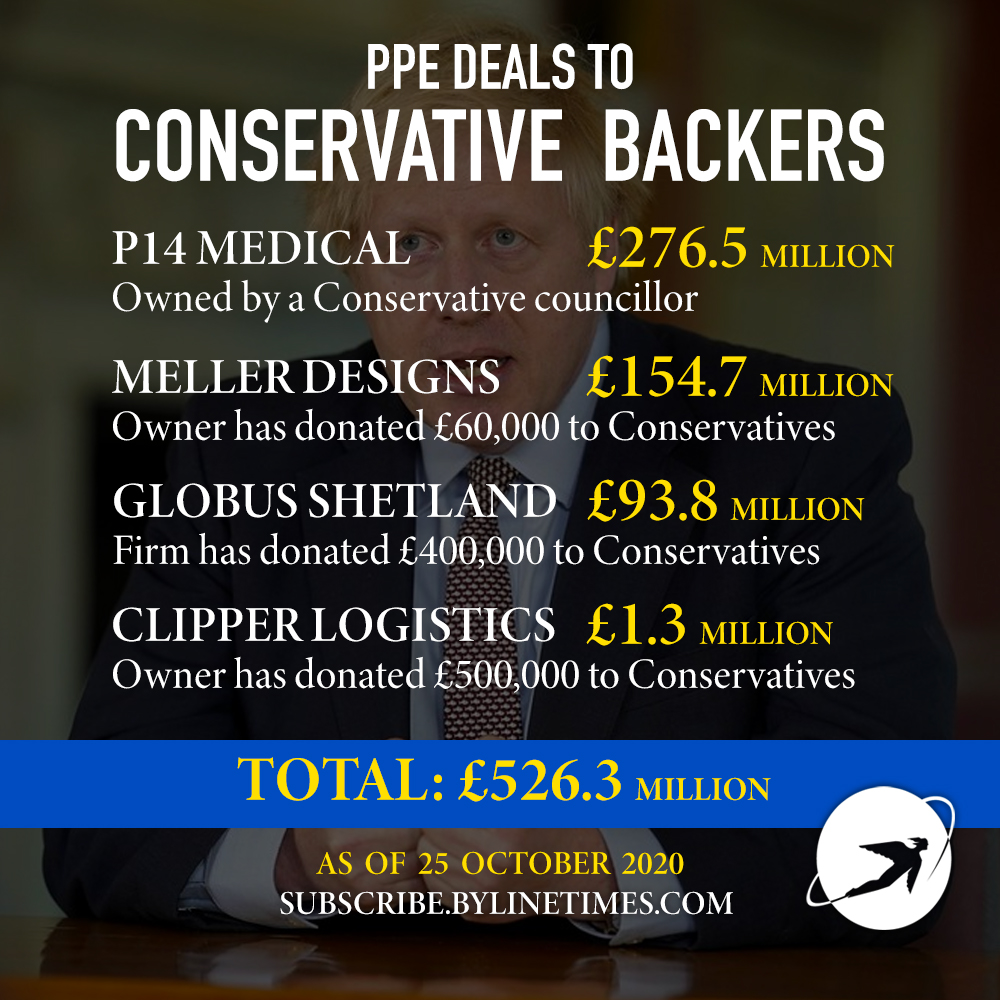
Through design or coincidence, contracts worth billions have subsequently been awarded to firms with links to the Conservative Party. This includes a £3 million deal awarded to Topham Guerin, the digital communications company that ran the Conservatives’ 2019 social media operation. And it includes a series of deals worth more than £150 million for personal protective equipment (PPE), awarded to a firm owned by a Conservative Party donor, a month after the company held a meeting with Lords Bethell and Feldman.
“It cannot be the case that Government contracts, even during a pandemic where fast decision-making is essential, are awarded to political insiders and friends of this Government and its ministers,” Labour MP Dawn Butler told Byline Times in reference to the Topham Guerin deal. “That’s cronyism, or worse.”
Yet, while the Government has deployed its old boys’ network to tackle the virus, a parallel trend of establishment patronage has hidden this scandal from view – until the evidence became too powerful to ignore.
The parliamentary lobby – the small cabal of journalists that sets the tempo of political news – largely ignored this story for months, until the publication of a report by the spending watchdog, the National Audit Office (NAO), in mid-November. It has largely been left to Byline Times, and legal campaigners at the Good Law Project, to illuminate the Government deals awarded to firms with questionable records.
For example, multi-million-pound PPE deals awarded to a hotel carpeting company, a naval design firm, a Florida fashion designer, a four-month-old DNA analysis firm, a one-year-old ‘micro’ firm, a small “luxury packaging” company, a one-month-old firm owned by offshore finance specialists, a dormant firm, a company owned by an individual listed in the Panama Papers, a fast fashion supplier, and a lifestyle company with no employees or trading history.
Corporate Occupation
Which leads onto the second, central trend of The Great Procurement Scandal – the corporate occupation of the public sector.
The logic, from the Government’s perspective, seems to go something like this: it is more efficient to commission private companies that specialise in certain fields of work to provide public services. These companies have the knowledge and expertise to deliver effective services at better value for money than the public sector, which is plagued by bureaucracy and waste.
Meanwhile, the corporate rationale for providing public services is very simple: the Government provides a huge market to exploit. Serco, for example, specialises pretty much exclusively in the provision of public services. The company, run by the grandson of Sir Winston Churchill and the brother of a former Conservative MP, boasts an annual turnover of £3 billion.
But, at some point since Margaret Thatcher’s privatisation drive of the 1980s, this idyll of private-public collaboration has become corrupted – or perhaps it was simply perfidious to begin with. Rather than empowering agile, innovative firms, the public realm is dominated by corporate hulks with a talent, above all else, for procuring Government contracts.
This has manifested with frightening scale and pace during the Coronavirus pandemic, with the Government seemingly unwilling or unable to provide the vast majority of its services without corporate assistance. The DHSC awarded private sector contracts worth £18 billion in the period up to August, the NAO estimates, with another £16 billion set to be spent on corporate suppliers to the ‘Test and Trace’ system before next March.
And so, consultancy giant Deloitte currently has more than 1,000 staff stationed in the ‘Test and Trace’ operation, roughly equivalent to a small Government department. ‘Test and Trace’ is run by Baroness Dido Harding – a former employee of the consultancy firm McKinsey – a firm that also has several dozen staff in the baroness’ set-up.
Serco, meanwhile, has been pivotal to the UK’s centralised contact tracing system – commissioned to run various call handling centres. The NAO believes that staff working at these centres had only been occupied for 1% of their contracted paid hours by June.


Labour MPs have consequently called for Serco’s role in public services to be diminished, with Shadow Cabinet Office Minister Rachel Reeves saying that the UK’s private-led system is “failing on almost every measure”.
Ironically, however, after facing criticism for its less-than-convincing contribution to the pandemic response, Serco has recently been included in a £7.5 billion contract, along with 27 other suppliers, to provide “employment services” after the pandemic.
The performance of corporate-occupied public services has hardly been an advert for the continued amalgamation of the public and private sectors. Awarding £10 billion worth of private sector contracts without competition, the Government sought to replenish the nation’s stockpile of PPE in the early months of the pandemic.
However, as the NAO explains, a failure to accumulate reserves prior to the crisis – and a delayed reaction to its severity – led the Government to massively overpay for equipment. In the scramble to ferry supplies to the frontline, dozens of healthcare workers died waiting for PPE.
The Test and Trace operation, meanwhile, has failed to process tests quickly enough amid surging cases, and has consistently reached too few contacts for the system to function effectively.
Complicit in these multi-faceted failures, and allergic to the idea of humility, the Government has been dogged in its defence of the private sector. Harding, Boris Johnson and various other ministers have publicly hailed the contribution of private firms to the national effort, saying that it wouldn’t have been possible without them.
In contrast, Reeves claimed that Johnson’s Government is “simply addicted to outsourcing,” in her article for Byline Times.
Private sector procurement has been pushed into the cerebral cortex of British politics over the past year, spurred by mass public concern. Johnson began the year saluting his administration as the “people’s Government”. As 2020 draws to the close, he has merely distributed wealth and power to a corporate, politically-connected elite under the guise of “outsourcing”.


Thank youfor reading this article
New to Byline Times? Find out about us
Our leading investigations include Russian Interference, Coronavirus, Cronyism and Far Right Radicalisation. We also introduce new voices of colour in Our Lives Matter.
Support our journalists
To have an impact, our investigations need an audience.
But emails don’t pay our journalists, and nor do billionaires or intrusive ads. We’re funded by readers’ subscription fees:
Or donate to our seasonal crowdfunder to hire an additional journalist to conduct more investigations.
Recent Comments