


When the U.S. Navy’s adversaries have reconnaissance capabilities and firepower to locate and destroy virtually any target, how can it achieve and sustain ocean supremacy? That’s the question facing the U.S. Navy right now, and the answer is very likely to include a large number of unmanned ships, both submersible and on the ocean surface.
By September of next year, engineering on navigational capabilities, autonomy and payload deployment for the Orca Extra Large Unmanned Undersea Vehicle (XLUUV) program, a major step toward achieving this superiority, is expected to be completed.
Measuring fifty-one feet in length and weighing fifty tons and with maximum diving depths of 11,000 feet, Orcas will have a range of 6,500 nautical miles and can run completely alone for months at a time. The submarine features an inertial navigation system, depth sensors, and the ability to surface to get a fix on its position via GPS. It uses satellite communications to phone home and report information or receive new orders. Echo Voyager has a top speed of eight knots.
One crucial feature of Echo Voyager is the modular payload system that allows it to take on different payloads to support different missions. The unmanned submarine has an internal cargo volume of 2,000 cubic feet with a maximum length of thirty-four feet and a capacity of eight tons. It can also support external payloads hanging off the hull.
How much Orca will improve upon the technology already inside Echo Voyager is unknown. U.S. Naval Institute News reports that Orca will be capable of mine countermeasures, anti-submarine warfare, anti-surface warfare, and strike missions. Orca could carry sonar payloads, detect enemy submarines, and send location data to friendly helicopters and surface ships.
Orca could even pack MK-46 lightweight torpedoes or MK-48 heavyweight torpedoes to attack submarines and surface ships. It would even carry anti-ship missiles. It can also be used to drop off cargoes on the seabed, such as sensors, to detect or lay mines to impede shipping. The modular payload system and open architecture software ensure Orca could be rapidly configured based on need.
This sort of versatility in a single, low-cost package is at this point unheard of in military spending. The nearest rough equivalent is the $584 million Littoral Combat Ship, which requires a crew of forty. While the LCS is faster and carries a larger payload, the autonomous Orca is cheaper by orders of magnitude.
For missions such as anti-submarine warfare, dozens of cheaper Orcas could saturate an area, potentially a far more effective strategy than that provided by a single surface ship or a manned submarine. Several Orcas could be controlled by a single shore-based crew, allowing the autonomous submarines to operate independently for days or even weeks at a time.
Another benefit of unmanned submersibles is that they are more or less disposable and able to operate in dangerous waters without risking human lives. Orca could pretend to be a full-size submarine; waiting for an enemy submarine to take a shot while a real Virginia-class nuclear-powered attack submarine sits back, waiting to ambush it. Orca could take on the most dangerous missions, such as laying mines in heavily defended waters. They would be leaving behind a deadly surprise for enemies convinced that mine laying in their waters is simply too dangerous for manned submarines.
It is still not known whether an Orca system can become a full-fledged part of the fleet, although the Navy’s purchase of four indicates that there are plans for using them for real-world missions. The Navy may be purchasing enough to continue testing while having a few on hand for actual use. Inexpensive systems like Orca could go a long way towards one of the most understated promises of unmanned air, land, and sea drones: reversing the out-of-control costs of today’s weapons systems.
While China’s development of unmanned surface vessels may just be getting started, researchers in AI projects report that the country is developing large, smart and relatively low-cost unmanned submarines that appear to be capable of performing a wide range of missions, from reconnaissance to mine placement to even suicide attacks against enemy vessels. These submarines—expected to be deployed in the early 2020s and not intended to entirely replace human-operated submarines—are intended to contest U.S. Naval forces in strategic waters like the South China Sea and Western Pacific Ocean.
At the testing facility at Zhuhai, Guangdong province, military researchers are also reportedly developing an AI-assisted support system for submarine commanders. The new class of unmanned submarines is expected to join the other autonomous or manned military systems on water, land and orbit to carry out missions in coordinated efforts, according to the researchers.
China’s plans for unmanned warships are clearly extensive. It is part of the government’s ambitious plan to boost the country’s naval power with AI technology.
With no human operators on board, these subs will handle their assignments and return to base on their own. While they may establish contact with the ground command periodically for updates, they will be designed to completing missions without human intervention.
According to researchers, the AI-powered subs are “giants” compared to the normal UUVs. Their cargo bays are reconfigurable and large enough to accommodate a wide range of freight, from powerful surveillance equipment to missiles or torpedoes. Their energy supply comes from diesel-electric engines or other power sources that ensure continuous operation for months. The Chinese unmanned submarine would not be nuclear-armed, and their main advantage is that they can be produced and operated on a large scale at a relatively low cost.
While not presently developing unmanned submarines, Russia has something of an equivalent with the Poseidon, deemed a “doomsday weapon” by the Pentagon back when the drone-bearing torpedo was still known as the Status-6 Oceanic Multipurpose System. President Vladimir Putin confirmed the operational status of Poseidon during his March 2018 State of the Nation address, in which he touted work on “unmanned submersible vehicles that can move at great depths—I would say extreme depths—intercontinentally, at a speed multiple times higher than the speed of submarines, cutting-edge torpedoes and all kinds of surface vessels, including some of the fastest. They are quiet, highly maneuverable and have hardly any vulnerability for the enemy to exploit. There is simply nothing in the world capable of withstanding them.”
There is also major competition underway between the United States and China to develop unmanned surface combat ships. On November 5, a strange-looking ship, just under 200 feet in length, docked at Port Hueneme, Calif., 4,700 miles from her departure point at Mobile, Ala. What was unique and historic about the ship and the event was that she had made the voyage, including transit of the Panama Canal, with no one aboard.
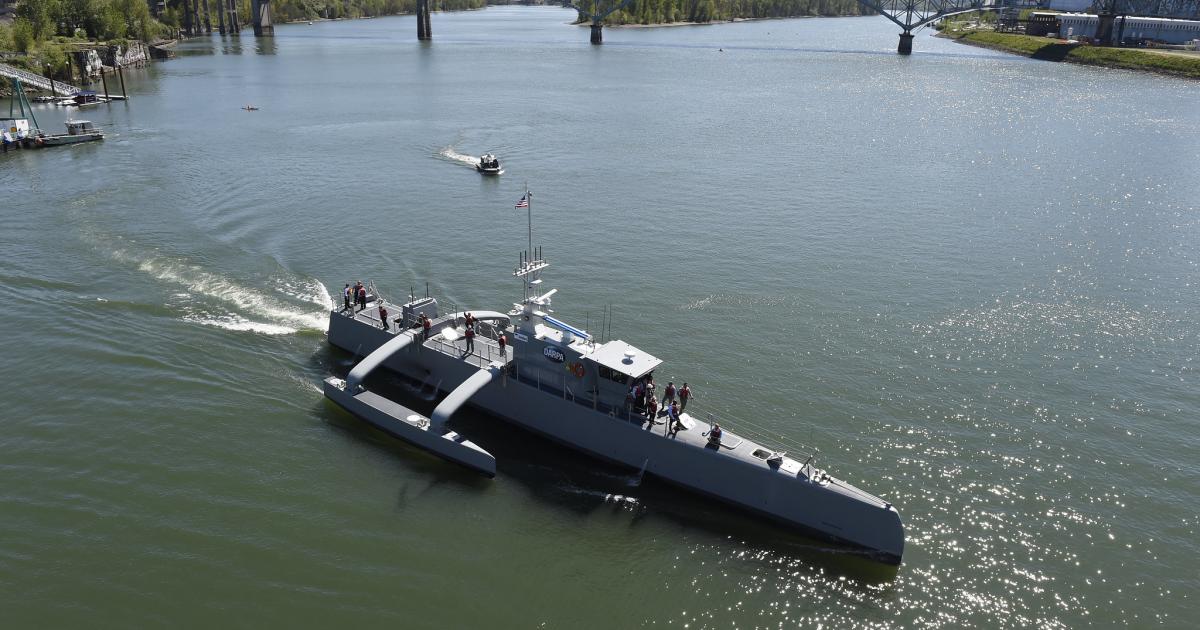
The unnamed ship is a Ghost Fleet Overlord test vessel playing a vital role in the U.S. Navy ‘s development is what is expected to be a large number of unmanned surface vessels (USVs) capable of packing massive fire power and vast recognizance capabilities into combat zones, without the risking a single crew member’s life and at vastly reduced cost than the manned navy.
In early 2019, USS Sea Hunter became the first ship to autonomously navigate a straight-line voyage from San Diego to Pearl Harbor and back without a crewmember, demonstrating that the Navy has autonomous technology and is ready to move from the developmental and experimental stages to advanced mission testing.
Today two-thirds of the U.S. fleet is made up of Large Surface Combatants (LSCs), monolithic and multi-mission platforms (e.g., destroyers and carriers) designed to perform many missions at once in self-contained kill chains existing within single hulls, which are expensive to man and maintain. The likely future alternative is a transition to unmanned systems capable of taking the place of manned platforms in some situations. Two unmanned systems could take the place of one destroyer and one frigate at a substantially lower cost.
Strategically, the Navy is transitioning from a war-of-attrition approach to a strategy of capabilities that will confuse enemies enough to forestall conflict or to win should conflict be unavoidable.
The service is so sure that it needs USVs for its future operations that it is pouring $2.7 billion into researching and buying ten large USVs over the next five years. With much still unknown about the capabilities of USVs, why is the Navy risking such major investment? According to Vice Admiral Bill Merz, formerly Deputy Chief of Naval Operations for Warfare Systems (OPNAVN9) and currently commander of the 7th Fleet, this lack of knowledge is precisely the reason.
“We have a lot to learn on the unmanned surface vehicles,” he explains. “We’ve all said that in testimony, but we’re at the point where we really have to get them out there to start understanding how tough are these things, how robust, and how are they going to integrate them with the fleet, what kind of policies are going to surround these systems when you start talking about potentially separating weapons from humans. We’re cautious on that side, but we’re very aggressive in getting it out there, and run these parallel paths and illuminate these challenges and start resolving them.”
Admiral Merz added that this commitment sends a tremendous message to the ship-building industry, crucial to companies making the investments needed to meet the Navy’s coming requirements. “Every recent study we have done, several of them directed by Congress, has indicated that this capability if indispensable. In fact, absolutely essential if a more distributed, more lethal, more cost-imposing, all to complement the 355-ship Navy,” he said.
Potential adversaries are, of course, well into the development of unmanned surface ships as well. At just over a third the length of the Sea Hunter, China’s JARI USV unmanned “warship” is boasted to have the firepower of an Arleigh Burke destroyer.
In its 2021 budget request to Congress, the U.S. Navy asked for $580 million for research and development of unmanned vessels. The appropriation is essential so the future Navy would include large and medium unmanned surface vessels and large unmanned submarines.
This piece originally appeared in the National Interest https://nationalinterest.org/blog/buzz/meet-us-navy%E2%80%99s-unmanned-ships-future-175522?page=0%2C1
Recent Comments