


TOKYO — A government panel of experts deliberating measures to reduce and recycle plastic waste has come up with an institutional reform proposal to achieve the Japanese government’s goal of reducing single-use plastic by 25% by 2030, causing concern among local governments, which will be responsible for collecting the plastic.
According to the government panel’s reform proposal, plastic waste will be newly categorized as “plastic resources,” the bulk collection of which will be tasked to municipal governments. Newly collected plastic resources are most likely to be single-material items that are easy to recycle, such as plastic buckets and basins. The government will deliberate drawing up guidelines to indicate to local governments what specific items are eligible for collection as plastic resources, among other detailed information.
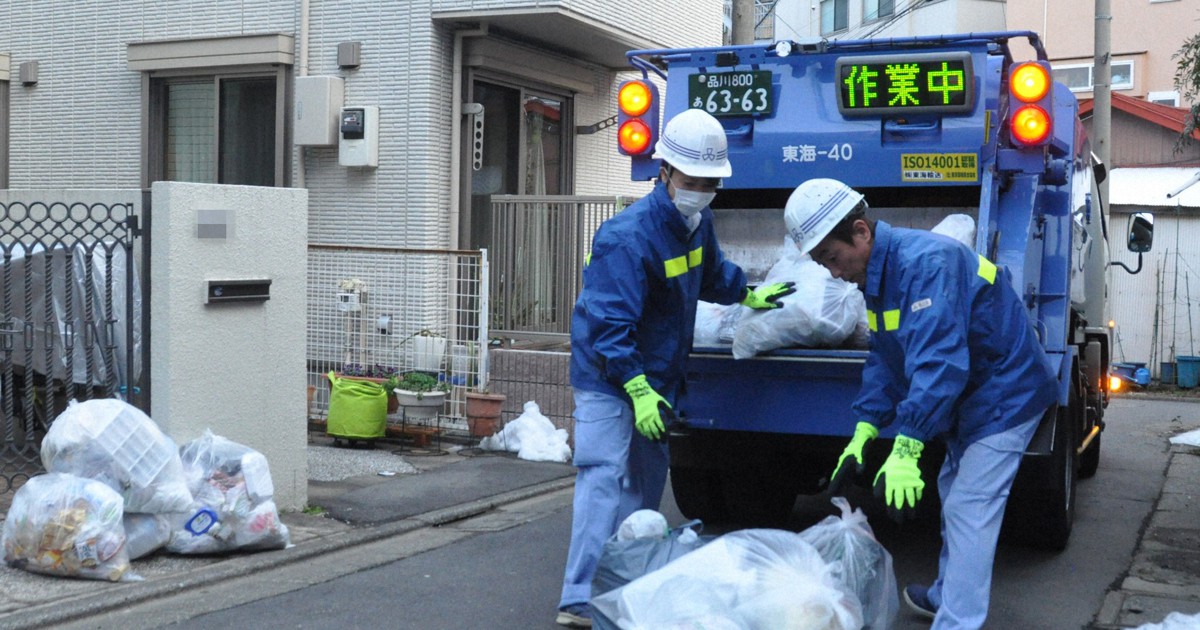
Under the Act on the Promotion of Sorted Collection and Recycling of Containers and Packaging, municipal governments are already being requested to collect plastic waste from households, sorted into two categories: plastic bottles, and other plastic containers and wrappers. However, other kinds of plastic that fall outside of these categories are either being incinerated as burnable trash or dumped in landfills.
Of the approximately 9 million metric tons of plastic waste that is generated domestically every year, that generated by corporations and considered industrial waste accounts for some 7 million tons, or nearly 80% of the total. Toward reducing the amount of corporate plastic waste, the government will request that manufacturers of plastic products collect the used plastic products themselves. At the same time, the government will request that plastic products be designed so that they can be easily sorted and recycled, and will therefore be environmentally responsible.
One aim is to promote standardized designs within industries by stipulating specific guidelines. Reducing the amount of plastic used when designing such products would invigorate the use and spread of alternative materials, such as recycled material and biomass plastic.
The goal under the new system, set to go into effect as early as fiscal 2022, would be to integrate household garbage and industrial waste and reduce plastic waste as a whole. However, requests made to local governments and companies are expected to be just that: requests, not requirements. It is therefore unclear whether the government’s plastic reduction target will be achieved.
The Waste Management and Public Cleansing Act, which sets basic rules for waste processing, stipulates that each municipal government decides its own household waste sorting and disposal methods. Because of this, despite the existence of the Act on the Promotion of Sorted Collection and Recycling of Containers and Packaging, as of fiscal 2019, household plastic waste was sorted in line with the rules in 1,110 municipalities, or 64% of all municipalities, according to the Japan Containers and Packaging Recycling Association. The majority of the remaining municipal governments are believed to be incinerating the plastic with other burnable waste, which means they will have to find the means to change their ways if the new system is implemented.
Tokyo’s Setagaya Ward is one of such municipalities that does not sort its plastic waste. Of the approximately 160,000 metric tons of burnable waste that is generated yearly, some 18% is plastic, but it is incinerated instead of recycled.
Twice a month, Setagaya Ward residents can bring their plastic food containers, trays and other items to 27 locations, including ward community centers. A total of some 7 tons of plastic is collected through such events, and fundamental measures to deal with the load will be indispensable. Confronted with the government’s reform proposal, Setagaya Ward officials say they plan on investigating how much it will cost to sort and collect plastic waste starting in fiscal 2021.
The head of the ward’s operations section, who oversees waste disposal, explained, “To launch a new system in fiscal 2022, it is necessary to solidify a policy by next summer, which means we don’t have much time. We’d like to deliberate the best method of garbage sorting for our ward, taking into consideration such things as the cost of collecting and transporting waste.”
According to another Tokyo ward that has already put a recycling scheme into place, the new category that the government is trying to institute — “plastic resources” — accounts for only 4% or so of household waste. “It is questionable how much this plan would actually reduce trash, and garbage collection would cost more money. With municipal finances being tight, there is a possibility that we might have to ask ward residents to bear some of the burden through designated paid garbage bags,” a ward official said.
In November, cosmetics and chemical company Kao Corp. and toiletry and chemical company Lion Corp. began an experiment at retail giant Ito Yokado’s Hikifune outlet in the capital’s Sumida Ward to collect and recycle empty refill packages for detergent and other products. Their plan is to collaborate, in the future, in creating guidelines for designing products that are easy to recycle.
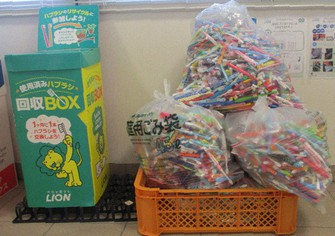
It is common for companies to incorporate features into product design that differentiate their products from those of other companies, so this is a very rare case of rival companies working together. Lion Corp. has already implemented a used toothbrush collection program for its own toothbrushes, but it has often seen toothbrushes from other companies mixed in with their own. “We felt that there were limits to what we could do as just one company,” a company representative said. “There’s a need to change our attitude from ‘competition’ to ‘collaboration,’ and build a recycling system as an industry.”
There are countless challenges, however. In experiments, collected plastic is washed and shredded, and is finally reborn as items including building blocks for children. Detergent refill packages are commonly made of multiple layers of five to six types of plastic film to make them durable. When different plastic types are recycled together, however, the plastic lacks durability. It is technologically difficult to create a recycled product.
The Lion Corp. representative said, “At this point, recycled plastic can only be used for simple structures such as planters and blocks. Collaborative efforts toward technological innovation are crucial to push ahead with the development of plastic that can be used over and over to create new products.”
(Japanese original by Toshiyuki Suzuki, Science & Environment News Department)
Recent Comments