


Chinese officials say they plan to share a portion of the nearly 4 pounds of lunar material returned by the Chang’e 5 mission with other countries, but an allocation for U.S. scientists will hinge on a change in U.S. policy restricting cooperation between NASA and China’s space program.
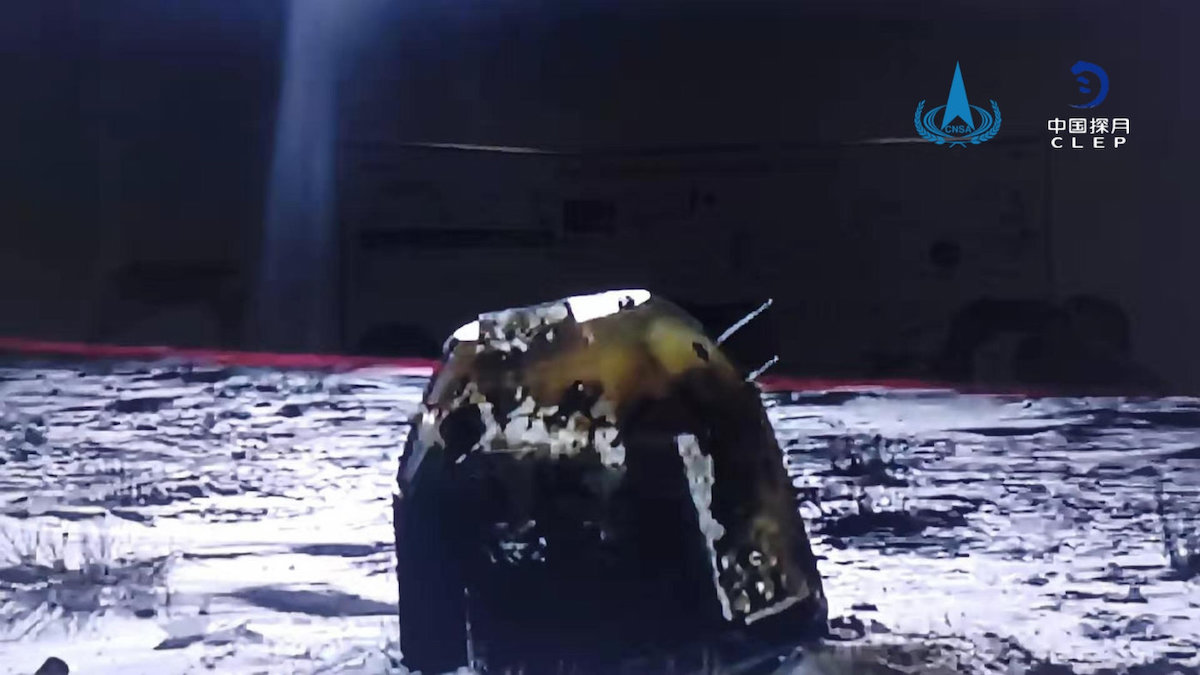
The Chang’e 5 sample return capsule landed in China’s Inner Mongolia region Dec. 16, ending a 23-day robotic mission that brought back the first lunar rocks since 1976. The mission made China the third country, after the United States and Russia, to successfully return samples from the Moon.
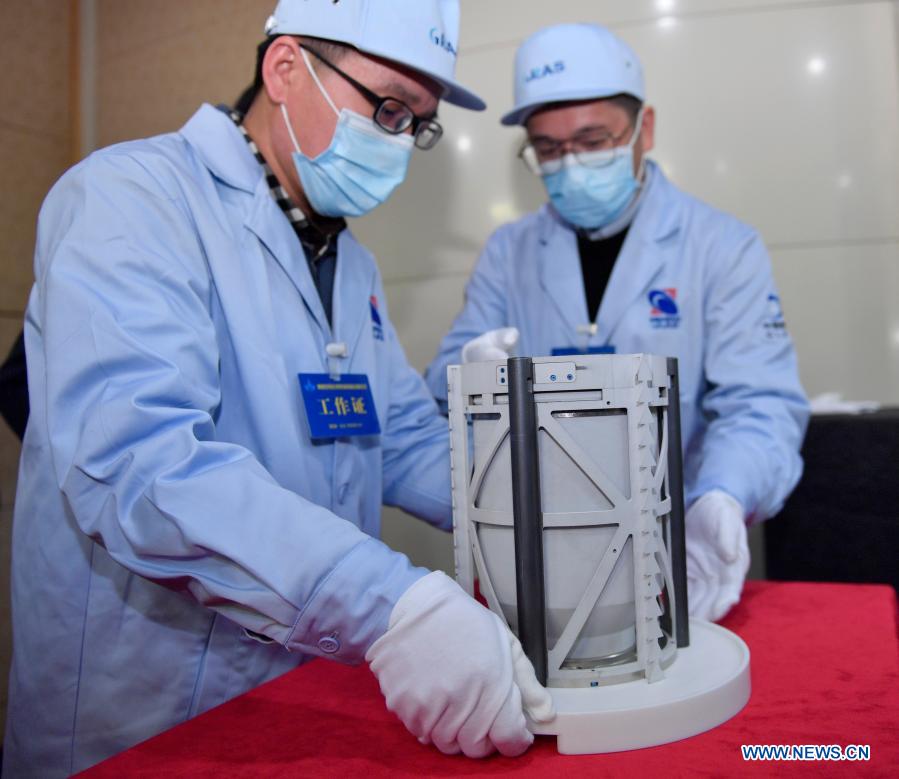
Officials from the China National Space Administration, or CNSA, handed over the Chang’e 5 samples to the Chinese Academy of Sciences on Dec. 19 to undergo detailed analyses inside Chinese laboratories.
Wu Yanhua, deputy director of the Chinese space agency, said in a press conference Dec. 17 that China will make some of the Chang’e 5 samples available to international scientists. Some of the specimens will also be put on public display at the National Museum of China in Beijing, and given to the United Nations, Wu said.
China will also “share samples with other countries and scientists around the world in accordance with the relevant international cooperation conventions, as well as multilateral and bilateral cooperation agreements,” Wu said Dec. 17. “We will soon release guidelines on the management of the lunar samples and data.”
Wu said some of the samples may be given to other countries as “diplomatic gifts” following the example set by the United States and Russia, which distributed lunar materials gathered by the Apollo and Luna missions.
Nine missions have returned moon samples to Earth, including NASA’s six Apollo missions with astronauts, and three robotic Luna spacecraft launched by the Soviet Union. NASA’s Apollo missions brought back 842 pounds (382 kilograms) of rocks from the moon.
The Soviet Union’s Luna 24 mission was the last mission to return rocks from the moon in 1976.
Asked in the Dec. 17 press conference whether China will share Chang’e 5’s samples with scientists in the United States, Wu said that depends on U.S. policy.
“The possibility of cooperation between us depends on the U.S. government,” Wu said in translated remarks.
He continued by saying China would like to cooperate with U.S. government agencies, such as NASA, commercial companies, scientists, and engineers on the basis of “equality, mutual benefits, and peace.”
Legislative language inserted in appropriations bills since 2011 has largely restricted NASA’s cooperation with the Chinese space program. There have been a few exceptions, such as multilateral meetings and bilateral discussions between NASA and Chinese officials regarding Earth science research.
The language was first added by former Rep. Frank Wolf (R-Virginia) to NASA’s section of a government appropriations bill in 2011, and similar provisions have been part of appropriations bills every year since then.
Wu called the provision, known as the Wolf Amendment, “unfortunate” in the Dec. 17 press conference.
NASA said in a statement after Chang’e 5’s launch that it hopes China “shares its data with the global scientific community to enhance our understanding of the moon like our Apollo missions did and the Artemis program will.”
The Artemis program is NASA’s effort to return astronauts to the lunar surface for the first time since 1972.
Wu said the European Space Agency, Argentina, Namibia, Pakistan, and other countries assisted China in executing the Chang’e 5 mission. ESA provided tracking and communications support, and Argentina hosts a Chinese ground station.
Clive Neal, a planetary geologist at the University of Notre Dame, said an interview before the mission’s launch Nov. 23 that he would be surprised if the Chang’e 5 samples are distributed to the United States, at least initially.
“I don’t expect them to come to the U.S. given the souring of relations between China and the U.S. at the political level,” Neal said. “However, I think there will be potential collaborations between scientists. The lunar science community is international in nature, and we tend to get along pretty well. So I’m hoping the results will be made available through our science colleagues, even if the samples can’t come out of China.”
The Chang’e 5 mission came after successful landings of Chinese spacecraft on the Moon in 2013 and 2019. The landing in 2019, on the Chang’e 4 mission, was the first soft touchdown of a spacecraft on the far side of the Moon.
Chang’e 5 landed on the near side of the moon in the Oceanus Procellarum, or Ocean of Storms, region, east of a volcanic plateau named Mons Rümker.
There is evidence that rocks in Chang’e 5’s landing zone are much younger than those returned by the Apollo astronauts. Those specimens are some 3.5 billion years old, created during a period of active volcanism in the first billion years of the moon’s existence.
Lava plains to the east of Mons Rümker appear to be less battered by asteroid impacts, suggesting rocks there could be less than 2 billion years old. But models of the moon’s evolution suggest its internal heating should have diminished by that time, rendering volcanoes extinct, Neal said.
“This is a whole new sampling region,” said Li Chunlai, deputy chief designer of the Chang’e 5 mission. “We’ve got the fresh new samples for research, which should be of great scientific value in areas including weathering, volcanism, the regional geological background, and evolution fo the Moon.
“Most of the samples will be used for scientific research,” Li said. “We will conduct long-term and systematic research on lunar samples in the laboratory, including its structure, physical properties, chemical composition, isotopic composition, characteristics of the minerals, and the geological evolution behind the samples.”
Chang’e 5 was designed to return a bit more material than the 3.8 pounds (1.731 kilograms) of samples it actually brought back to Earth.
The mission’s robotic lander drilled specimens from within the lunar crust, and a scoop gathered fine-grained material from the surface.
“We were going to drill a 2-meter-deep (6.6-foot) hole,” said Hu Hao, chief designer of the third phase of China’s lunar exploration program. “However, while the lander started drilling there, the radar echograms showed that there were several layers of slates underneath the landing site. So we were unable to go further down when we reached about 1 meter (3.3 feet) deep.”
Chinese officials decided to forego further drilling and not risk spending too much time on the operation before commanding the lander to continue with its next tasks. The landing craft’s time on the Moon’s surface was limited to about two days.
NASA set aside some of the hundreds of pounds of Apollo lunar samples for analysis using lab technology unavailable 50 years ago. U.S. scientists began analyzing some of the previously-unopened samples in 2019.
While the Apollo missions returned significantly more material than Chang’e 5, the Chinese mission may have returned clues about a different era in the Moon’s history.
“All of Apollo and Luna sites selected for sampling were old,” said Brett Denevi, a planetary geologist at the Johns Hopkins University’s Applied Physics Laboratory. “And of the sites that were on terrain shaped by volcanism, the volcanic eruptions occurred over 3 billion years ago.
“What is exciting about the Chang’e 5 sampling location is that it is on a volcanic deposit that may have formed closer to 1 billion years ago,” Denevi said. “That might sound old still, but for the Moon, that would have been the last major gasp of volcanism, so those samples will give us what may have been the final chapter in the story of volcanic eruptions on the Moon and how the interior of the moon evolved over time as eruptions waned.”
China’s next lunar mission, Chang’e 6, will attempt to return samples from the Moon’s south pole region in 2023.
Wu said China will launch the Chang’e 7 and Chang’e 8 robotic lunar missions to test technologies and perform further scientific research before China sends astronauts to the Moon. He did not say when the Chang’e 7, Chang’e 8, or a future human expedition might launch.
Email the author.
Follow Stephen Clark on Twitter: @StephenClark1.
Recent Comments