


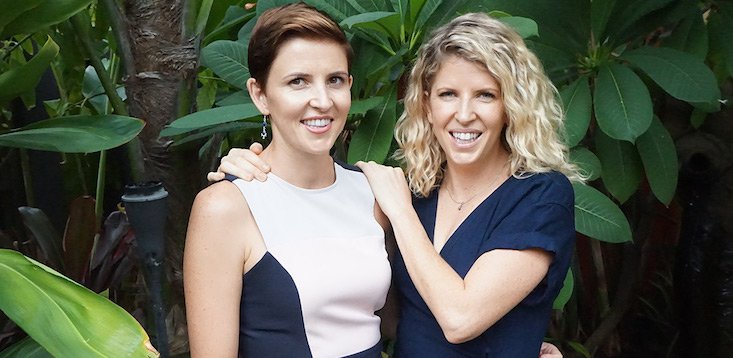
Coreo co-founders Ashleigh and Jaine Morris. Source: Citizens of the Great Barrier Reef.
In early-2017, I was lying on my sister’s bedroom floor listening to her lament about the state of the world.
For years, Ashleigh had worked on some of the world’s most intractable environmental issues: from the rising burden of e-waste to deforestation in Indonesia. She told me that throughout all of her professional experiences she only ever felt like she was putting bandaids on the symptom of the problem and not tackling the problem itself.
It would take the indomitable solo sailor, Dame Ellen MacArthur, to evoke a clear understanding for Ashleigh that the problem was our linear ‘take, make waste’ economy. Ash then dived into a monologue about how she believed the antidote to this flawed economic model could be found in the circular economy.
However, it was at this point in the conversation that I stopped Ashleigh’s reverie and asked her quite bluntly what she was going to do about it. You see, we are both believers of the philosophy that when you know better you do better, so to me it made perfect sense to challenge her.
Several reports had been released in early-2017 articulating the benefits of transitioning towards the circular economy, including the South Australian government’s Creating Value report, which highlighted the significant reduction in carbon emissions and the potential job creation opportunities.
The problem was though, no matter where we looked in Australia there was no tangible demonstration of how to take the circular economy out of theory and put it into practice.
So, on that fateful day in early-2017, Ashleigh and I decided we would work to answer the question: ‘What does the circular economy look like in practice?’ And we launched Australia’s first circular economy pilot project, The Circular Experiment.
Recognising that the circular economy is a systemic level transition that doesn’t have just one answer our first attempt to action this model was to work with small businesses.
For six months in 2017, we worked with 45 small businesses on one city street to implement a range of different circular economy concepts — things that were tangible to the businesses at the beginning, such as energy, water and waste. And gradually, as we built trust and rapport with the street, we started working with them on things that were a little more intangible, like logistics networks and asset sharing.
Fundamentally, The Circular Experiment was a success, and as such, it was no longer an experiment.
Fast forward three years, and our expertise now lies in advising and guiding industry and government through their circular economy aspirations at both a strategic and operational level. We are now a team of five (all women) circular economy practitioners working in three countries at all key junctures of the global economy.
We have delivered over 70 circular economy projects with some of the world’s largest organisations and governments, including BHP, Lendlease, the City of Sydney, Mirvac, Rio Tinto and more.
Since that day in early-2017, the circular economy has moved beyond a niche topic to a priority area of research and practice, and an undeniable economic opportunity. Australia is finally catching on to the opportunity and it’s incredibly exciting to see the circular economy and our work leading this transition, as well as being valued and embraced on a national and international scale.
Last year, Ash and I were invited to the 73rd United Nations General Assembly. Ash was the only Australian invited to speak at the World Circular Economy Forum and we continued to deliver ambitious projects that really pushed the boundaries of the circular economy in Australia.
Business news, information and ideas, free in your inbox daily.
You’ll also receive special offers from our partners. You can opt-out at any time.
Needless to say, it’s been an adventure. But something I’ve realised that is critically important about the transition to a circular economy is education.
The circular economy can feel like quite a nebulous topic, so I wanted to take this opportunity to dispel some of the common myths.
Myth one: It’s all about better waste management
In a circular economy, waste is eliminated through better design, rather than developing novel ways to utilise waste that has already been created.
It focuses on upstream innovation, and not better waste management.
There is a clear distinction between designing from waste and designing out waste.
Myth two: It’s only about recycling more
The focus of a circular economy is on maintaining products, components and materials at their highest possible value for the longest possible time.
This can be achieved through reuse, repair, refurbishment and remanufacturing strategies.
Recycling is part of the circular economy, but it represents the ‘loop of last resort’ when other options for products and materials are no longer available. Say it with me, folks: ‘Recycling is not the answer.’
Myth three: Efficiency is the answer
Traditional sustainability efforts have focused on efficiency tactics, or reducing the amount of material and energy used in production processes and aiming to lower environmental impacts.
A strategy focused on reducing the negative impacts of our activities — or making them more efficient — can only go so far.
We need to ensure systems are effective, not just efficient.
Remember, it’s not about doing less bad, but rather, more good.
Myth four: It’s just a fancy word for sustainability
The circular economy is a fundamentally different vision for the industrial economy in direct opposition to the incumbent take-make-waste linear model.
It focuses on industry-led transformation and systems-level change — drawing inspiration from nature — rather than individual action or guilt.
It is about designing differently from the outset, rather than mitigating and reducing the impacts of something that has already been created.
Key takeaway? Sustainability describes a state we are aiming to achieve, and circular economy gives us the tools to get there.
Myth five: Waste-to-energy is part of the circular economy
In many countries, incineration — the burning of waste such as plastics to produce energy — is viewed as a valuable pathway. But let’s be clear: mass incineration isn’t part of a well-designed system.
For example, in the case of plastics, taking an energy source (oil), turning it into an important material using more energy, which is then used for a very short period of time, only to then use more energy to turn it back into another form of energy, is not an example of a high-value process.
There’s also increasing evidence that waste-to-energy plants can lock cities, regions and even countries into needing a steady flow of waste to make these plants economically viable, essentially creating a demand for waste rather than designing it out.
This article was first published by Women’s Agenda.
Recent Comments