
Tech News, Magazine & Review WordPress Theme 2017
  • Home
  • Supply Chain Updates
  • Global News
  • Contact Us
  • Home
  • Supply Chain Updates
  • Global News
  • Contact Us
No Result
View All Result
No Result
View All Result
Home Supply Chain Updates

Cygnus cargo ship leaves space station to test 5G tech and spark fires in orbit

usscmc by usscmc
January 6, 2021
Cygnus cargo ship leaves space station to test 5G tech and spark fires in orbit
Share on FacebookShare on Twitter

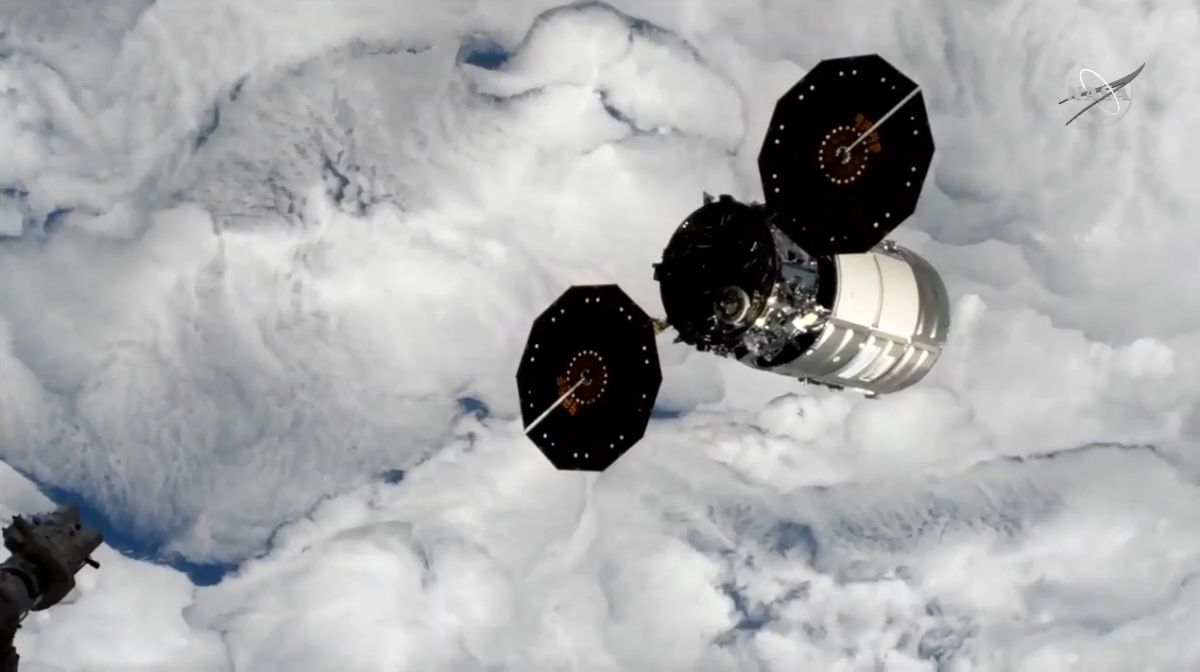
A Northrop Grumman Cygnus cargo ship successfully left the International Space Station for a new mission Wednesday (Jan. 5) to test 5G communications technology and spark fires in orbit.

The uncrewed Cygnus NG-14  spacecraft departed the space station at 10:10 a.m. EST (1510 GMT) after ground controllers released it from the Canadarm2 robotic arm. NASA astronaut Kate Rubins monitored the systems aboard Cygnus during its departure, from her perch on the space station.

Northrop Grumman launched the Cygnus cargo ship in October to deliver nearly 8,000 lbs. (3,600 kilograms) of scientific equipment, supplies, hardware and other things — including a space toilet — to the station. Astronauts then packed the ship full of trash, which will eventually burn up in the atmosphere in a planned (and destructive) reentry on Jan. 26.

Video: Watch the Cygnus NG-14 spacecraft cast off from the space station

Image 1 of 3

The uncrewed Northrop Grumman Cygnus NG-14 cargo ship S.S. Kalpana Chawla departed from the International Space Station on Jan. 6, 2020 to end a 93-day resupply mission.

(Image credit: NASA TV)
Image 2 of 3

The uncrewed Northrop Grumman Cygnus NG-14 cargo ship S.S. Kalpana Chawla departed from the International Space Station on Jan. 6, 2020 to end a 93-day resupply mission.

(Image credit: NASA TV)
Image 3 of 3

The uncrewed Northrop Grumman Cygnus NG-14 cargo ship S.S. Kalpana Chawla departed from the International Space Station on Jan. 6, 2020 to end a 93-day resupply mission.

(Image credit: NASA TV)

But first, Cygnus will allow ground investigators to squeeze a little more science out of the mission – including the SharkSat 5G technology experiment and the Saffire-V fire investigation.

SharkSat will collect measurements and other telemetry from the spacecraft and send it down to Earth, with the aim of further developing Ka-band software defined radio. Ka-band is a less crowded part of the electromagnetic spectrum than the other bandwidths used in space, NASA said in a statement. The investigation is testing equipment such as integrated circuits, multiprocessor systems and digital receivers.

“Potential uses of the technology include various types of terrestrial 5G telecommunications, as well as space-to-space and space-to-ground communications, among others,” NASA added. 5G is the newer and faster protocol for mobile technology that allows for the Internet of things and other applications, and it continues to be rolled out in the United States and worldwide despite the global pandemic.

The Cygnus spacecraft will also host Saffire-V, the latest in the Spacecraft Fire Safety (Saffire) investigations. Fire’s behavior in microgravity is poorly understood, and scientists want to know more about how to predict the growth of fire — and how to monitor it and extinguish it — to improve the safety of future astronaut flights.

“Saffire-V examines fire growth in the range of pressures and oxygen concentrations expected in future exploration spacecraft,” NASA said in a description of the Saffire series. “Saffire-V also demonstrates fire detection, combustion product monitoring, and post-fire cleanup using hardware similar to that planned for future human exploration spacecraft.”

Cygnus is expected to operate for about two weeks on SharkSat operations before re-entering the atmosphere, NASA said in a description about SharkSat. 

This Cygnus spacecraft is named after NASA astronaut Kalpana Chawla, the first female astronaut of Indian descent; Chawla and six other astronauts died during the Columbia space shuttle accident in 2003, in which the shuttle broke apart during reentry.

Follow Elizabeth Howell on Twitter @howellspace. Follow us on Twitter @Spacedotcom and on Facebook. 

usscmc

usscmc

No Result
View All Result

Recent Posts

  • How Hapag Lloyd captured a major market share in the Container Shipping Industry in USA
  • Why USA’s East Coast is the Favorite Destination for Manufacturing Companies
  • How Trade Relations Between the USA and UK Improved After Keir Starmer Became Prime Minister
  • Tips and Tricks for Procurement Managers to Handle Their Supplier Woes
  • The Crazy Supply Chain of Walmart Spanning Across the Globe

Recent Comments

  • Top 5 Supply Chain Certifications that are in high demand | Top 5 Certifications on Top 5 Globally Recognized Supply Chain Certifications
  • 3 Best Procurement Certifications that are most valuable | Procurement Newz on Top 5 Globally Recognized Supply Chain Certifications

Archives

  • July 2024
  • June 2024
  • May 2024
  • April 2024
  • March 2024
  • February 2024
  • January 2024
  • December 2023
  • November 2023
  • October 2023
  • September 2023
  • August 2023
  • July 2023
  • June 2023
  • May 2023
  • April 2023
  • March 2023
  • February 2023
  • January 2023
  • December 2022
  • November 2022
  • October 2022
  • September 2022
  • August 2022
  • July 2022
  • June 2022
  • May 2022
  • April 2022
  • March 2022
  • February 2022
  • January 2022
  • December 2021
  • November 2021
  • October 2021
  • September 2021
  • August 2021
  • July 2021
  • June 2021
  • May 2021
  • April 2021
  • March 2021
  • February 2021
  • January 2021
  • December 2020
  • November 2020
  • October 2020
  • September 2020
  • August 2020
  • July 2020
  • June 2020
  • May 2020
  • April 2020
  • March 2020
  • February 2020
  • January 2020
  • December 2019
  • November 2019
  • September 2019

Categories

  • Global News
  • Supply Chain Updates

Meta

  • Log in
  • Entries feed
  • Comments feed
  • WordPress.org
  • Antispam
  • Contact Us
  • Disclaimer
  • Home
  • Privacy Policy
  • Terms of Use

© 2025 www.usscmc.com

This website uses cookies to improve your experience. We'll assume you're ok with this, but you can opt-out if you wish. Cookie settingsACCEPT
Privacy & Cookies Policy

Privacy Overview

This website uses cookies to improve your experience while you navigate through the website. Out of these cookies, the cookies that are categorized as necessary are stored on your browser as they are essential for the working of basic functionalities of the website. We also use third-party cookies that help us analyze and understand how you use this website. These cookies will be stored in your browser only with your consent. You also have the option to opt-out of these cookies. But opting out of some of these cookies may have an effect on your browsing experience.
Necessary
Always Enabled
Necessary cookies are absolutely essential for the website to function properly. This category only includes cookies that ensures basic functionalities and security features of the website. These cookies do not store any personal information.
Non-necessary
Any cookies that may not be particularly necessary for the website to function and is used specifically to collect user personal data via analytics, ads, other embedded contents are termed as non-necessary cookies. It is mandatory to procure user consent prior to running these cookies on your website.
SAVE & ACCEPT
No Result
View All Result
  • Home
  • Supply Chain Updates
  • Global News
  • Contact Us

© 2025 www.usscmc.com