


The good news is that over time many of the initial problems inevitable with such a dramatic change will dissipate. Alongside that, there will be new opportunities – some of them already evident in areas such as pharmaceutical manufacturing, and others yet to be spied by canny entrepreneurs.
If capitalism can create winners even in a depression, then there will certainly be those who will get rich from the barrier pushing Northern Ireland economically away from the rest of the UK.
The bad news is two-fold. First, the full regulatory and customs border is still barely being enforced in key areas, while other aspects of the new rules – especially in moving food products – will not be implemented until April.


A combination of December stockpiling, the economic effect of lockdown and January always being a lean month for freight means that the volume of trade crossing the Irish Sea in the last week has been unusually low. Therefore, the full scale of the problems are not yet evident.
Secondly, even when business adapts to the new bureaucracy and finds ways to trade across or around this border, there are going to be significant additional costs.
Many items will now simply not be sold in Northern Ireland and those that do cross the Irish Sea will be more expensive – not only because of the direct costs of the more expensive journey but because with some sellers abandoning the market there will be less competition, allowing prices to rise.
The loss of choice has started already, with Sainsbury’s withdrawing hundreds of products which its customers could buy until the end of last year. Customers who enjoyed Sainsbury’s Taste The Difference products now find many of them replaced with what they would find at a filling station – Spar brand. Sainsbury’s says it hopes the move is temporary, but there is no sign of the reason for the decision – the difficulty moving many fresh foods across the Irish Sea – being resolved.
That is good news for Henderson Group, the Mallusk-based wholesaler which supplies Spar in Northern Ireland, and for its local suppliers – although many of the products come from the Republic, Italy or elsewhere.
But it is an example of how customers are losing choice. Until now, Northern Ireland consumers could choose Sainsbury’s fresh pasta or Spar fresh pasta; now there is only the latter. That situation is likely to be replicated in multiple other companies, particularly in fresh food where the border checks are most onerous and costly.
That will not return Northern Ireland to the position during the Troubles when supermarkets such as Stewarts, Wellworths and Crazy Prices operated, with the public unable to access what was on offer in shops such as Tesco and Sainsbury’s. However, it will move us some way back in that direction and emphasise Northern Ireland – in yet another area of life – as a place apart from the rest of the UK.
Just five months ago, Boris Johnson travelled to Belfast and delivered an unequivocal assurance: “There will be no border down the Irish Sea – over my dead body.” But that Prime Ministerial promise has been cast aside with a casualness that jars with Mr Johnson’s self-appointed title of ‘Minister for the Union’.
Perhaps it is out of loyalty to Mr Johnson as his boss that Secretary of State Brandon Lewis has repeatedly insisted that “there is no Irish Sea border”. There are few other rational explanations for why Mr Lewis would choose this hill on which to sacrifice his reputation.
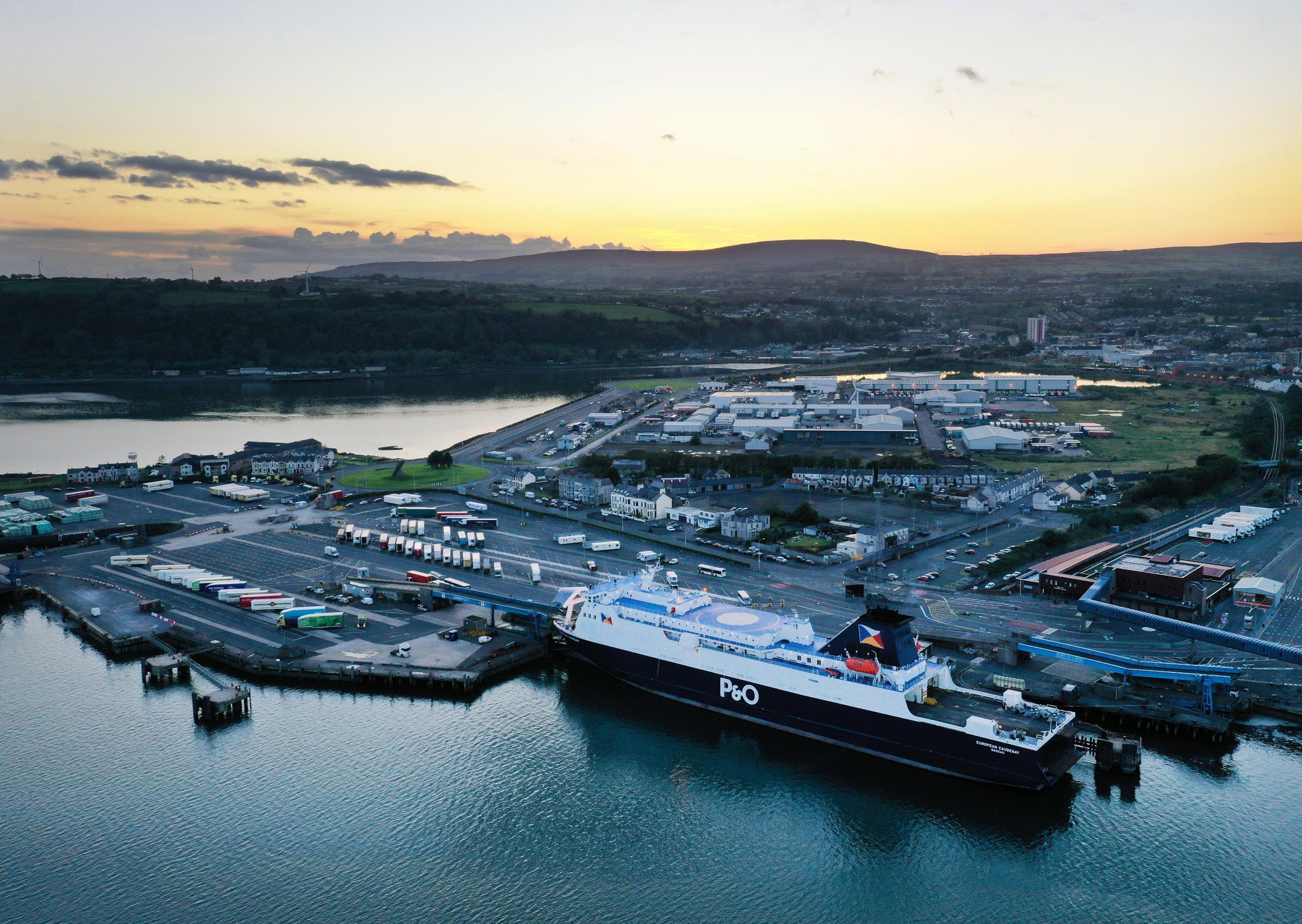
Self-evidently there is a new trade border: Mr Lewis’s own government has paid £40 million for what it describes as new ‘Border Control Posts’ in Larne, Belfast and Warrenpoint, frontier checks are being overseen by EU officials, lorries are being stopped from travelling between two parts of the United Kingdom if they do not have customs declarations for what the government now describes as ‘imports’ and ‘exports’, and UK Border Force officials are directing vehicles to be searched.
Industry figures speak with derision about Mr Lewis’s denial of that reality. One of the printable responses from a senior businessman is that “anyone who claims the process isn’t cumbersome and complicated hasn’t tried to do it”.
In fact, the first week of the new border has actually largely involved officials turning a blind eye to widespread infringements of the new rules. On Wednesday, Northern Ireland’s chief vet, Robert Huey, was blunt about what happened over recent days. Drawing on the famous words of the 19th century Prussian general Helmuth von Moltke the Elder, he told a Stormont committee: “We had a plan and it didn’t survive first contact with the enemy.”
He and Stormont officials had hoped that most hauliers would pre-notify their consignments electronically before crossing the Irish Sea. However, he said that “didn’t even get started” with many traders not having done so: “So on day one we had to dump the plan and go back to the more traditional method of going through the manifest to identify likely SPS [animal and plant] goods and pull those lorries off the end of the ramp.”
As compliance improves, most of those checks should speed up or be avoided altogether. But the compliance will involve continuous form-filling – some of which can only be done by expensive specialists.
The checks for which Mr Huey is responsible are only one part of the new border processes. He admitted that the new HMRC customs processes for companies trading with Northern Ireland “seem unbelievably complex to me”.
This week even customs expert Robert Hardy – the man chosen by the government as a key part of their scheme to attempt to smooth over the new border – admitted in an email seen by the News Letter: “The first few days of the new rules have been very tough. There are so many new processes and a massively steep learning curve, even for me….with 40 years’ experience in this field.”
Senior civil servant Denis McMahon, the man responsible for the Northern Ireland side of the plant, animal and food border, said that just days into the new rules one major firm to whom many hauliers have sub-contracted the form-filling is “simply overwhelmed” and working two days behind schedule.
A quarter of loads arriving at GB ports to cross the Irish Sea have been turned away – not even making it to Belfast or Larne, he said.
Unionists who remain sympathetic to the prime minister point to the fact that while moving goods into Northern Ireland is now a headache, he has at least secured “unfettered” access for goods going the other way.
The Ulster-born pro-Brexit economist Graham Gudgin wrote last week on ConservativeHome that the deal with the EU meant that “Johnson’s word on unfettered trade for Northern Ireland producers is upheld. Huge efforts have been made to ensure that few if any traders are more than minimally inconvenienced”.
But behind the word “unfettered” lies a hidden fetter. Mark Cosgrove, who has decades of experience in moving freight around the UK and Ireland, explained that there is more demand to send goods into Northern Ireland and so therefore it has been cheaper to export from NI.
He said that the cost of a lorry’s round-trip from NI to GB could typically be split 65% to the GB firm and 35% to the NI firm. Another industry source put the split about 55/45, but freight sources agreed that having a stream of otherwise empty lorries returning to GB has benefited local manufacturers.
The problem with a circular flow of lorries between GB and Northern Ireland is that a blockage in either direction is immediately felt in both directions. Thus, the fettering of trade east-west means that there are insufficient empty lorries coming back the other way to complete the cycle.
Mr Cosgrove said: “If there’s a diminution of what comes in, then the cost of exports going out will be higher because there will be less supply and equal demand.”
John Martin, NI policy manager for the Road Haulage Association, said that one local haulage company generally sends about 300 lorries laden with Northern Ireland produce to GB and would expect them back within four days carrying goods back into the province. But after four days only 100 of the lorries had returned.
The danger for Northern Ireland firms is that if they cannot reliably deliver products to Great Britain – and that can involve raw materials coming from GB to be processed here before returning – then their customers may find alternative suppliers.
Mr Martin also disputed the claim by Brandon Lewis that empty supermarket shelves in Northern Ireland this week were in large part down to problems last month in Dover. He said: “It is not solely or primarily about issues at Dover. I think politicians want to dampen down concern and make it seem everything is OK. It’s not, and ultimately it will be apparent to the public that products aren’t being delivered. Look at the shelves; the shelves are empty.”
He said that “the short term impact has been horrendous, to the extent that people are considering giving up haulage and manufacturers are considering moving their entire enterprise to GB”.
The haulage representative said that the “unmitigated disaster” of recent days will likely settle down. But what will not alter, he warns, is that the costs of the new procedures will make Northern Ireland a more uncompetitve place to do business and “more unattractive as a marketplace”.
Forms which a fortnight ago took 15-20 minutes now take 3-4 hours, he said. In time, that may be reduced to 2-3 hours, “but we will never be back to pre-December 31. That all adds to the cost of doing business and that will be passed on to the customer”.
On top of those direct costs, there are the indirect costs of a £100,000 lorry and an £80,000 trailer which will now be less productive when plying the Irish Sea route because of bureaucracy slowing the journey.
Political embarrassment makes this a delicate issue for most Stormont parties, London and Brussels. Some in the DUP who sold Brexit as a land of milk and honey rather than a complicated world few of them really understood are now backing the invocation of Article 16 of the Northern Ireland Protocol, allowing some of the measures to be disapplied in extreme circumstances. But that apparently easy solution in an extraordinarily complex area, would entail likely retaliatory consequences.
Meanwhile, the parties which, while opposing Brexit, firmly endorsed the Irish Sea border arrangements as a better alternative to such controls being implemented at the Irish border – Sinn Féin, the SDLP, Alliance and the Greens – may find it politically difficult to accept that the protocol they endorsed has created multiple problems.
But the greatest ideological problem here is for unionism. There was an extraordinary section in the prime minister’s Christmas Eve speech in which he announced the UK-EU trade deal. Mr Johnson said: “We have taken back control of laws and our destiny. We have taken back control of every jot and tittle of our regulation. In a way that is complete and unfettered.
“From January 1 we are outside the customs union, and outside the single market. British laws will be made solely by the British Parliament. Interpreted by UK judges sitting in UK courts. And the jurisdiction of the European Court of Justice will come to an end.”
Every one of those things was only true if the “we” excluded Northern Ireland. In fact, he never mentioned Northern Ireland once.
This new border will yet again reinforce to many unionists that London cannot be trusted to defend their place in the Union. But, unlike the Anglo-Irish Agreement, this is a dilemma which the leader of unionism willingly embraced by endorsing radical constitutional change with no coherent plan for how to implement it.
That does not necessarily make Sinn Féin’s still simplistic argument for even greater constitutional upheaval in the form of a united Ireland any more convincing to sceptics.
A message from the Editor:
Thank you for reading this story on our website. While I have your attention, I also have an important request to make of you.
With the coronavirus lockdown having a major impact on many of our advertisers — and consequently the revenue we receive — we are more reliant than ever on you taking out a digital subscription.
Subscribe to newsletter.co.uk and enjoy unlimited access to the best Northern Ireland and UK news and information online and on our app. With a digital subscription, you can read more than 5 articles, see fewer ads, enjoy faster load times, and get access to exclusive newsletters and content. Visit https://www.newsletter.co.uk/subscriptions now to sign up.
Our journalism costs money and we rely on advertising, print and digital revenues to help to support them. By supporting us, we are able to support you in providing trusted, fact-checked content for this website.
Recent Comments