


Rates for trucking, ocean containers, airfreight, parcels, you name it, the costs for shipping consumer & industrial goods are surging.
By Wolf Richter for WOLF STREET.
The dollar-amount spent by shippers, such as manufacturers or retailers, on shipping their goods jumped by 13% in December from a year earlier, driving the Cass Freight Index of Expenditures to a new record (red line). The amount spent on freight is a function of shipment volume and freight rates:
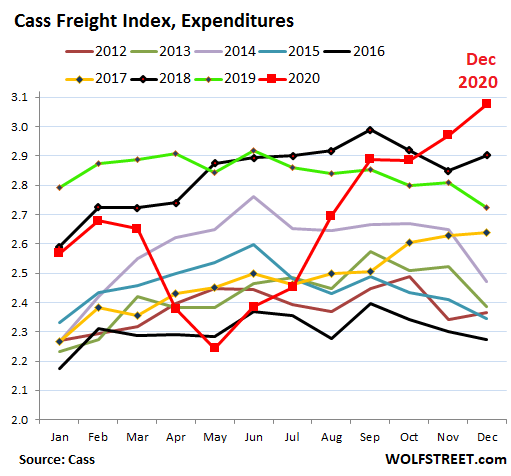
The Cass Freight Index covers shipments by all modes of transportation, but is heavily concentrated on shipments by truck, with truckload accounting for over half of the expenditures, followed by less-than-truckload (LTL), rail, parcel services, etc. It does not cover commodities.
The freight rates embedded in the index jumped by 6.0% in December compared to a year earlier. “Based in part on spot trends, the acceleration in freight rates is likely to persist in the coming months,” Cass said in the report.
Shipment volume surged 6.7% year-over-year, given the Pandemic shift in consumer spending to goods that need to be shipped, from services that are not shipped. But shipment volume in December (red line in the chart below) remained below the levels of 2018 (black) and 2017 (brown) at this time of the year:
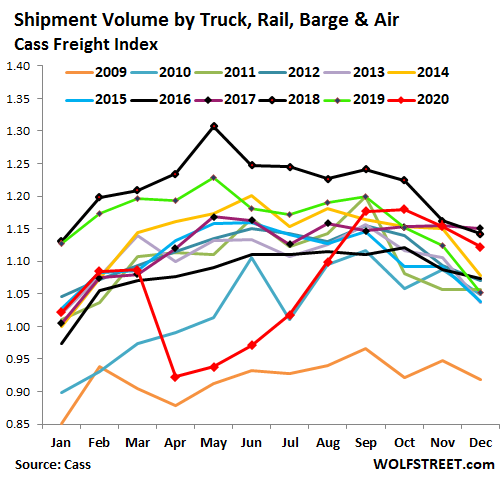
While Americans have cut back buying services, and spending on services remains sharply lower year-over year, they have been buying all kinds of goods, and many categories in record quantities, to where periodic supply shortages have cropped up here and there since March, ranging from hot-tubs to low-end laptops.
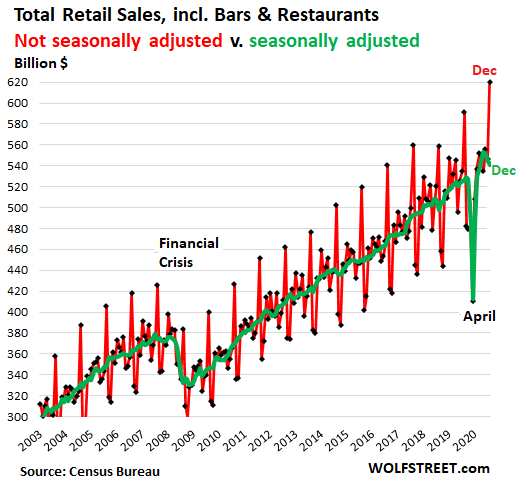
Retail sales (goods) in December rose by 4.8% from a year earlier to a record $620 billion (“not seasonally adjusted,” red line in the chart below). Everyone got sidetracked by the dip in “seasonally adjusted” retail sales. That dip was likely due to seasonal adjustments that had gone awry, particularly for ecommerce, due to the massive distortions in spending during the Pandemic:
In addition to consumer goods, there are industrial goods that supply manufacturers, oil and gas drilling operations, and construction – and single-family house construction is going wild right now. All these goods have to be transported. And in terms of consumer goods, many of them are imported.
So the freight rates for shipping containers from China to the US – and to Europe and other countries – have exploded, amid a mad scramble for empty containers. The Shanghai Containerized Freight Index (SCFI), which tracks the average spot rate of shipping containers from Shanghai on 13 major shipping routes, nearly tripled from a year ago to a record of 2,885 as of Friday.
Container rates to the US West Coast, which account for 20% of the SCFI, rose to a new record of $4,054 per TEU (Twenty-foot-Equivalent Unit), a standard measuring unit in the shipping industry. Chart of the SCFI via Shanghai Shipping Exchange:

FedEx and UPS, amid spiking shipment volume due to the boom in ecommerce, announced a slew of rate increases, most of which have now taken effect. These rate increases come on top of similar rate increases a year ago.
FedEx increased its rate for FedEx Freight by an “average” of 5.9%; and for FedEx Express, FedEx Ground, and FedEx Home Delivery by 4.9%. Surcharges increased between 3.2% and 9.3%. Among a slew of other increases, it imposed a new residential delivery surcharge (effective February 15). UPS increased its rates for Ground, Air, and International on “average” by 4.9%, in addition to other increases of fees and surcharges.
Air freight rates suddenly spiked in the spring. By December, the average rate per kilogram for example from Hong Kong to North America had shot up by 107% year-over-year to $7.50 per kilogram, according to the TAC Index, reported by Air Cargo News.
Before the Pandemic, roughly half of all air freight was carried in the belly holds of passenger planes. When airlines parked their passenger aircraft in March and April, they removed that freight capacity from the market, with massive effect. For example, from February to May the average rate from Hong Kong to North America shot up by 142% from $3.19 per kg to $7.73 per kg. As airlines began stuffing passenger compartments with freight, and as they began flying more planes, the spike began to wind down. But in October, prices began to spike again. In December, they hit $7.50 per kg, up by 107% year-over-year.
The pressures for each of these segments are different but all are related to the big shifts and distortions that occurred as a result of the Pandemic, during which consumers cut back spending on services and threw their stimulus money and stock market gains at goods, particularly durable goods, which created a lot of demand for the transportation industry.
But the transportation industry had its own issues when this demand for its services suddenly surged.
Planes were parked or retired in March and April, with airlines furiously trying to stay out of bankruptcy as their passenger business had collapsed. And the cargo capacity of those planes vanished from the market.
Trucking companies had just gone through their own crisis. Hundreds of them had filed for bankruptcy in 2019 as a result of the sharp downturn in the freight business, declining mileage rates, and pressures from debt. Many were liquidated. Most of them were small. But it also included regional carriers, such as New England Motor Freight and car-hauler Jack Cooper. And in December 2019, one of the largest full-truckload operators in the US, Celadon collapsed chaotically into bankruptcy. This took some capacity off the road.
In addition, trucking companies had drastically cut their purchases of new Class-8 trucks in 2019. They’re now trying to make up for it with historic spikes in orders, but it will be a while before these units are delivered.
And container carriers – having gone through a multiyear crisis of overcapacity and collapsed freight rates that sent some of the larger ones into bankruptcy, such as Korean carrier Hanjin in 2016 – have not sufficiently invested in containers, hence the current container shortage, and were purposefully slow in adding idled capacity in 2020, when demand surged, loving the resulting spike in freight rates all the way to the bank.
Perhaps fearing the exposure to this type of surge in freight rates, Amazon, for which shipping is a huge expense item, started to build its own transportation empire a few years ago, from last-mile delivery to a rapidly growing fleet of cargo planes for Amazon Air.
Enjoy reading WOLF STREET and want to support it? Using ad blockers – I totally get why – but want to support the site? You can donate. I appreciate it immensely. Click on the beer and iced-tea mug to find out how:

Would you like to be notified via email when WOLF STREET publishes a new article? Sign up here.

Recent Comments