


Unlike plastic, traces of cement are not found in food, nor seen stuck in the bellies of wildlife, fish, and birds. Hence, on the surface, it doesn’t seem as evil. In fact, it’s the favourite foundation material for both urban and rural populations because it’s robust, reliable, can hold water in our dams and keep us safe in our homes. Besides, it’s affordable.
But cement is responsible for almost 8% of the carbon emissions on the planet. Its impact on the environment is conveniently ignored for the larger profit. In fact, by the time you read this article, millions of litres of cement will already have been poured across the globe to create infrastructure that lasts for decades.
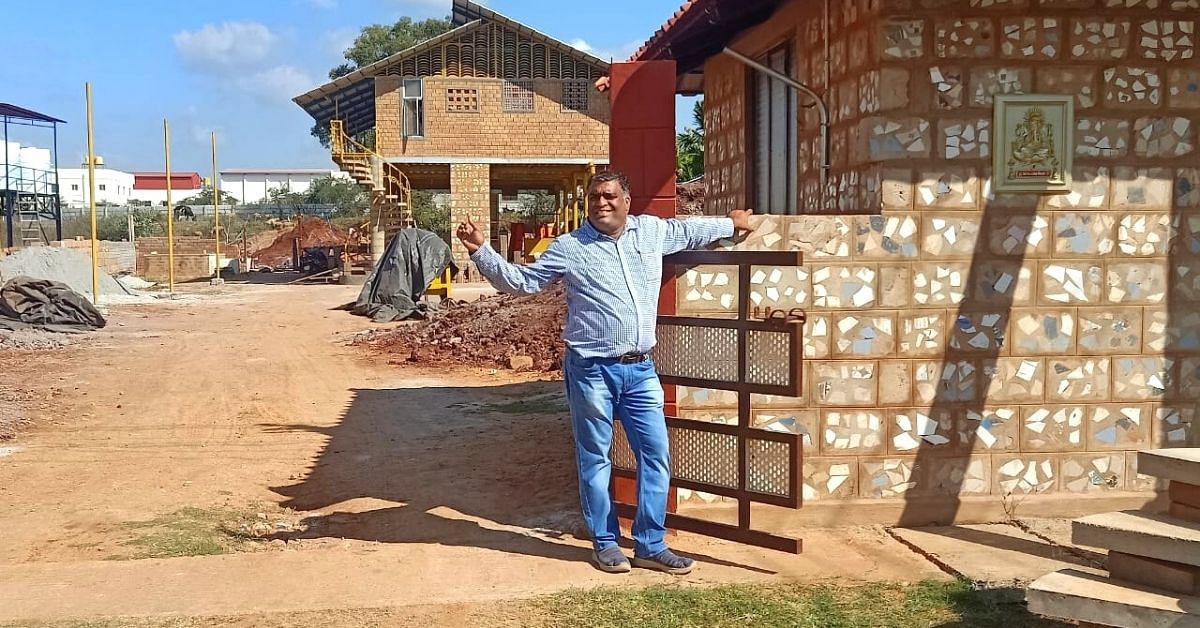
But a man from Karnataka is addressing this issue. Since 2005, Mysuru-based architect Rajesh Kumar Jain has been taking concrete steps to reduce carbon footprint. Through his venture, Regional Low Energy Environment-Friendly (RLEEF), the 45-year-old reuses cement from construction debris to build sustainable and zero waste infrastructure. He says he has built around 175 houses using this debris, including his office, which is made entirely of waste material that has been carelessly dumped in isolated parts of the city, or on riverbeds.
A cause for sustainability

“I was always inclined towards working in sustainable architecture, and academics allowed me to gain better insight into the matter. I learned about the health hazards of cement on human lives and nature, which is why I took up the challenge to reuse cement in my final-year academic project” he tells The Better India.
“Construction debris from old buildings is often dumped along the riverside and chokes the water bodies. Local governing bodies have a tough time managing such waste, as there is no robust system in place to tackle the issue. Also, manufacturing cement involves the emission of harmful gases, excess use of water, and extracting natural resources from the quarry,” he says, adding that careless management of construction debris at times is as hazardous as plastic.
With help from labourers, Rajesh collects debris and processes it manually into fine granules. The method involves identifying the strength and quality of the material. Depending on the usage, the waste is used to make tiles, walls or the foundation. All the buildings constructed in such a manner have rainwater harvesting structures, solar power plants, and kitchen wastewater treatment.
A host of eco-friendly features
The building is designed in a manner that requires no air conditioning or ceiling fans during summers. Explaining the approach, Rajesh says, “The buildings I recommend usually have a cylindrical water tank, light roof with micro-concrete slabs, jaali clay blocks used as parapets, tile cladding blocks and cudappah stone. The walls are built by interlocking stabilised earth blocks in an arched form. The windows and doors are reused from previous construction debris as well.”
The architect says that soil excavated from the construction site is used for making bricks. “I prefer rectangular rooms against the square-shaped rooms, because they use less steel and concrete. To further reduce construction cost, I recommend introducing skylights to allow more ventilation and natural light inside the building,” he says.
Rajesh adds that various interventions take place at every level, from the foundation to the actual construction, to evade plastering costs by using alternative material like stones instead of steel and concrete.
‘Kind to the environment’
The rubble from construction waste that is used to make walls is water-resistant, economical, sustainable and reduces heat transfer. “This eliminates the need to use natural resources like soil, stone from quarries, and so on. Additionally, it reduces the cost of transport and logistics for material. This further reduces carbon footprint,” he adds.
Rajesh says the most challenging part of his work is to convince the clients. “Many are aware of the issue, but need a deeper explanation of how their decisions in building a house affect the environment. Clients are told how the use of high-energy consuming materials and technologies, high cost of construction, and running cost of building, directly cause environmental degradation, as well as an adverse impact on health,” he says.
“People carry the notion that only cement is synonymous with durability. I want to highlight examples of structures that are as economically viable as cement ones, and cause minimum damage to nature,” he adds.
Michael Moraes, a retired navy official whose farmhouse Rajesh is constructing, says, “After my retirement, my family and I wanted to live in harmony with nature. We wanted to grow our own food, and thus, opting for earth architecture over conventional construction made sense.”
Michael says he visited some of RLEEF’s earlier projects, and was impressed with the fact that the bricks used were from the same site of the project, and not baked in a kiln. “The bricks were made using the compression technique, and did not chip. Also, some houses did not require fans during summers. Convinced with the quality and the eco-friendly features, we opted for this architecture, which is kind to the environment,” he says.
Making sustainability affordable
Many customers now come to Rajesh to build environment-friendly houses. “Awareness has increased, and more people are now curious about such architecture. I am also glad I could train a few students who trust this method and follow the techniques in their professional lives,” he says.
To create awareness, Rajesh with support from Mysore city corporation, has prepared a booklet called ‘Green Home Guide’, which contains information about eco-friendly alternative material and technologies possible to be used as various components of buildings.
However, despite using construction debris, building the house still costs the same as constructed from conventional methods. To make the concept economically viable, Rajesh has already initiated steps in the required direction.
“The current challenge we face is to reduce the cost of construction of such buildings. We are in the process of working with the local body to set up a unit to process construction debris and convert it into an asset. Recycling debris on a mass scale will significantly bring down the construction cost, and hopefully push people to opt for eco-friendly alternative housing,” he adds.
(Edited by Divya Sethu)
Recent Comments