

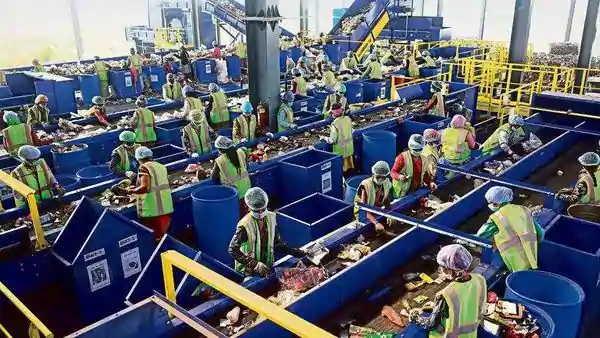

India generates around 10 million tonnes of plastic waste a year, 40% of which is not even collected, let alone being recycled. This is not just a massive problem but also an opportunity to create value from waste, with tech innovations.
The scale of this prompted Singapore-based Circulate Capital to dedicate half of its $106 million “ocean fund” to India. The fund aims to reduce plastic waste going into the ocean in South and Southeast Asia. The investment firm has committed $39 million to six Indian companies so far.
“Our strategy to prevent leakage of plastics into the ocean is to invest in a circular economy. We looked at over 350 companies in the region over the last couple of years, and many of them are in India,” says Rob Kaplan, founder and CEO of Circulate Capital, who was a director of sustainability at Walmart in the US before becoming an impact investor.
A circular economy has multiple facets, from collection to recycling, manufacturing and finding buyers for products from waste. So, Circulate Capital has been investing in solutions across this spectrum.
Expansion mode
In November, it invested in Nepra, which has been working with waste pickers and other collectors of dry waste in Ahmedabad, Pune and Indore. “The plan is to help them expand to 25 cities over the next five years,” says Kaplan. “Our investments are targeting interventions that we feel need to be scaled in order to transform waste and recycling across India.”
Once the plastic waste is collected and sorted, it has to be recycled. Here, the big opportunity is in recycling the PET (polyethylene terephthalate) plastic used for soft drink and water bottles. “Right now in India, all of the recycled bottle-grade PET plastic for use in bottling is imported. None of the domestic supply is used; instead, it’s downcycled, mostly into textiles and apparel,” points out Kaplan.
So, in December, Circulate Capital invested in Hyderabad-based Srichakra Polyplast and Mumbai-based Dalmia Polypro which are developing bottle-to-bottle recycling facilities for food-grade applications. “We’re helping them bring in new technology to be able to do that,” he says.
While bottles are made of rigid plastic, the collection and recycling challenge is even greater with flexible plastics used in packaging like sachets and wrappers. Unlike the demand for recycled PET bottles, the market for products from flexible plastic waste is yet to develop. Here, two solutions are Lucro and Ricron, which are creating products ranging from shopping bags to sheets used as building material.
And finally, for all such interventions to work more efficiently, there’s a need for digitalization. That’s where Hyderabad-based Recykal comes in with an online marketplace connecting waste generators and collectors with recyclers. This creates more options to sell or buy waste. For example, an NGO collecting waste in Bengaluru that was relying on local recyclers can now look at potential buyers nationwide. And, like an e-commerce firm, Recykal also provides the logi-stics support to fulfil these transactions.
“The biggest problem recyclers face is consistent material supply. The second challenge is the quality. Now, because of our marketplace, they have visibility throughout the country. They can see the ratings of sellers, check how much material is available, compare prices and optimize production,” says Abhishek Deshpande, co-founder of Recykal.
Another area where Recykal comes into play is in extended producer responsibility (EPR). World over, manufacturers are increasingly being held to account for managing the waste their products generate after consumers have used them. India also proposes to enforce EPR rules.
Here, the Recykal platform connects brands with various service providers on the ground who can help them fulfil their EPR obligations. “We’re working with 75 brands already,” says Deshpande.
Fixing responsibility
At the same time, India has been dragging its feet on holding brands responsible for the plastic waste they produce. Critics have questioned new EPR draft rules that give companies the option to pay money into a central kitty in compensation, which will ostensibly be used to manage plastic waste. This falls short of putting the recycling onus on brands.
So, despite the Swachh Bharat Mission initiated in 2014 to improve solid waste management, among other things, that’s not reflected in effective regulatory action on the ground. It’s the familiar story of lots of promises, talk and framing of regulatory schemes, without enough follow-through.
Municipalities can also do a lot more. “Cities need to take more responsibility and introduce degrees of formalization instead of leaving waste collection and management mostly to the informal sector,” says Kaplan. “There’s just not enough waste being collected.”
What’s needed at a fundamental level is a change in mindset, says Kaplan. “Instead of just thinking about it as a problem we want to go away—just like trash that we want to throw away—we can look at it as an opportunity, as this waste is a resource that can be deployed into economic development, job creation and tax revenue.”
Nevertheless, despite the slow-moving wheels of governance and regulation, the idea of creating value from waste has caught the interest of entrepreneurs and impact investors. Bengaluru-based Social Alpha, for one, is an incubator for startups making a social and environmental impact. Among those it has backed is Hasiru Dala Innovations, which provides waste management services to apartment complexes, corporations and brands, while generating demand from recyclers. Social Alpha founder Manoj Kumar also believes that a shift in thinking is the way forward. “This whole activity around waste management was seen as a public service and not as a business. What we are now seeing with the likes of Hasiru Dala and Nepra is a focus on building businesses around it,” he says.
For Kaplan, the key to making a difference lies in scaling up such solutions. “In India, you’ve got a kind of fragmentation, with small, medium-sized players. We’re at a stage now where we can start to say, how do you roll this up into a national strategy and footprint.”
US-based Rubicon, for example, provides waste recycling solutions for businesses and governments worldwide, with a marketplace model not unlike that of Recykal. But while the Indian startup has seed funding of $2 million, the American company is a unicorn with nearly $300 million in funding.
Kaplan hopes that the first few startups that Circulate Capital has backed will instigate more and larger investments, because the untapped opportunity is massive.
Malavika Velayanikal is a Consulting Editor with Mint. She tweets @vmalu
Recent Comments