

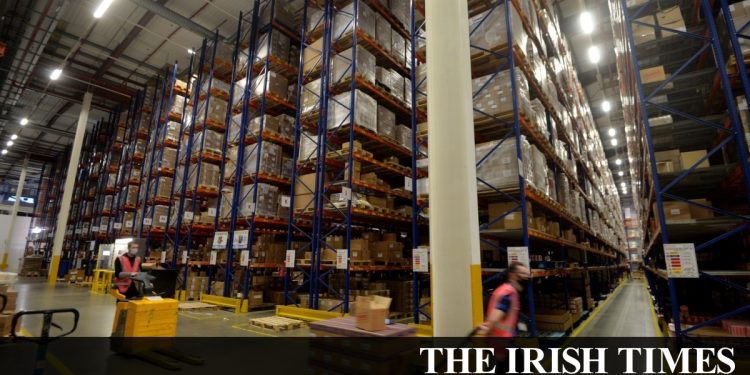
In a large warehouse in a Citywest industrial park in southwest Dublin, sit a row of five tall freezers storing tiny vials of the coronavirus vaccine, probably the most sought after commodity in the State.
Staff at the National Cold Chain Service, a key cog in the Health Service Executive’s vaccine supply chain, have to work fast.
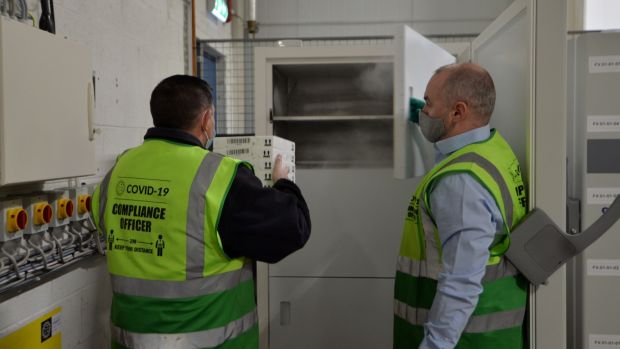
The Pfizer/BioNTech vaccine, which makes up the bulk of Ireland’s supply at present, must be stored at ultra-low temperatures of minus 70 degrees.
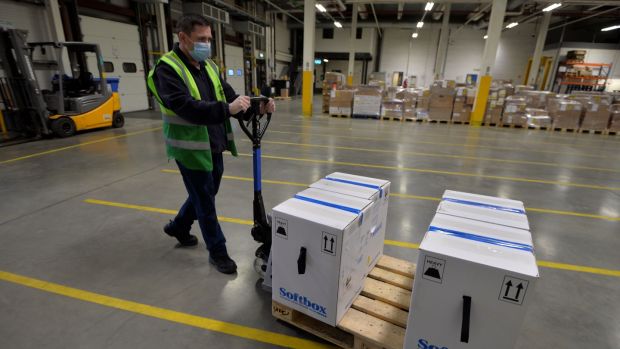
The vaccine is mainly shipped from a Pfizer plant in Puurs, Belgium, and arrives at the Citywest facility in boxes the size of picnic baskets.
Each sealed box has a GPS and temperature tracker, and is packed with dry ice pellets to keep the vaccine at minus 70 degrees in transit. Inside each are five small trays, nicknamed “pizza boxes”, with 195 vials per tray.
Every vial provides about six doses after diluent is added, meaning each tray will provide at least 1,170 doses of the vaccine.

When the weekly shipments arrive, warehouse staff have less than three minutes to remove the trays, label and scan each one, and put them into the freezers. The staff have the changeover time down to one minute and 40 seconds.
The doors of the specialist freezers storing the vaccine can only be opened for 20 seconds, and there are timers everywhere in the warehouse.
Security concerns
When The Irish Times visited on Friday, a batch of vaccines had been dispatched earlier that morning to a number of nursing homes across the country.
The cold chain distribution facility is run by a private company, which has been partnered with the HSE for a number of years, and specialises in storing and transporting vaccines. This winter, the facility distributed about 1.6 million doses of the flu vaccine out to general practitioners, pharmacies and hospitals within seven weeks.
The company has not been publicly identified, and has been careful to keep its branding out of any photographs or videos of vaccines arriving at the facility, due to heightened security concerns.
Once the Pfizer/BioNTech vaccine is taken out of the freezers the clock starts again, and it must be used within 120 hours, which is five days.
From the freezer, the trays of vials are brought into a separate “cold room”, where they are often divided up and packed into smaller boxes, like a pharmacy dispensary. The distribution centre has to make sure hospitals and nursing homes are not given more doses than they can use, to avoid wasting any of the precious vaccine.
Once supply ramps up, the facility will be able to continuously ship full trays out to sites like mass vaccination centres as they come in. But at the moment vials, are carefully rationed. The sense from those overseeing the operation is that the second phase, where they will be transporting large quantities to mass vaccination centres, will be easier to manage.
When the AstraZeneca vaccine comes into play, following EU regulatory approval, the hope is the rollout will gather pace quickly. That vaccine only needs to be stored at normal fridge temperature which, unlike the complex requirements of current vaccines, is the Citywest facility’s “bread and butter”, one senior manager explains.
A second row of five freezers for the Pfizer/BioNTech vaccine is located in a separate corner of the facility, along with four freezers used to store the Moderna vaccine at minus 20 degrees.
The low hum of the freezers, which are sealed off behind security gates, is drowned out by the sound of the noisy warehouse floor.
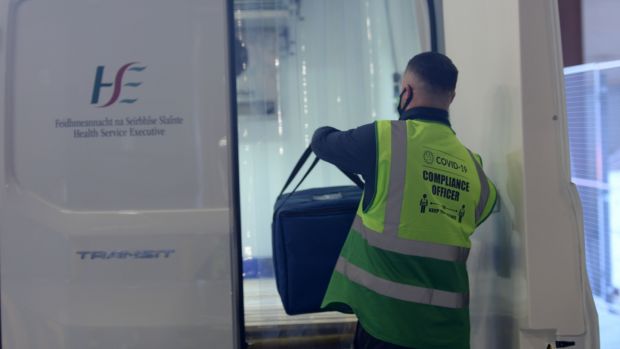
From the Citywest site the vaccines are transported in vans with special refrigerated compartments, keeping the vials’ temperature between 2 and 8 degrees. The vans have a GPS tracker and a backup battery for the fridge if the vehicle breaks down.
On Friday morning, a worker checks on the status of one of the vans currently on the road from his laptop. He can see the driver started his engine at 6.30am, leaving a Limerick depot with an order of vaccines to be delivered to nursing homes across Co Tipperary.
The laptop screen shows a log of the driver’s location every five minutes, and the temperature inside the compartment carrying the vaccines. If the temperature slips either side of the two to eight degree limit, staff in Dublin will receive an alert.
The distribution centre’s fleet of vans has in the last two weeks delivered to more than 600 different locations, mainly nursing homes and hospitals. The journeys can take up to 12 hours, hitting a number of locations on a carefully planned route to minimise travel time.
There have been a small number of instances where vans were en route to nursing homes, only to learn mid-journey of a fresh outbreak of the virus in the care home. This meant the planned inoculation of those vulnerable residents and the staff had to be delayed, with the doses diverted elsewhere.
Devastating effects
Nursing homes will usually receive the vaccines the day before they are to be administered, storing them overnight in their pharmacy fridges.
At 6.08am on Friday, a van left the Citywest site on a delivery route and by 10.42am it had arrived at St Camillus’ Community Hospital, a HSE-run nursing home in Limerick city.
A team of seven vaccinators began setting up from 8.30am on Saturday in St Camillus, to deliver the first doses to 72 residents and more than 160 staff.
The virus raged through the nursing home sector during the pandemic, with devastating effects, but St Camillus has successfully kept the virus out so far.
The vaccination team set up camp in a spare 25-bed ward that had been converted from a staff canteen. Once the vaccinators make up the doses by adding diluent to the vials, they have six hours to administer them.
Before each person was vaccinated, their personal information and consent was double checked and recorded. After receiving the jab to the upper arm, they were monitored for 15 minutes for any adverse reactions.
Dr Ann Hogan, principal medical officer for HSE Mid-West Community Healthcare, said some vaccinators had been able to get seven doses out of vials “if you are very careful and precise”.
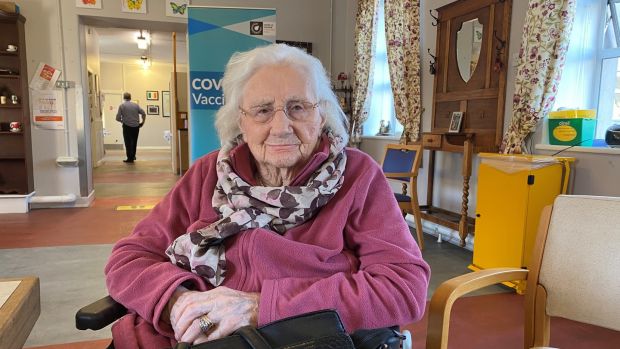
For one of the residents, Nora Gray, the vaccine was an early present ahead of her 102nd birthday next month. Originally from Co Tipperary, she has lived in Limerick most of her life and met her late husband there while working in a bar.
For the last six years St Camillus has been her home. Restrictions on visitors had made the past year tough, but she told The Irish Times she “was not that worried” about the virus. “The nurses are great, they’re wonderful to you, all the staff,” she said.
It was difficult not being able to see her daughter Marie, or her grandchildren, but she said the pandemic had been “worse for them”. Upon turning 100 two years ago, she had a big party in the nursing home, and hopes to have a small celebration next month, before the home receives the second vaccine dose.
Sian Rowe-McCormack, St Camillus director of nursing, said staff were “absolutely thrilled” residents were receiving the vaccine. “It’s like the first page of a whole new chapter,” she said.

Recent Comments