

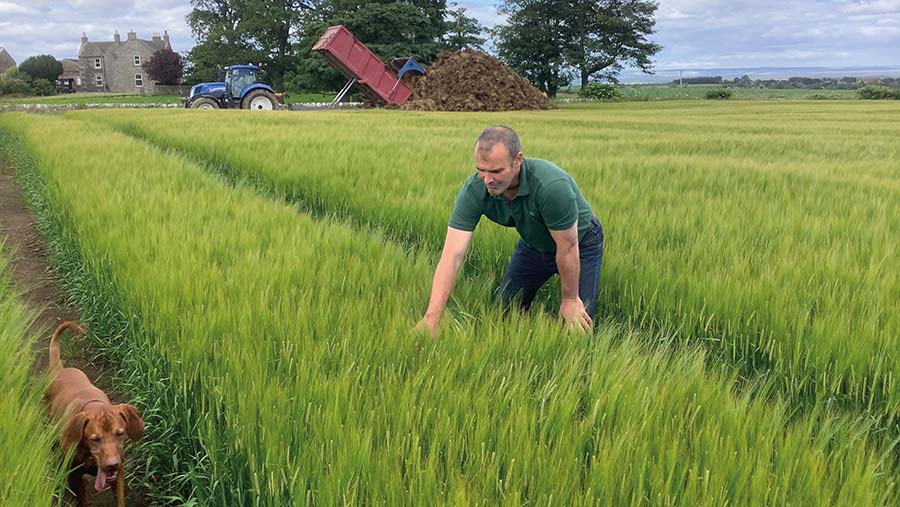

Spring barley growers will face tough market conditions and some uncertainty around disease control this year. This is how two YEN category-winning growers approach growing the crop to maximise performance.
See also: How to tackle the spring milling oat challenge
Peter Chapman, South Red Bog Farm, Aberdeenshire
Rapid early establishment and a comprehensive nutrition programme, including organic manures, is key for Peter Chapman’s high spring feed barley yields in north-east Scotland.
Mr Chapman would typically expect yields in the 7.5-8t/ha bracket across his 140ha grown each year, but his Yield Enhancement Network (YEN) entry for 2020 hit 9.7t/ha with a field of Diablo, taking bronze in the best yield category and gold in best percentage of potential yield.

© Peter Chapman
It was a bumper harvest for South Red Bog Farm, with rain arriving at just the right time for record winter wheat, oilseed rape and spring barley crops, although too late for winter barley that dropped tillers before the drought broke.
This was then followed up by a long and cool ripening period, which allowed the YEN crop – fed by long-term organic material applications and a comprehensive nutrition programme – to achieve 87% of its 11.1t/ha potential.
The organic materials are applied annually, with each field getting either food waste compost, farmyard manure or chicken muck in rotation.
Fresh phosphate
This supplies the bulk of the crops’ phosphate and potash needs, but Mr Chapman also opts to place fresh phosphate at drilling to aid rooting, with his 2020 YEN entry receiving 200 litres/ha of a liquid 8-24-0 nitrogen, phosphate and potash (NPK) on top of chicken manure ahead of ploughing.
Typically, all required nitrogen is applied to his spring barley when the tramlines are visible and when chicken muck has been applied. This totals 100kg/ha, but last year’s YEN plot was pushed harder with 120kg/ha.
“It did lodge, but it went over late in the season so there wasn’t any impact on yield and the bushel weight was very good,” he explains.
Early drilling was also noted as key in achieving his 9.7t/ha crop – the optimum window for Scots growers during the last week of March or the first week of April and he managed to plant the Diablo seed on 22 March.
The multi-use variety has been grown on farm for the past two years alongside old favourite Planet and normally a seed rate of 325 seeds/sq m would be sown, but for YEN this was dropped to 300 seeds/sq m.
This bucks the industry trend, with many growers still drilling spring barley at 400 seeds/sq m or more, but Mr Chapman says with modern high-yielding varieties like Diablo you can get away with less.
“I was a bit concerned at the start because it was so dry, but in the end, it tillered out and was thick enough. It’s difficult to know what influence it had on yield, but it definitely shows you can save a bit of money on seed.”
Grain analysis
Looking ahead, the YEN process – which produces crop reports that include grain nutrient analysis – has thrown up another lesson this year, which will prompt a change in management for 2021.
It had shown Mr Chapman’s crops were suffering with copper deficiency in 2019, which has been addressed with upping micronutrient applications, and 2020 suggests that plants were lacking optimum potash levels despite soil indices being high.
This will see the farm install another liquid fertiliser tank in the yard to store a liquid 19.8-0-9.4 NPK + S product to add some fresh K, hopefully, satisfying the crop’s demand before rapid growth beyond growth stage 30.
“It will be backed up with tissue testing to help us supply the crop with what it needs,” adds Mr Chapman.
David Bell, St Andrews, Fife
David Bell’s 2020 YEN spring barley entry hit 11.3t/ha on his farm overlooking the town of St Andrews, with a diverse rotation and a policy of feeding the soil, plant roots and plant foliage key in hitting such heady heights.
His mixed farming enterprise has a beef suckler herd, with all followers finished on farm, alongside a cropping rotation of potatoes, cereals, peas, grass and agri-environmental schemes.
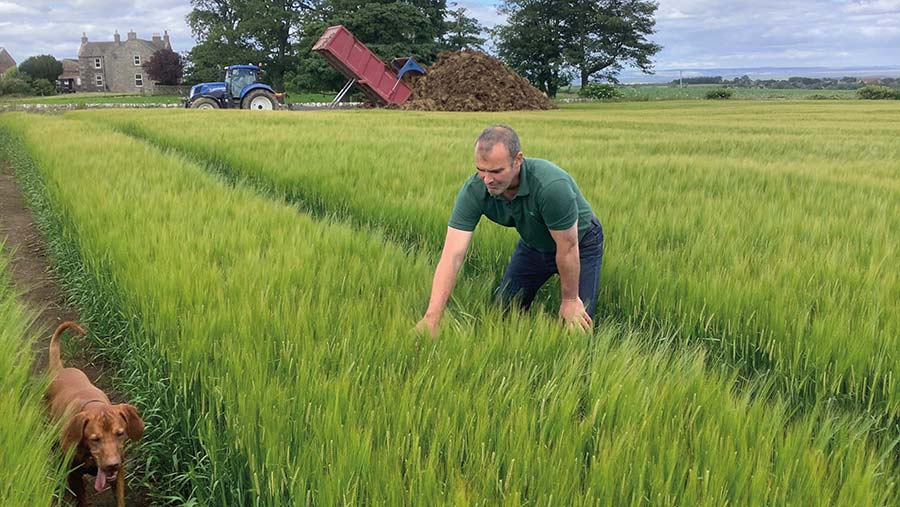
© David Bell
Spring malting barley is an important part of the rotation, helping to spread machinery use and keep three full-time team members busy across the growing season, and growing for a quality market on the doorstep is central in maximising financial returns.
Looking back on 2020, although Mr Bell achieved a yield of 11.3t/ha with his YEN field, he points out that variability across the farm – starting as low as 5t/ha – meant overall yields were about average.
“As much as some fields did really well, others didn’t because of a very challenging growing season.
“What I get from the YEN entry is knowledge about which methods we’ve used that can help hit those highs. Then it’s about applying those lessons to drag the rest of the farm’s average up,” he adds.
Reduced tillage
Mr Bell is in the early stages of transitioning to a reduced inversion system, with rotational ploughing and a chunk of the farm’s winter crops direct drilled this year, but this is after building a solid foundation of good soil health in recent years.
Farmyard manure from the suckler herd has been used rotationally ahead of potatoes to maintain organic matter and soil microbial activity, while the grass swards also help to build soil fertility and resilience.
A proportion of stubbles have fibrophos – a coarse powder P and K fertiliser with trace elements – and spring barley gets a granular fertiliser applied down the spout, followed by a standard farm practice of 130kg/ha liquid N straight after drilling.
Previous YEN grain analysis has shown his crops to be manganese deficient, so a focus has been placed on improving trace element uptake, with a manganese seed treatment used and foliar applications as and when tissue tests dictate.
This multi-pronged approach to nutrition is seen as a key factor in his winning spring barley YEN entry.
The foundation of good organic matter and structure allowed the crop to get its roots down to depth, so it established before the drought started to bite, and the soil available and applied nutrients helped it on its way.
“It’s like having different modes of action in your nutrition programme, and with P and K, we don’t mind putting on a bit more than we need to and running indices higher with potatoes in the rotation.
Nitrogen
“We are currently reviewing our nitrogen practice, as we may need to increase it because we are growing modern spring barley varieties like Diablo and Laureate. Their higher yields can dilute grain nitrogen and still hit malting spec,” explains Mr Bell.
Other aspects of his spring barley management include a split plant growth regulator programme and a robust fungicide programme, which was beefed up for the YEN entry of Diablo.
This saw fungicide costs increase from £52/ha in non-YEN crops to about £73/ha in the competition entry, which might seem high for some, but given the final yield Mr Bell says it is a relatively small investment to swallow.
“The idea of splitting the plant growth regulator application is to reduce plant stress. We like to take a little-and-often approach to most of our inputs to avoid overloading the plants with big doses or complex tank mixes,” he adds.
Achieving cost-effective ramularia control without chlorothalonil is a concern for Mr Bell this year, as he believes that there is chemistry available that can help limit its development, but it will come at a cost.
One example is BASF’s Revystar (fluxapyroxad + mefentrifluconazole), which has performed comparatively well against the disease in AHDB fungicide performance trials in the past two years.
The farm focuses on integrated pest management and Mr Bell hopes one day to be able to utilise the cornerstone of integrated pest management, the AHDB Recommended List, to choose ramularia-resistant varieties.
However, until then, reducing plant stress with his nutrition programme and judicious use of fungicides when disease pressure is high will be the core ramularia management strategy.
Recent Comments