


Food retailers are making big bets on small warehouses to bulk up their growing delivery businesses, as supermarkets try different approaches to get groceries to customers more efficiently.
Albertsons Cos.,
Walmart Inc.
and other chains are building small fulfillment centers near existing stores and customers to quickly fill orders placed online. More grocers are choosing this strategy over the larger, remote distribution centers that
Kroger Co.
and
NV’s Peapod division are building to make deliveries over wider areas.
“We have a broader assortment of fresher items, and we are closer to the customers,” said
Narayan Iyengar,
senior vice president of digital and e-commerce at Albertsons.
The owner of the Safeway and Jewel-Osco chains is adding small fulfillment facilities at two stores in South San Francisco, Calif., and San Jose, Calif., in partnership with Takeoff Technologies Inc., which builds automated warehouses. Albertsons said it is establishing more of these 10,000-square-foot distribution centers, which each cost about $3 million to build.
According to Jefferies Group LLC, facilities known as micro-fulfillment centers typically range from 10,000 to 20,000 square feet and can fulfill roughly 4,000 orders a week. These warehouses can be built in three to six months and reach profitability in a year.
SHARE YOUR THOUGHTS
Which strategy is better: small warehouses closer to hubs, or larger ones in more remote areas? Why? Join the conversation below.
Bigger centers can be larger than 300,000 square feet and fulfill about 65,000 orders a week, Jefferies said. These centralized facilities can be built in two to three years and reach profitability in four years.
Food sellers were slower to embrace e-commerce than other retailers because many of their customers still want to inspect fruit and steaks before buying. That is changing quickly. Online grocery sales rose 15% in 2019, according to a survey by advisory firm Brick Meets Click.
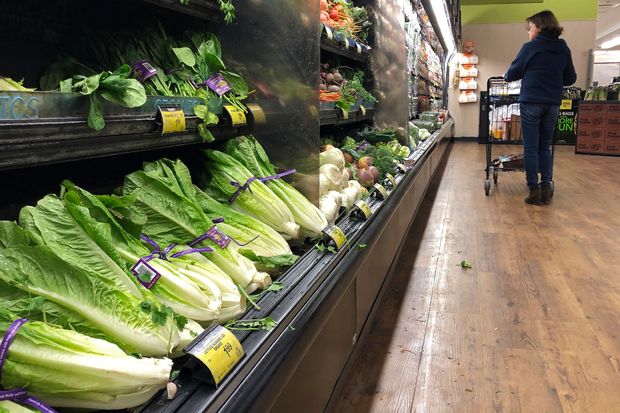
Photo:
Mark J. Terrill/Associated Press
Supermarkets are introducing the additional storage and new warehouses in part to keep stock and couriers for delivery out of existing store space, where some customers have complained of crowding as delivery has taken off.
“It’s an entire paradigm shift for companies,” said
Steve Hornyak,
chief commercial officer at Fabric, a four-year-old builder of small fulfillment centers for grocers and other retailers.
Walmart and Meijer Inc. are testing small fulfillment centers. Ahold Delhaize’s Stop & Shop LLC said it would open several more of these warehouses this year, while its Peapod delivery division continues to build bigger distribution centers.
In contrast, Kroger, the nation’s biggest supermarket operator, is building bigger distribution centers for delivery, wagering that economies of scale will make the larger investment worthwhile.
“You control and you know exactly what’s in the facility,”
Yael Cosset,
chief digital officer, said in an interview.
Kroger took a stake of more than 6% last year in U.K.-based warehouse company
PLC and said the partnership would build as many as 20 largely automated facilities in the U.S. They will vary in size from 20,000 square feet to more than 300,000 square feet, Mr. Cosset said.
Kroger is investing about $55 million in the first warehouse with Ocado in Monroe, Ohio. Analysts have said the centralized facilities take too long to build when coming up with a timely formula for delivery is critical for Kroger. Executives have said they are sticking with the Ocado strategy and remain open to other models.
Big fulfillment centers that are best suited to next-day delivery are already behind the times as consumers now expect an order to show up in as little as a few hours, said
Mike Montani,
an Evercore analyst.
Smaller grocers aren’t adding their own delivery capabilities, relying instead on companies including Instacart Inc. Price Chopper, a chain in the Northeast, formed a partnership with Instacart a year ago and now offers delivery from 90% of its roughly 100 stores.
“We don’t see the economic benefit to having stand-alone fulfillment centers,” said
Jim Peterson,
Price Chopper’s chief financial officer and treasurer.
Some analysts caution that food retailers might lose control of their customer relationships when solely using services like Instacart. Instacart shoppers are also crowding aisles of stores.
Instacart, valued at roughly $7.8 billion when it raised $871 million last year, delivers from over 300 supermarket chains.
“Not every grocer has the desire, time or capital to build their own fulfillment center,” Instacart President
Nilam Ganenthiran
said.
Write to Jaewon Kang at [email protected]
Copyright ©2019 Dow Jones & Company, Inc. All Rights Reserved. 87990cbe856818d5eddac44c7b1cdeb8
Recent Comments