

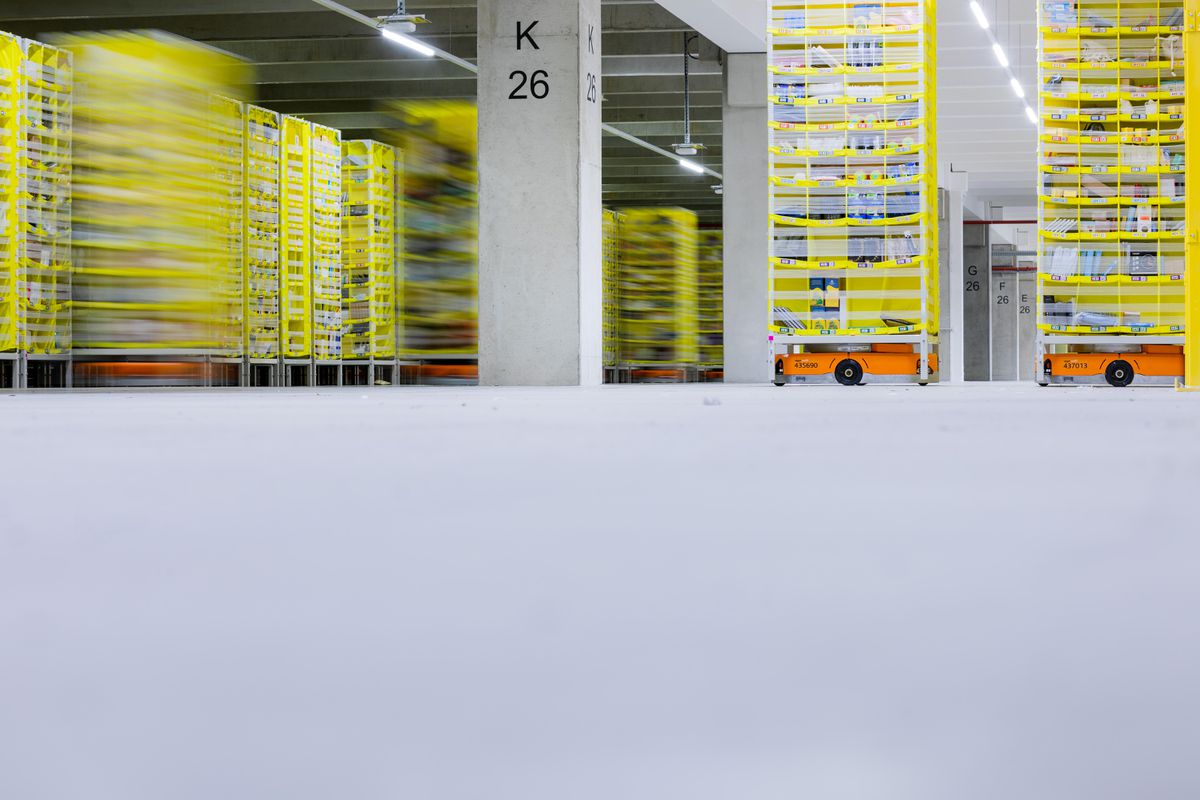

08 December 2020, North Rhine-Westphalia, Mönchengladbach: Robots transport goods to the employees … [+]
dpa/picture alliance via Getty Images
ARC is getting ready for our Supply Chain Forum on February 16th and 17th. I was originally scheduled to speak. But we ended up with a good problem. We have so many good, high level executives speaking, we canned my speech (Forum Agenda). End users – supply chain practitioners working for manufacturers, distributors, or retailers – can attend for free. The quick registration link for end users is HERE.
So instead of giving a speech on this, I am repurposing this content into an article.
So, what are the mega trends? How does the pandemic and digital technology play into these trends?
The Growth of Ecommerce
Ecommerce and omnichannel was already growing more than twice as fast as traditional retail. The pandemic has greatly accelerated this trend.
From a supply chain digital perspective, the growth of ecommerce has:
· Ramped out the growth of each picking automation, including autonomous mobile robots.
· Led some supply chain planning supplier to create new digital twins – new supply chain models – that model this supply chain much deeper than it had been previously modeled. A more granular model means better planning – planning that more fully reflects the constraints that exist in these supply chains.
· Increased the need for last mile solutions. We are still looking for better solutions here. Drones and autonomous mobile robots that operate on sidewalks are not there yet. Grocery retailers are exploring dark stores, stores that have been converted to warehouses that are close to customers and support quicker and lower cost deliveries.
Relentless Competition
It is a truism that competition is tougher, that digital technologies are creating new tough entrants to a variety of industries, and that industry changes are happening faster and faster. Supply chain applications have long been a way for companies to compete better. These applications improve service while holding down supply chain costs.
But this is not entirely true; relentless competition may be becoming less relentless. Trade barriers are beginning to go up, particularly between China and the US. Competition from companies that reside in low wage nations may be beginning to wane. But the trade disputes create their own challenges. With tariffs and trade rules changing more frequently, the need for global trade management applications has increased.
Mass Personalization
Personalization is the act of tailoring a product or service based upon what customers desire. Manufacturing automation – including 3D printing (also called additive manufacturing) – is making it easier to create many, many more product variants. Companies are beginning to explore on-demand manufacturing rather than traditional manufacturing models, meaning they can keep less physical inventory on-hand. Using a digital representation of parts allows manufacturers to make small changes to digital files quickly at no additional charge, which provides more agility in the manufacturing process.
Stock keeping units (SKUs) are proliferating. When a company has proliferating stock keeping units created through traditional manufacturing, the supply chain becomes much more complex. Many companies still struggle to achieve segmentation strategies. A segmented strategy reflects the idea that companies should not just have one service level that applies to all customers and products. Some customers or products are more important and more profitable. These products or customers really should get a higher service level. Advanced supply chain planning solutions support this.
Urbanization
There has been a steady stream of human migration out of the countryside, and into swelling metropolitan centers. Since 1950, the world’s urban population has risen almost six-fold, from 751 million to 4.2 billion in 2018. Last mile logistics challenges is not just about ecommerce, it is also about urbanization. There are also environmental impacts from these movements, and the urbanization megatrend creates urban pollution which is another reason many consumers would prefer the companies they buy their products from to embrace sustainability.
Mobile and Cloud Computing
When it comes to supply chain applications, there has been a decided trend toward software-as-a-service products hosted in public clouds. Public cloud solutions have a quicker payback period and can be implemented more easily and quickly. Covid-19 has also proven that cloud-based solutions can be implemented with far fewer consultants located at the customer’s site. Supply chain software suppliers have told me that in terms of implementations, Covid was mostly a non-event; pivoting to remote implementation consulting was not that difficult.
Robotics & Automation
When it comes to robotics and supply chain management, the biggest question is when are we going to have autonomous trucks? Startups have been pouring money into tests, but we are still some years away from seeing fleets of autonomous trucks on the road. And in some cases, investment dollars are beginning to dry up for this technology. One of the biggest names in autonomous truck technology was Starsky Robotics. It was at the forefront of putting autonomous trucks on the road. Its list of accomplishments is staggering. In 2016, it became the first street-legal vehicle to be paid to do real work without a driver behind the wheel. In 2018, it became the first street-legal truck to do a fully unmanned run. In 2019, it became the first fully unmanned truck to drive on a live highway. And now, even with these accomplishments, due to a lack of funding, the company shut down this year. The best guess on when we might see autonomous trucks delivering loads without drivers in the truck to take over in case something goes wrong is 2024. That is what the folks at TuSimple are projecting and they seem like straight shooters. But even in 2024, these trucks will not be running across all lanes nationwide. Rather there will be a focus on delivering across targeted lanes for select customers. What seems clear, however, is that the ROI of autonomous trucks could be very, very good.
Robotic process automation is software that is used to automate high volume, repeatable tasks. Over time enterprise systems develop better automation and users can do their job more effectively. But companies using legacy systems may have opportunities to use an external RPA solution to automate the work inside the legacy system. RPA’s do this by performing the same computer keystrokes and opening the same modules humans do. We know of a 3PL that received good payback by using RPA to automate the highly manual tasks associated with planning optimization in their legacy transportation management system (TMS). It is also used to examine carrier websites for appointment scheduling.
Descartes is embedding RPA into its routing solution. Descartes points out that for all but the simplest route planning problems, creating the best plan is not as simple as loading data and hitting the “optimize” button. Instead, the best planners go through multiple steps to generate optimal results. Essentially, RPA can model the steps that the best planners take to produce superior results.
Sensors & the Internet of Things
Sensors connected to the Internet provide data that supply chain applications can use. The theory is that as more and more devices throughout the supply chain and manufacturing process become part of the ‘Internet of Things,’ they will produce an incredibly rich data stream that will send signals in real-time to trigger a wide variety of events. For example, using a 5G network, a parts tote could communicate that the tote is 80% depleted for this SKU which would trigger a re-order of the necessary parts. This would be a trigger across the supply chain which would result in warehouse movements, maybe LTL, consolidation, and finally distribution and delivery of re-supplies.
5G is not getting as much attention as it did last year, but we are still at the hype stage here. Despite television commercials that suggest 5G is already here, the 5G wireless networks are still being built out across the U.S. ARC is not hearing providers of supply chain technology leveraging this network to provide new value to their customers.
Big Data, Artificial Intelligence & Machine Learning
Any device that can perceive its environment and takes actions that maximize its chance of success at some goal is engaged in some form of artificial intelligence (AI). In the supply chain realm, machine learning is where most of the activity surrounding artificial intelligence has been focused. Learning occurs when a machine takes the output, observes the accuracy of the output, and updates its own model so that better outputs will occur.
When you look at machine learning this way, artificial intelligence for supply chain management is nothing new. Machine learning has been used to improve demand forecasting since the early 2000s. Demand planning applications rely on a series of algorithms to take historical shipment data and turn it into a forecast. One algorithm works better for promotions, another for end of life products and so forth. The machine looks at the forecast, compares it to actual shipments, and suggests when it may be time to move from one algorithm to a different one for a certain stock keeping unit or product family.
Over time, many more data inputs have been introduced into the demand planning process, and many companies are doing far more forecasts across different time horizons, products, and ship to locations. Supply chain planning has always been a Big Data solution. But machine learning works better the more data there is. SCP is becoming a Giant Data solution.
Now AI is also being applied to improve supply planning. In supply planning there are key parameters that greatly affect the scheduling. For example, lead times are critical. The longer the lead time, or the greater the variability associated with an average lead time from a supplier, the more inventory a company must keep. But humans are not very good at detecting when these parameters need to be changed and without ongoing vigilance a planning engines outputs deteriorate. The loop between planning and execution needs to be closed to prevent this. AI solutions can be used to look in supply chain transactional data and keep these parameters up to date.
Chris Cunnane wrote portions of this article.
Recent Comments