


This winter’s LNG supply constraints and the associated surge in Asian spot LNG prices in mid-January have prompted buyers to rethink their procurement strategies, given sellers’ opportunity to market long-term deals with renewed vigor, and may trigger some lasting changes in contracting behavior.
The supply disruptions seen in recent weeks exposed vulnerabilities in the procurement system for many importers, with countries like Japan focusing on energy security implications, while end-users in China attempt to put together a more robust forecasting, coordination and emergency demand-response mechanism.
Other countries with more demand elasticity like India, Pakistan and Bangladesh responded by simply deferring imports, but this flexibility is enabled by lesser dependency on gas-fired power generation, and could hinder the growth of the sector in the longer term.
In Southeast Asia, the possibility of $30/MMBtu Platts JKM has reignited interest from new buyers in the Philippines and Vietnam for long-term deals, and as buyers go back to the drawing board, term suppliers like Qatar have renewed cause to promote their contracted volumes, despite low summer prices looming on the horizon.
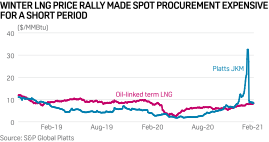
Spot price movements can be a relevant factor in contract negotiations and influence an ongoing contractual relationship, Agnieszka Ason, visiting research fellow at Oxford Institute for Energy Studies, said.
“The record-high spot prices naturally increase the attractiveness of oil-linked LNG SPAs [sale and purchase agreements] and, following a period of the all-time low spot prices and related multiple price review requests from the buyers last year, should generally have a positive impact on long-term contractual relationships,” Ason said.
She said buyers with term contracts can discuss options for additional volume under SPAs that may allow additional LNG subject to specified circumstances or ‘at any time’ during the life of the contract, and such requests can be expedited or discussed in a broader context of a long-term business relationship.
“A situation, where a buyer heavily, or exclusively, relies on spot transactions to satisfy domestic demand (especially in Asia), is more difficult and could force some buyers to enter into unfavorable deals in the short-term,” Ason said.
“In the long run, recent price movements could incentivize buyers to restructure the pool of their contractual commitments in favor of new-generation term contracts with robust contract adjustment mechanisms,” she added.
DEFAULTS AND CANCELLATIONS
Pakistan was an interesting example, as low summer prices had prompted state importer Pakistan LNG to boost spot procurement, but it was caught off guard by unforeseen supply conditions.
The lowest bidder for one of its spot tenders for end-February delivery, Emirates National Oil Company Group, was unable to follow-up on its bid, while the remaining bidders backed out due to cargo shortages.
While Pakistan LNG maintained in an official statement that this was a “default” by ENOC, market sources with knowledge of the matter said ENOC has maintained that it withdrew its bid within a stipulated period before the final contract was signed, allowing it to pay a $300,000 fine for breaking the bid bond as opposed to a wider penalty in the event of a full legal default.
The case underscores how market anomalies can cause disputes and how Asian buyers, especially state-owned entities, may lack sufficient legal protection, or simply not be as sophisticated as larger players to deal with such issues.
An LNG buyer is unlikely to receive adequate compensation for a delivery failure from a bid bond or capped liability provision; LNG sellers generally seek to cap their liability for a failure to deliver based on a percentage of the agreed cargo price, James E. Atkin, partner at law firm Reed Smith said.
“As a result, LNG buyers should consider including a ‘wilful default’ exception to LNG sellers’ liability cap for a failure to deliver; that is, a LNG seller’s liability will be uncapped if the LNG buyer can demonstrate that a scheduled cargo has been diverted or sold to a third party for profit,” Atkin added.
He said LNG buyers need to tailor their procurement strategy to reflect market demand and flexibility to use alternative fuels, while securing a degree of price certainty. “As a result, we may see certain LNG buyers varying their LNG procurement strategy and adopting a mixed portfolio of mid- to long-term supply, complemented by spot purchases.”
Anecdotally, term contractual discussions have already picked up in the market.
Woodside Energy chief executive Peter Coleman said in January that Chinese customers were coming back to the company and wanting to start negotiations for supply again.
Texas LNG chief executive Vivek Chandra said in an interview last month that the ability to cancel US LNG cargoes in summer was a feature and not a bug, as it promoted seasonal flexibility.
Prices at the top of the commodity price cycle tend to incentivize new investment. While $30/MMbtu JKM may not necessarily trigger new liquefaction final investment decisions, investors in LNG vessel newbuilds and gas storage infrastructure, and physical and financial traders, have undoubtedly taken notice.
High-priced spot LNG trades recorded in January 2021
| Date | Buyer | Destination | Seller | Price ($/MMBtu) | Feb JKM ($/MMBtu) |
| 13-Jan | Tohoku Electric | Japan | Trader | Above 40 | 32.5 |
| 12-Jan | ExxonMobil | JKTC | APLNG | 16-17 FOB | 32.494 |
| 12-Jan | CPC | Taiwan | Trader | 19-20 | 32.494 |
| 12-Jan | Trafigura | JKTC | Total | 39.3 | 32.494 |
| 8-Jan | Kyushu Electric | Japan | ExxonMobil | 35-38 | 21.453 |
| 7-Jan | Vitol | JKTC | Uniper | 15.9 | 20.705 |
| 7-Jan | Japan end-user | Japan | European trader | 20-21 | 20.705 |
| 6-Jan | Trafigura | JKTC | PetroChina | 21.7 | 19.977 |
| 6-Jan | Trafigura | JKTC | PetroChina | Feb JKM minus 1 | 19.977 |
| 5-Jan | Mid-east supplier | Japan | Japanese Utility | 22-24 | 18.33 |
| 5-Jan | Mid-east supplier | S.Korea | Korean Utility | 22-23 | 18.33 |
| 5-Jan | Trafigura | JKTC | Gunvor | 20.8 | 18.33 |
Note: The list covers MOC, bilateral and tender markets for LNG
Source: S&P Global Platts
Source: Platts
Recent Comments